
Thermal mapping within the MonitAnt project

Thermal mapping within the MonitAnt project

m

August 4, 2024

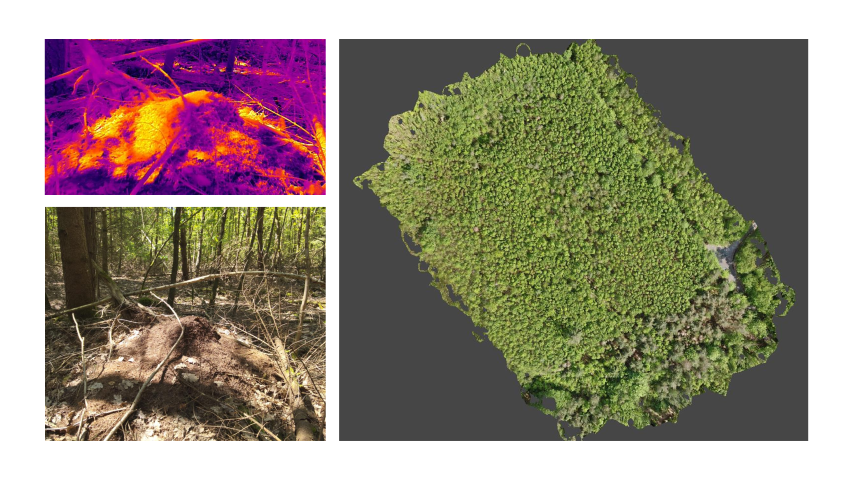
In collaboration with Prof. Heike Feldhaar from the University of Bayreuth we explored the potential of UAS data to map ant mounds within forests automatically. Such an approach would help ecologists to analyse the spatial pattern of mounds and also its changes over time within larger areas.

The UAS team performed the field work in a forest area close to Haßfurt, Lower Franconia, within the scope of the project MonitAnt. MonitAnt aims to develop a harmonized, efficient, and cost-effective monitoring strategy that is freely available to various stakeholders to enable long-term monitoring of population trends of mound-building Formica ants and associated myrmecophiles across Europe.

Within the project we are collecting and processing the geospatial data; thus, analysing if the ant mounds can be detected within different data sets. Our team members operated various drones by mounting multispectral and thermal cameras as well as LIDAR instruments. Besides, the study is supported by ground-truth data to test the accuracy of the aerial images. The ground in-situ data, in particular, revealed important insights about the reflectance characteristics of the ant mounds.

On the long run the main aim is to develop an European-level Monitoring strategy for mound-building Formica Ants and symbiont communities residing in nest mounds.

follow us and share it on:

you may also like:

Thermal Drone Data Acquisitions: CalVal project with Informatics

Thermal Drone Data Acquisitions: CalVal project with Informatics

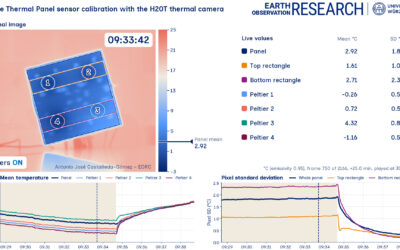
Thermal cameras on drones look very good - visually. They show us temperature of our study objects be it stressed trees, warm patches in a city or active fires. But we do not yet know for sure how far we can trust the temperature values they deliver especially when...

Würzburger Förderpreis awarded to our URBAN:Pulse project

Würzburger Förderpreis awarded to our URBAN:Pulse project

“A remote sensing scientist, a social geographer, an informatics researcher, a sports researcher, a psychologist, a linguist and an economist meet ... what sounds like the start of a joke, was the start of a great interdisciplinary research project.” That’s how Hannes...

Annual Meeting of the NetCDA consortium

Annual Meeting of the NetCDA consortium

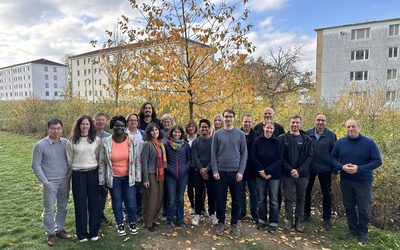
On November 3-4, 2026, the NetCDA II (European Academic Network for Capacity Development in Climate Change Adaptions in Africa) project network of 12 German academic partners met at the EORC for their annual meeting. We welcomed our new German research institutions on...

Mainpost reported on Stefan Dech’s Bavarian State Medal

Mainpost reported on Stefan Dech’s Bavarian State Medal

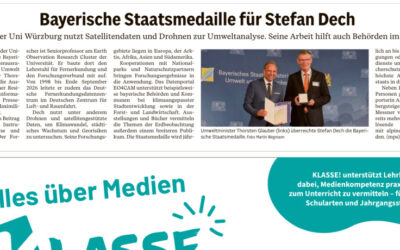
We’re happy to see that Mainpost, our local newspaper, also reported on the Bavarian State Medal for Outstanding Services to the Environment. Stefan Dech received it on October 21 at the Munich Residenz, and Environment Minister Thorsten Glauber gave the laudatory...

UrbanPulse in the Mainpost, and invitation to the festivities

UrbanPulse in the Mainpost, and invitation to the festivities

If you open the printed Mainpost today, keep an eye out for the Universitätsbund Würzburg’s invitation to the Festkonzert. Among the topics on the page, there’s one we’re rather proud of: our newly funded project URBAN:Pulse, which will be officially celebrated at the...

bzgl. Art. 50 Verordnung (EU) 2024/1689 (AI Act):

Überwiegend werden eigene originäre Texte und Bilder des EORC genutzt, jedoch sind einige Inhalte von blog post Texten teilweise mit Hilfe von KI überarbeitet worden und einige Bilder sind ganz mit KI erstellt, die jedoch deutlich keine photorealistische Darstellungen abbilden. Aussnahmen sind KI generierte fernerkundliche Datensätze, die explizit für Forschungszwecke mit KI erstellt wurden, hier wird aber durch den assoziierten Text der wissenschaftliche Grund der KI generierten Bilder erläutert.

Share This