
Our PhD student Adomas Liepa published new research on the impacts of seasonal differences in the local climate on maize cropping systems in East Africa. This study, conducted in collaboration with partners from the German Aerospace Center (DLR) and the International Centre of Insect Physiology and Ecology (icipe), provides valuable insights into how varying climatic conditions influence maize growth and yield. The research highlights the importance of understanding local climate patterns to optimize agricultural practices and improve food security in the region.
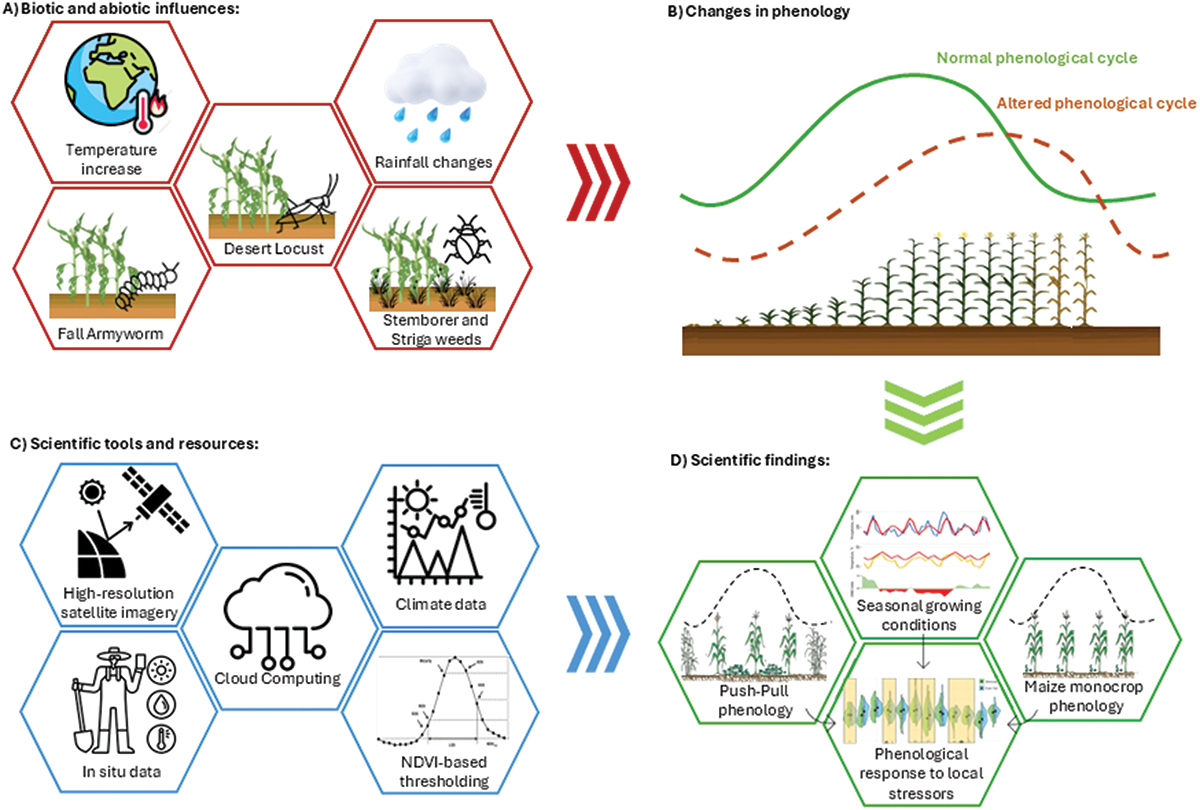
The abstract: In Kenya, climate variability and change threaten smallholder, rainfed farms, with crop failures, yield reductions, and pest infestations. Efficient agroecological strategies, such as Push-Pull intercropping, offer documented benefits including pest control, improved soil fertility, and water conservation compared to traditional maize monocropping. To date, no studies exist comparing traditional maize monocropping and Push-Pull intercropping using earth observation tools over several growing seasons in East Africa. Our research addresses this by harmonizing Landsat 7, 8, 9 with Sentinel-2 remote sensing time series from 2016 to 2023. Phenological metrics of 15 growing seasons are extracted based on a threshold method using the Normalized Difference Vegetation Index (NDVI) as a vegetation proxy. Field data from 58 sites in southwestern Kenya provided training for this analysis, revealing detectable inter-class differences. Notably, Push-Pull intercrop fields showed greater resilience during biotic stress events, such as the locust outbreak in 2020 short rainy season and the fall armyworm infestation in combination with delayed and below-average rainfall during the short 2021 and the long 2022 growing seasons. Higher maximum NDVI and extended season duration indicated a higher resilience of Push-Pull farming under unfavorable agricultural conditions. Short growing seasons with unfavorable conditions showed earlier end of seasons in both systems, whereas long growing seasons with unfavorable conditions caused delayed onset and end of seasons. This study marks the first attempt to leverage earth observation data to compare traditional maize agriculture with agricultural systems featuring applied ecological management strategies, showcasing the potential of earth observation tools to monitor and evaluate agroecological resilience.
Link to the full paper: https://www.tandfonline.com/doi/full/10.1080/15481603.2025.2476248#abstract