
New publication on modelling spatio-temporal distribution of urban population
Researchers from the Institute for the Protection of Terrestrial Infrastructures as well as the Earth Observation Center (EOC) of the German Aerospace Center (DLR), the Institute of Rescue Engineering and Civil Protection of the University of Applied Sciences in Cologne, the Invenium Data Insights GmbH in Graz, the Institute of Geography of the University of Bonn and our Earth Observation Research Cluster of the University of Würzburg teamed up for a study on modelling the spatio-temporal distribution of urban population. The paper titled “Modelling spatio-temporal distribution of urban population – A high-resolution model for German cities” was just published in the journal Computers, Environment and Urban Systems by Peter Priesmeier, Alexander Fekete, Michael Haberl, Christian Geiß, Roland Baumhauer and Hannes Taubenböck.
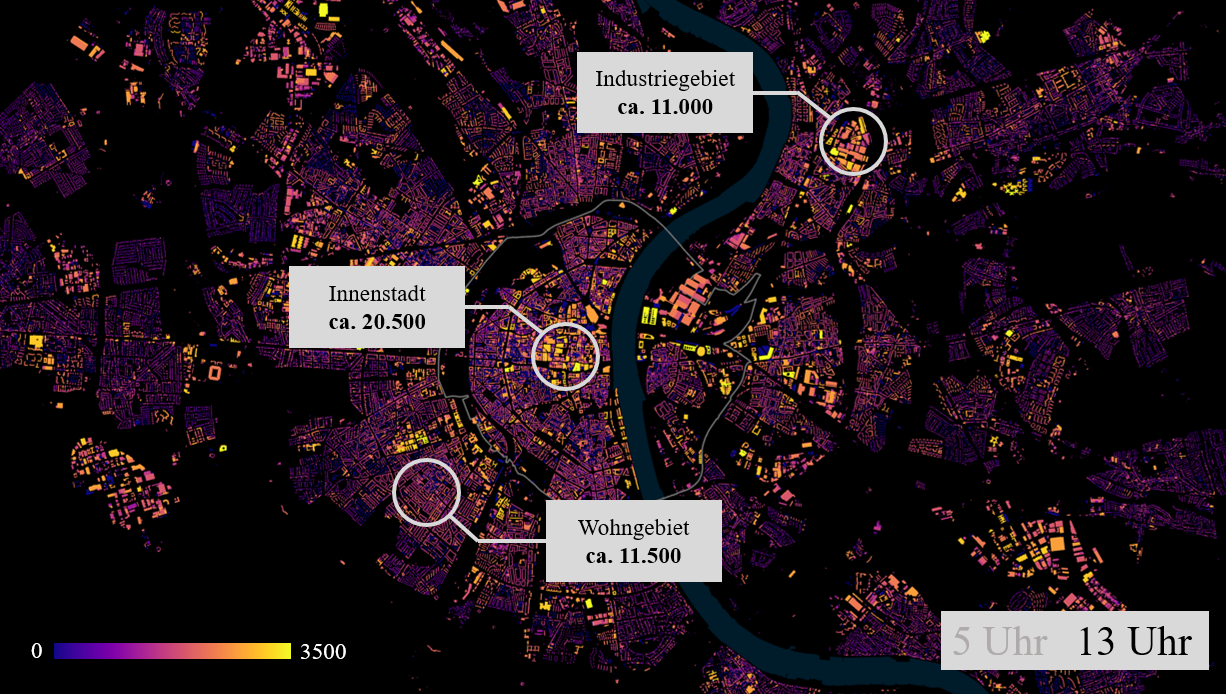
Here is the abstract of the paper: Information about the spatial distribution of urban populations is highly relevant for areas such as urban planning, infrastructure services, and hazard prevention. Conventionally, census-based population maps provide a static image of population numbers. However, the distribution of urban populations is highly dynamic and changes throughout the course of a day, which can result in significant discrepancies from static maps. We therefore developed a spatio-temporal population model, which is designed to provide the relevant space- and time-dependent distribution for individual cities in Germany. Germany has been selected due to the high data availability, which allows us to base the model on public data, making it transferable to other cities. The city of Cologne serves as a case study, but the transfer of the approach to Hamburg has been successfully tested. The model is built on extensive dasymetric mapping cycles to combine extensive socio-demographic population and building data with mobility information. The results obtained are city-wide population maps for seven time sequences, which provide the total number of people, as well as the number of people for seven population subgroups (children, retired, etc.), on building level. The results are compared to three independent data sets (ENACT-POP, emergency call locations, and mobile phone location data), which show substantial improvement towards static census data and good correlation metrics. The spatio-temporal results show strong time-dependent differences in comparison to static population distribution (e.g., up to six times more people for the inner city of Cologne at midday), underlining the relevance of time-dependent data for population-based analyses.
Here is the link to the full paper: https://www.sciencedirect.com/science/article/pii/S0198971526000219
This research relates to other studies of ours on population assessment – for further reading, please see here:
- Spatially explicit downscaling and projection of population https://www.sciencedirect.com/science/article/pii/S0048969724037707
- Deep learning for consistent large-scale population estimation from Earth observation data https://www.sciencedirect.com/science/article/pii/S1569843224000852
- The unseen population: Do we underestimate slum dwellers in cities of the Global South? https://www.sciencedirect.com/science/article/pii/S0197397524000560
- So2Sat POP – A Curated Benchmark Data Set for Population Estimation from Space on a Continental Scale https://www.nature.com/articles/s41597-022-01780-x
- Empiric recommendations for population disaggregation under different data scenarios https://journals.plos.org/plosone/article?id=10.1371/journal.pone.0274504