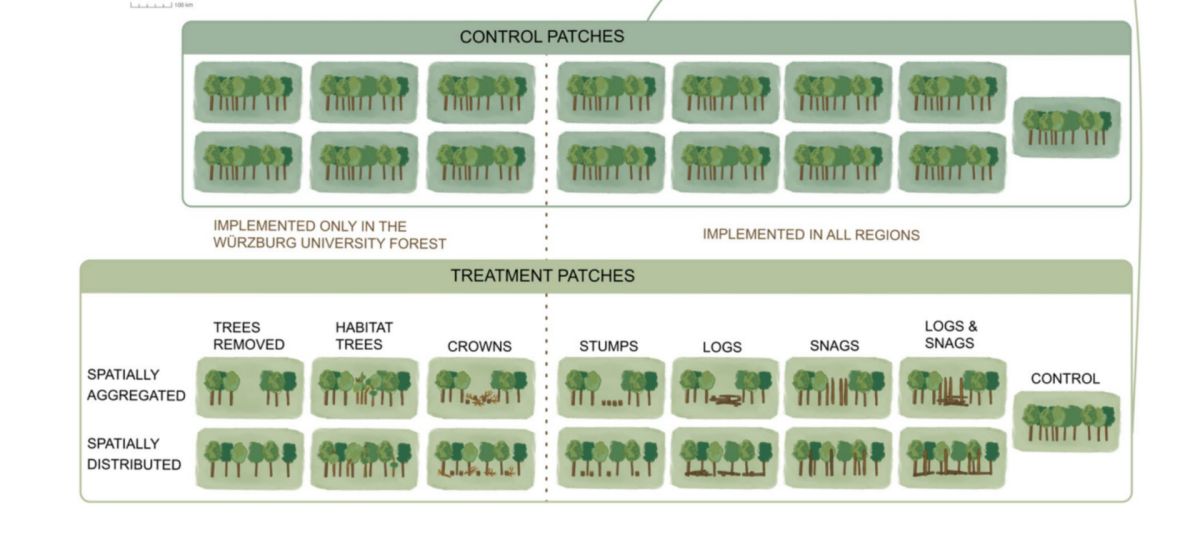

We are excited to share our latest collaborative publication with our colleagues from the biological sciences lead by Lena Carlson, now published in Landscape Ecology. This interdisciplinary effort highlights how combining ecological expertise with advanced environmental observation can reveal entirely new dimensions of biodiversity.
🔬 What is the study about?
Forests are more than what we can see. While structural diversity—trees, canopy layers, and deadwood—has long been studied, our research explores an invisible but crucial component: volatile organic compounds (VOCs).
These compounds create a “chemical landscape” in the air, shaping ecological interactions between plants, microbes, and insects. Our study shows that differences in these airborne chemicals—referred to as β-diversity of volatiles—represent a previously overlooked dimension of habitat heterogeneity.
🌍 Key findings
-
Chemical diversity matters: Forests with greater structural complexity also exhibit higher variability in VOCs—especially above the forest floor.
-
Deadwood plays a central role: The amount and diversity of deadwood emerged as a key driver of this “invisible heterogeneity.”
-
Links to biodiversity: Patterns in VOC diversity are associated with differences in saproxylic beetle communities, suggesting real ecological consequences.
Together, these findings suggest that forest management strategies promoting structural diversity—particularly deadwood retention—can also enhance hidden chemical diversity and potentially support biodiversity.
🤝 A truly interdisciplinary collaboration
This publication is the result of a strong collaboration between ecologists and remote sensing researchers, demonstrating the power of cross-disciplinary work in addressing complex environmental questions.
We are especially proud to highlight the contributions from our EORC team: Mirjana Bevanda, Luisa Pflumm, Jakob Schwalb-Willmann and Antonio Castaneda-Gomez
Their work was instrumental in bridging field ecology with spatial and environmental analysis.
🌱 Why this matters
Published in Landscape Ecology—a leading journal covering biodiversity, spatial ecology, and environmental management —this study contributes to a growing recognition that ecosystems operate across both visible and invisible dimensions.
Understanding these hidden layers of diversity opens new pathways for:
-
biodiversity conservation
-
ecosystem monitoring
-
sustainable forest management
🚀 Looking ahead
This work lays the foundation for future research integrating chemical ecology, biodiversity science, and remote sensing. By capturing the “invisible” aspects of ecosystems, we can better understand—and ultimately protect—the complexity of our natural environments.
👉 For further reading, access the full article here:
Read the full paper