
New RapidEye datasets granted from RESA platform of DLR/Black Bridge

New RapidEye datasets granted from RESA platform of DLR/Black Bridge

July 14, 2015

The Dept. of Remote Sensing recently applied for a time series of 7 RapidEye scenes to support a PhD thesis by M.Sc Omid Karami (Sari University of Agricultural and Natural Resources Sciences, Iran). The proposal is now accepted, and th PhD work will be supported by a time series of RapidEye scenes acquired between 07.2009 and 09.2014 over a semi-Meditteranean forested site in Lorestan province in Western Iran.

The PhD thesis which will use these processed datasets is entitled  “Monitoring and modelling of Zagros forest oak decline using high resolution satellite data”, supervised and advised by Dr. Asghar Fallah (Sari University of Agricultural and Natural Resources Sciences), Dr. Shaban Shataee (University of Gorgan) and Dr. Hooman Latifi (University of Würzburg). Additional multisource datasets to be used within the work include very high resolution data from Quickbird and World View-2.

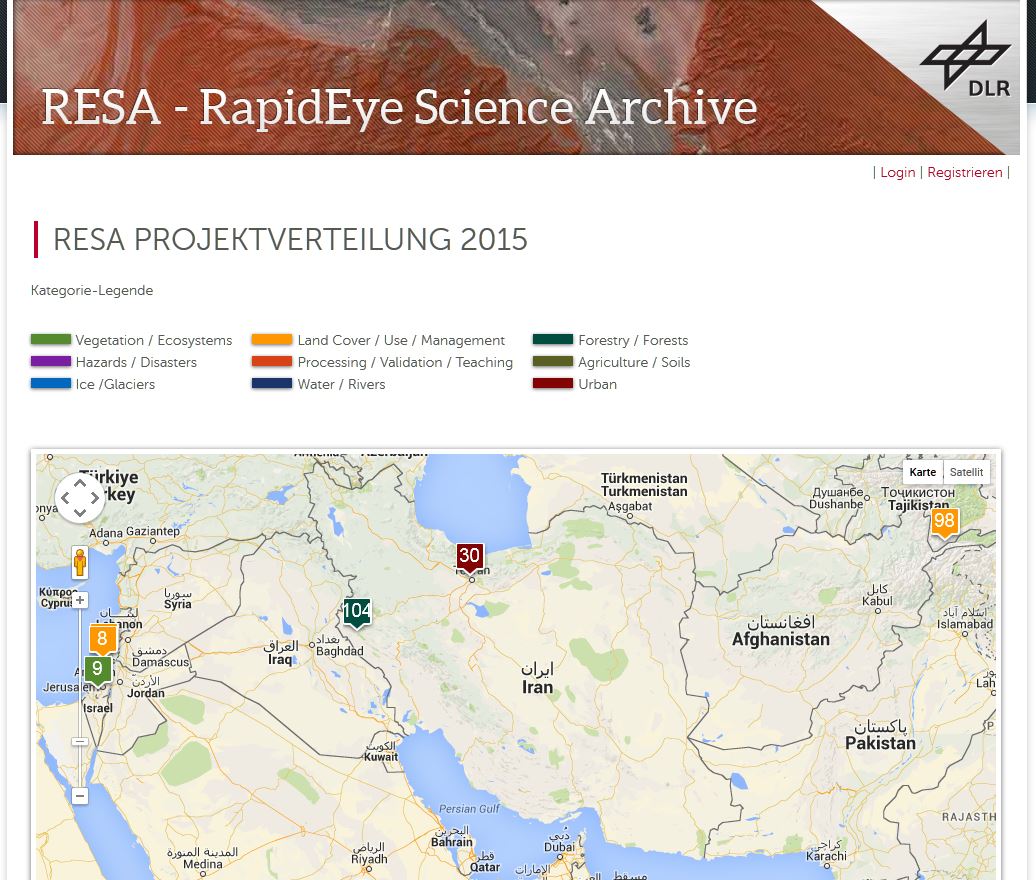
RESA already published this project in RESA project map 2015 which can be found online HERE. The project area is flagged under No. 104 (project number 168) in the map.
resa_iran

The RapidEye Science Archive (RESA) supported by DLR (BMWi) and Black Bridge AG supports scientific projects with German participation through the provision of free image data of the RapidEye satellite constellation. The projects are given the opportunity on an extensive image archive to get current and archived satellite image data to ensure optimal support for individual research projects.

follow us and share it on:

you may also like:

Starkregen in Bayern: Beobachtungen und Dokumentation zählen

Starkregen in Bayern: Beobachtungen und Dokumentation zählen

Starkregenereignisse treten immer häufiger lokal, kurzfristig und mit hoher Intensität auf. Innerhalb weniger Stunden können sie erhebliche Überschwemmungen und Schäden verursachen. Um solche Ereignisse künftig besser zu verstehen und die wissenschaftliche Grundlage...

Seeing the World in Points: Lidar Course for the EAGLEs

Seeing the World in Points: Lidar Course for the EAGLEs

Lidar has a funny way of sneaking up on you. You think you know what it is, a laser that measures distance, fine, but then someone shows you a point cloud of a forest canopy with individual branches floating in 3D space and suddenly you realize there's a whole...

RTL covers EORC: TV Crew Films MONID Habitrack Fieldwork

RTL covers EORC: TV Crew Films MONID Habitrack Fieldwork

A bit of extra excitement at EORC recently, an RTL television crew showed up to film a segment on the MONID Habitrack project, and Dr. Ariane Droin was right in the middle of it, walking them through what Earth Observation actually brings to the table for a project...

Ticks from Above: UAS Fieldwork for the MONID Habitrack Project

Ticks from Above: UAS Fieldwork for the MONID Habitrack Project

Forest edges are tricky places. They're where woodland meets open ground, where light and shade trade off every few meters, and where, it turns out, ticks tend to do really well. That last bit is exactly why Dr. Ariane Droin, Sofica Garcia de Leon, Dr. Jakob...

Course on urban EO by Michael Wurm

Course on urban EO by Michael Wurm

Walk through any city and you pick up on things that are hard to put a number on. The noise of a main road, the heat that sits between buildings in summer, the question of whether that little park around the corner is really enough green space for the whole...

EireR R package: unified gateway to Irish geospatial data

EireR R package: unified gateway to Irish geospatial data

Anyone who's tried to do geospatial work across the whole island of Ireland knows the headache. Ireland is one island geographically, but it's split across two jurisdictions, the Republic and Northern Ireland, and each one runs its own data infrastructure. Different...

Share This