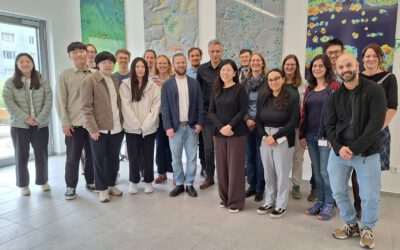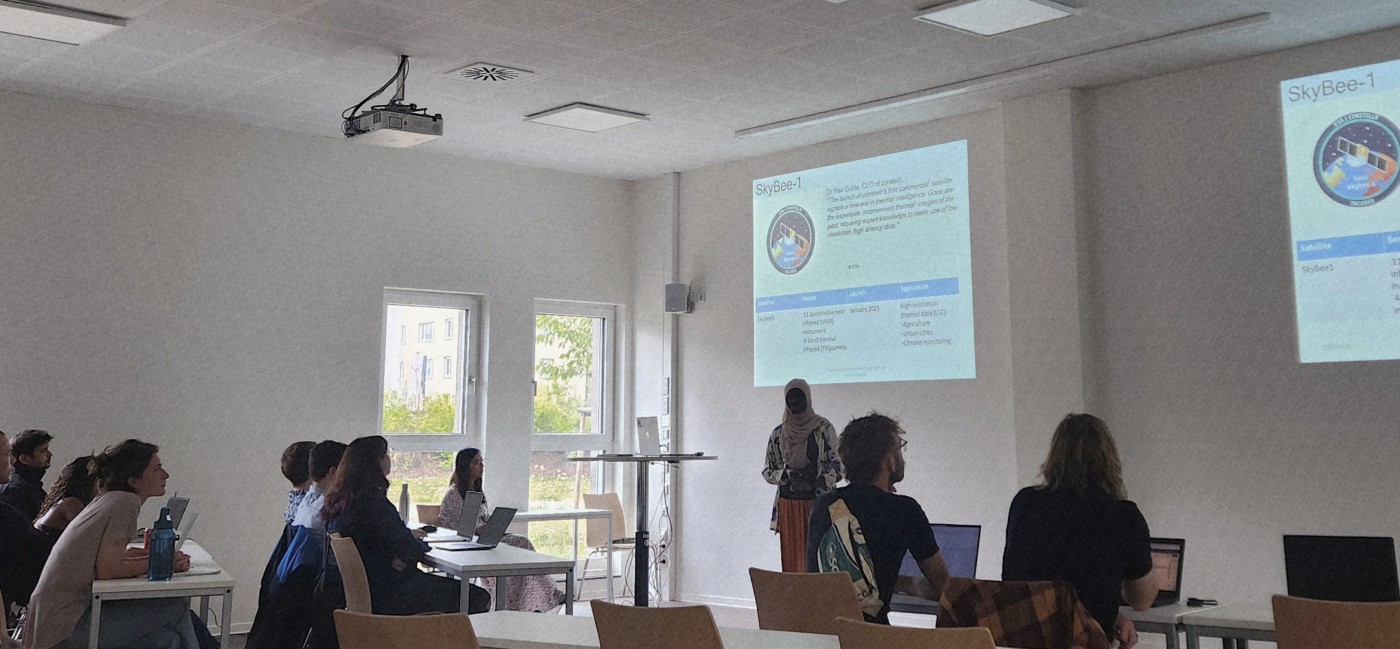

In a spirited display of teamwork, scientific curiosity, and professional growth, our international MSc students from the EAGLE program recently organised and chaired their own scientific mini-symposium, showcasing the latest developments in remote sensing. The event was the highlight of their “Scientific Presentation” course—entirely student-led from concept to execution.
Held in a collegial seminar setting, the mini-symposium featured two themed sessions covering both foundational topics and cutting-edge planetary research. Students not only delivered their presentations but also chaired the sessions, giving them a chance to hone both scientific communication and leadership skills in a professional setting.
🌍 Part 1: Earth Observation Foundations & Ecosystem Applications
Chair: Mahnoor
The first session provided a comprehensive look at the many ways Earth Observation (EO) technologies support ecosystems, conservation, and mobile innovation:
-
Mariam kicked things off with an insightful overview of the Latest Earth Observation Satellites and Their Applications, setting the stage with key missions and their global relevance.
-
Luis explored the rise of EO in Mobile Apps, illustrating how satellite data is becoming more accessible and integrated into everyday tools.
-
Lukas F. took us down to earth—quite literally—with a talk on Detecting Hedges from Satellite Imagery, a niche but ecologically relevant topic.
-
Max highlighted the importance of Remote Sensing for Conservation, emphasizing EO’s role in protecting fragile habitats.
-
Anugraha wrapped up the session by drawing attention to Water Towers, and why monitoring them is vital for downstream ecosystems.
🌋 Part 2: Hazard Monitoring & Planetary Remote Sensing
Chair: Mariam
The second session ventured into more dynamic terrain—from landslides on Earth to radar sensing on distant moons:
-
Mahnoor presented her work on Evaluating Multi-Factor Landslide Susceptibility in Kyrgyzstan, showing how EO can help mitigate natural hazards in mountainous regions.
-
Hanna examined Sinkhole Hazards at the Dead Sea, revealing dramatic landscape changes linked to groundwater dynamics.
-
Lukas R. took the audience out of this world with a presentation on Radar Remote Sensing on Saturn’s Moon Titan, combining space exploration with EO science.
-
Elin is set to add another dimension with a forthcoming topic to be updated—demonstrating that science is always a work in progress.
-
The session concluded with a brief wrap-up and discussion, reflecting on the diversity of EO applications presented.
This student-led initiative reflects the EAGLE program’s commitment to fostering practical experience, international collaboration, and scientific independence.. The mini-symposium was not only a milestone in the students’ academic journey, but also a glimpse into the promising future of Earth observation research.
Stay tuned—this is just the beginning – you might see them at the next conference on the stage like at ESA Living Planet Symposium 2028 ….