
LANDSURF: 2nd End-user Workshop “Evaluation of the Decision Support System (DSS)”

LANDSURF: 2nd End-user Workshop “Evaluation of the Decision Support System (DSS)”

m

June 28, 2023

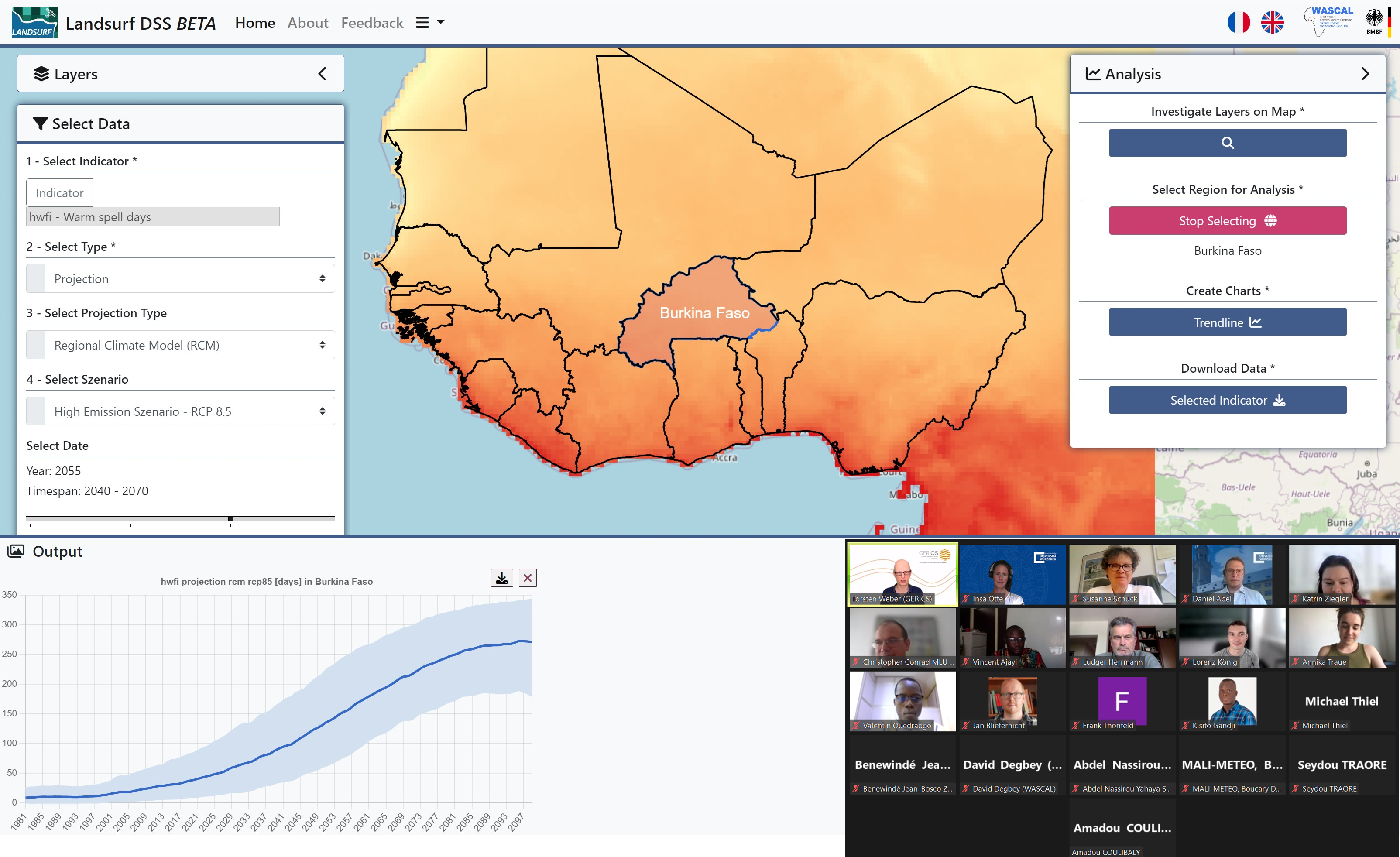
Within the WASCAL WRAP 2.0 project LANDSURF the 2nd End-user Workshop “Evaluation of the Decision Support System (DSS)” took place at 26th June. Within the workshop the project partners presented their contribution to the DSS and received feedback from end-useres that tested the platform beforehand. The virtual workshop was well attended with 28 participants from six countries. The DSS that is developed within LANDSURF provides a user-oriented graphical interface with a strong focus on parameters that can be related/utilzed for decision making in the broader context of agriculture in West Africa. Additional information on land use change and data uncertainty is included as well in the DSS platform. Results from the FURIFLOOD project will also be integrated in the DSS – thus it also serves as an example of our successful synergistic research effort between multiple projects.

follow us and share it on:

you may also like:

UrbanPulse in the Mainpost, and invitation to the festivities

UrbanPulse in the Mainpost, and invitation to the festivities

If you open the printed Mainpost today, keep an eye out for the Universitätsbund Würzburg’s invitation to the Festkonzert. Among the topics on the page, there’s one we’re rather proud of: our newly funded project URBAN:Pulse, which will be officially celebrated at the...

Field work for MONID-HABITRACK project

Field work for MONID-HABITRACK project

Today our researchers from the department working on the MONID-HABITRACK project, that is funded by the BMFTR, went to the field to acquire LiDAR, thermal and multispectral data with their drones. Within our department the project is located at the Chair of Remote...

bzgl. Art. 50 Verordnung (EU) 2024/1689 (AI Act):

Überwiegend werden eigene originäre Texte und Bilder des EORC genutzt, jedoch sind einige Inhalte von blog post Texten teilweise mit Hilfe von KI überarbeitet worden und einige Bilder sind ganz mit KI erstellt, die jedoch deutlich keine photorealistische Darstellungen abbilden. Aussnahmen sind KI generierte fernerkundliche Datensätze, die explizit für Forschungszwecke mit KI erstellt wurden, hier wird aber durch den assoziierten Text der wissenschaftliche Grund der KI generierten Bilder erläutert.

Share This