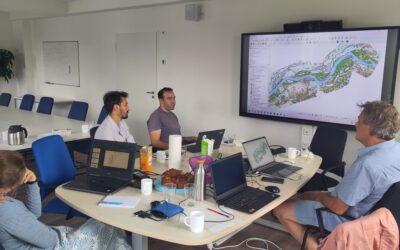
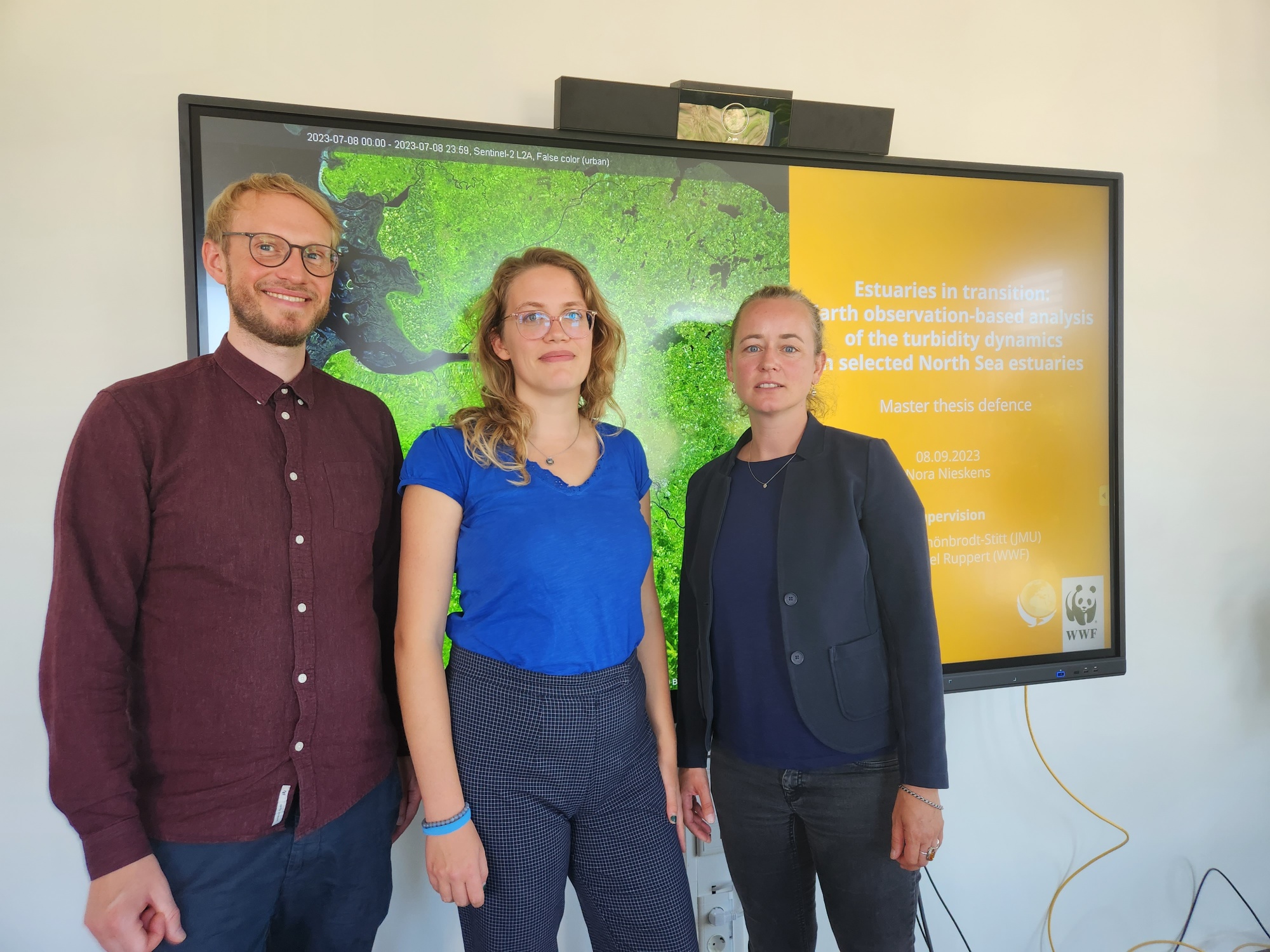

On September 08, 2023, Nora Nieskens successfully defended her master’s thesis entitled “Estuaries in transition: Earth observation-based analysis of the turbidity dynamics in selected North Sea estuaries” at the Earth Observation Research Cluster.
The thesis was supervised by Dr. Sarah Schönbrodt-Stitt and Daniel Ruppert (WWF Germany).
Abstract of the thesis: Estuaries are among the most sensitive, complex and biologically productive aquatic environments. Intensive human modification of estuarine depth and shape has resulted in altered hydromorphological conditions and consequently modified patterns of suspended particulate matter (SPM) for all German North Sea estuaries. The amount of SPM in estuaries, for which turbidity is used as a proxy, is of high economic and ecological importance as increased sediment loads contribute to aquatic environment degradation. This study investigated the long-term development and spatial patterns of surface turbidity in the Elbe estuary using in-situ data and remote sensing (RS) techniques. For long-term spatial turbidity retrieval, established RS approaches were tested employing Landsat data. Three semi-analytical algorithms (Nechad et al. 2009, Nechad et al. 2016 and Dogliotti et al. 2015) were applied, validated and calibrated against in-situ turbidity data. In addition, a random forest-based (RF) machine-learning approach was implemented and assessed. Accuracies varied considerably between different satellites and methodologies. The semi-empirical models, the RF model and the index-based approach (NDTI) show the potential to adequately capture the spatial and temporal distribution of turbidity. However, the semi-empirical approaches do not consistently capture the turbidity dynamics quantitatively for the Elbe estuary. The machine learning approach provides better predictive power compared to in-situ turbidity. The analysis of the long-term development and spatial patterns of surface turbidity in the Elbe estuary based on in-situ data and RS-based turbidity products showed that a new high turbidity level occurred in 2011 and intensified in the following years. Further challenges and potentials of transferring the RS-based approach to the other German North Sea estuaries are evaluated. It is found that additional complexities and uncertainties arise due to differences in in-situ data and estuarine conditions.
We wish Nora all the best for her future career.