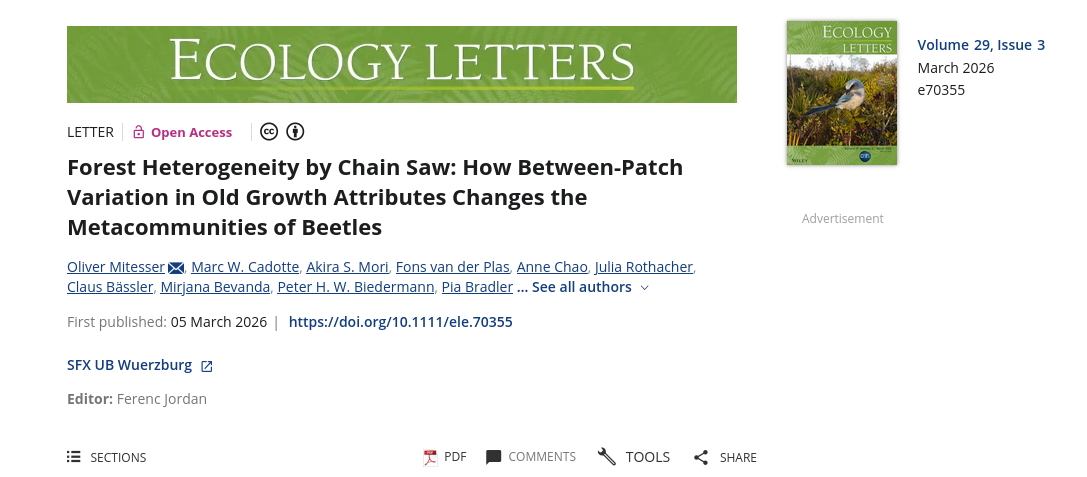

A new study published in the journal Ecology Letters (DOI: 10.1111/ele.70355) explores how ecological interactions and environmental conditions shape the structure and functioning of ecosystems. Research in this field increasingly relies on integrating ecological theory with large-scale environmental data and computational approaches.
The study investigates how species interactions and environmental drivers influence ecological communities and their dynamics. Understanding these processes is essential for predicting how ecosystems respond to environmental change, biodiversity loss, and human pressures. Ecological communities are structured not only by the presence of species, but also by how they interact with each other and with their environment, which ultimately determines ecosystem functioning and stability.
To address these questions, we combined ecological data analysis with advanced modelling approaches lead by Dr. Oliver Mitesser from the biology faculty. Such approaches allow scientists to examine complex ecological networks and explore how environmental gradients or disturbances can reshape species interactions and community composition. More broadly, the work contributes to ongoing efforts in ecology to better understand the mechanisms that drive biodiversity patterns and ecosystem resilience.
The study also highlights the importance of interdisciplinary collaboration. Among the contributors are colleagues from our Earth Observation Research Cluster (EORC), including Mirjana Bevanda, Jakob Schwalb-Willmann, Luisa Pflumm and Antonio Castañeda-Gómez, whose expertise in geospatial analysis and computational workflows supports the analysis of ecological data as well as the provision of forest structure data through UAS based Lidar acquisitions.
Integrating ecological research with geospatial and Earth observation approaches is becoming increasingly important for studying environmental change across spatial scales. These collaborations enable researchers to connect field observations, ecological theory, and spatial data to better understand how ecosystems function and how they may respond to future environmental pressures.
You can read the full article here:
https://onlinelibrary.wiley.com/doi/10.1111/ele.70355