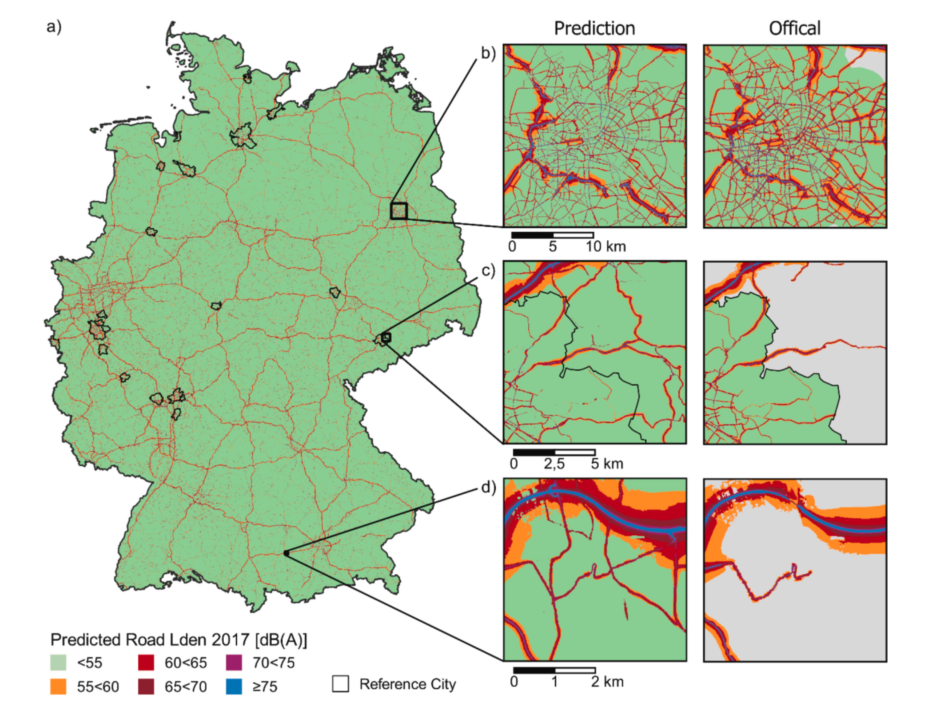

Researchers from the Geography Department of the Humboldt-University Berlin in Germany, the Helmholtz AI as well as the Institute of Epidemiology of the Helmholtz Zentrum München in Neuherberg, the Institute for Medical Information Processing of the LMU Munich, the Earth Observation Center (EOC) as well as the Institute of Atmospheric Physics of the German Aerospace Center (DLR) in Oberpfaffenhofen and our Earth Observation Research Cluster of the University of Würzburg teamed up for a study on national road traffic noise estimation. The paper titled “National road traffic noise estimation with ensemble learning and multimodal geodata” was just published in the Journal Transportation Research Part D by Jeroen Staab, Matthias Weigand, Arthur Schady, Ariane Droin, Donatella Cea, Marco Dallavalle, Nikolaos Nikolaou, Mahyar Valizadeh, Kathrin Wolf, Michael Wurm, Tobia Lakes and Hannes Taubenböck.
Here is the abstract of the paper: The European Noise Directive mandates the mapping of noise – high, continuous sound pressure levels considered to be a major health threat. However, the strictest rulesets apply to specific regions only and the majority of residential areas are unmapped. Transfer learning was deployed to close spatial data gaps between the official, strategic road traffic noise maps. The three most suitable hyperparameter configurations achieved weighted Kappa values (a measure of ordinal agreement) ranging between 0.889 and 0.956 during repeated cross-validation. The best model achieved an overall classification accuracy of 90.7 % when tested against held-out samples. 7.8 % of predictions exhibited minor deviations within ± 5 dB(A). The model was subsequently deployed to predict road traffic noise across Germany at 10 x 10 Meter resolution for 2017. The results suggest a total of 13.1 million people exposed to yearly averaged road traffic noise (Lden) above 55 dB(A) and stress need for improved noise policies.
Here is the link to the full paper: https://www.sciencedirect.com/science/article/pii/S1361920925004730
This research is part of the work on the topic of noise and environmental impact. For further studies please see here:
- https://www.sciencedirect.com/science/article/pii/S0301479725014513
- https://www.sciencedirect.com/science/article/pii/S0301479725018778?via%3Dihub
- https://www.nature.com/articles/s41370-021-00355-z
- https://ieeexplore.ieee.org/document/10144160
- https://elib.dlr.de/187661/1/STAAB-etal-2022_Proceedings_A04.pdf