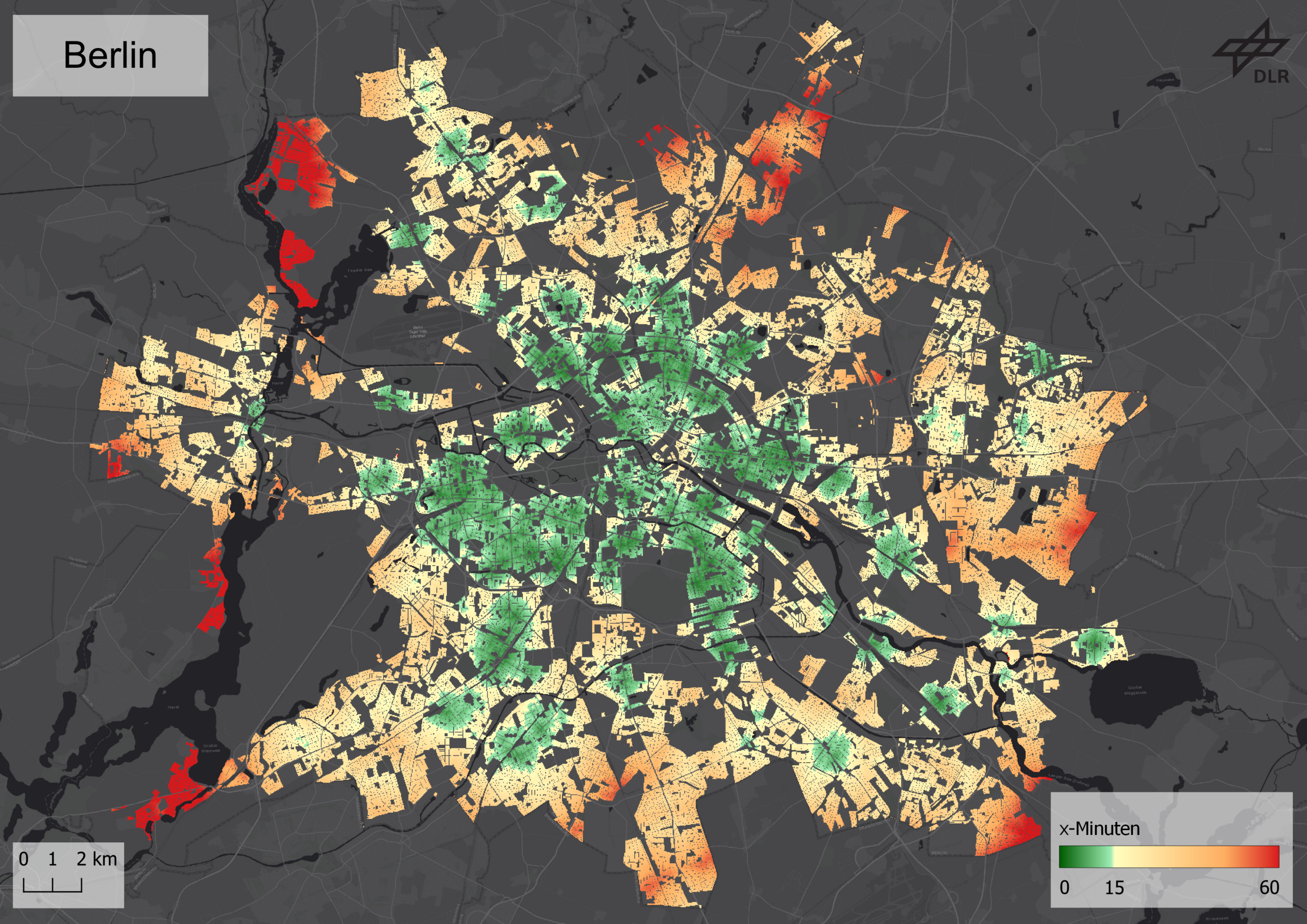

New publication on the influence of urban structure types on the x-minuteness of cities
Researchers from the Earth Observation Center (EOC) of the German Aerospace Center (DLR) in Oberpfaffenhofen and our Earth Observation Research Cluster (EORC) of the University of Würzburg teamed up for a study on the influence of urban structure types on the x-minuteness of cities. The paper titled “The influence of urban structure types on the x-minuteness of cities: An accessibility analysis of 15 German cities” was just published in the journal Environment and Planning B: Urban Analytics and City Science by Ariane Droin, Michael Wurm, Matthias Weigand, Henri Debray, Manuel Köberl and Hannes Taubenböck.
Here is the abstract of the paper: The concept of the 15-minute city has gained a lot of popularity in recent years. Numerous studies have looked at a wide variety of cities, providing insights into the extent to which the 15-min-city has been achieved, or the specific x-minuteness that has been achieved so far. In a context of competition between cities in terms of quality of life and sustainability, statements about their performance in terms of x-minuteness dominate. However, to date there has been no research on the quantitative measurement and comparison of x-minuteness for different urban structure types. Urban structure types are defined by specific combinations of characteristics of the built environment. In this study, the pedestrian x-minuteness is computed for the fifteen most populated cities in Germany and compared across six characteristic urban structure types. The results underline that pedestrian accessibility varies greatly based on different urban structural types and that it is important to look more closely at the spatial composition of cities at the neighbourhood level. This spatially differentiated information helps to target improvements more efficiently and, thus, to increase quality of life more equitably.
Here is the link to the full paper: https://journals.sagepub.com/doi/10.1177/23998083261424942?utm_source=researchgate.net&utm_medium=article
This research is part of our works on walkability and permeability in cities – for further readings on our research on these topics, please see here:
- The Individual Walkable Neighborhood – A spatial concept for a realistic, individual perception of urban density https://www.sciencedirect.com/science/article/pii/S0198971522001375
- How does pedestrian permeability vary across cities due to local barriers and urban morphology? A fine-grained assessment for all large cities in Germany https://www.sciencedirect.com/science/article/pii/S0198971524000449
- Liveability in large housing estates in Germany – Identifying differences based on a novel concept for a walkable city https://www.sciencedirect.com/science/article/pii/S016920462400149X
- Assessing the x-minuteness for urban structural types https://ieeexplore.ieee.org/document/11076038
- Spatial Accessibility in Transition: Evaluating Urban Growth and Service Distribution in Westhoek, Belgium https://ieeexplore.ieee.org/document/11076063