
New publication on the remote sensing–based assessment of urban tree ecosystem services
Researchers from our Earth Observation Research Cluster of the University of Würzburg, the Technical University of Munich, the Company for Remote Sensing and Environmental Research (SLU) and the Earth Observation Center (EOC) of the German Aerospace Center (DLR) in Oberpfaffenhofen teamed up for a study on the urban tree ecosystem services assessment. The paper titled “Beyond public inventories: Remote sensing–based assessment of urban tree ecosystem services” was just published in the journal Urban Forestry & Urban Greening by Andrea Sofía García de Leon, Thomas Rötzer, Tobias Leicht le,Stephan Pauleit, John Friesen, Klaus Martin, Tobias Ullmann and Hannes Taubenböck.
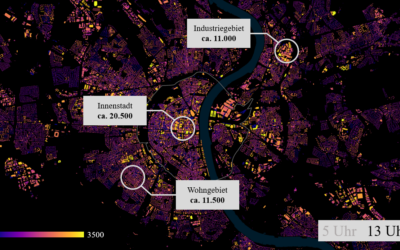
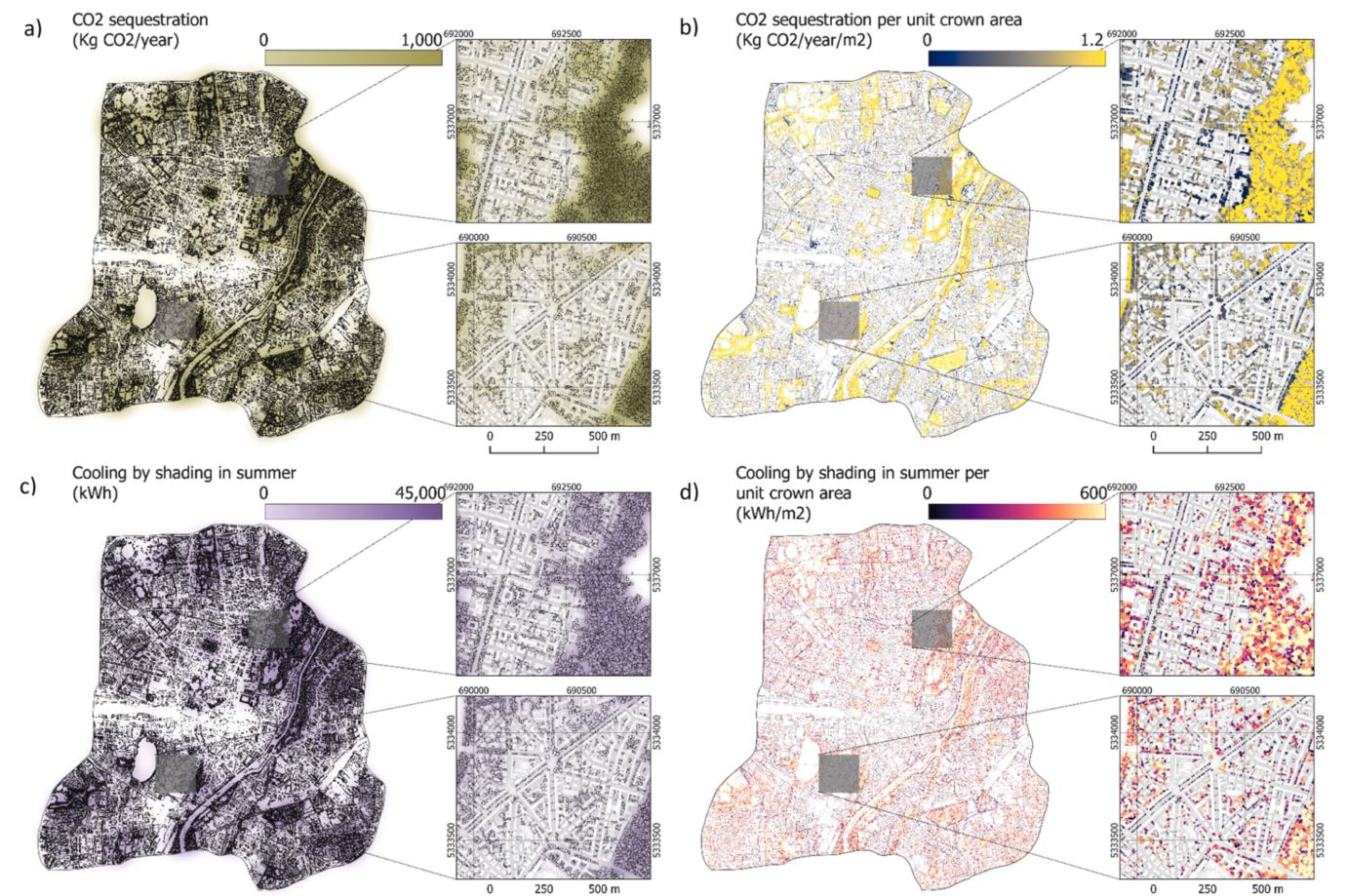
Here is the abstract of the paper: Urban trees provide important ecosystem services (ESS), but their contributions are often undervalued and less acknowledged due to the complexity of quantifying them. Therefore, ESS assessment for urban trees at the individual tree level using ESS models is crucial for a more knowledge-based management of urban green spaces. In this study, we used very high-resolution aerial and satellite-based remote sensing imagery to derive the geospatial input for the CityTree model to estimate regulating ESS from over 160,000 individual trees in Munich, Germany. Our assessment includes both, trees on public and private land and enables fine-scale spatial modeling of eight ESS (carbon storage, carbon sequestration, CO2 sequestration, evapotranspiration of trees, runoff under the tree, transpiration, cooling by transpiration and shading). We found that public trees, especially those in recreational areas such as parks and woodlands, contribute largely to ESS provision. Private trees also play a meaningful role by contributing around one third of the total ESS. A statistical comparison with the tree inventory data revealed good agreement between the two datasets. However, we also found systematic measurement differences, possibly due to rounding in field measurements and limitations in remote sensing datasets. However, the size effect of these differences is small in practical terms, indicating that both data sources are comparable and complementary. Our findings support the use of remote sensing as a scalable, area-wide, consistent, and resource-efficient approach for urban ESS estimations.
Here is the link to the full paper: https://www.sciencedirect.com/science/article/pii/S1618866726001226?via%3Dihub
This work was partly funded by the German Federal Environmental Foundation (DBU) as well as from the Free State of Bavaria via the Bavarian State Ministry of Economic Affairs, Regional Development and Energy as part of the “Earth Observation Innovation Laboratory for Climate Adaptation and Mitigation” project (www.EO4CAM.de).
This research is part of our works on urban green – for some further reading of recent papers, please see here:
- Patterns of urban green cover and green volume depend on land ownership in Munich, Germany https://www.sciencedirect.com/science/article/pii/S1618866726000889?via%3Dihub
- The influence of city size versus urban form on land surface temperature variation and the surface urban heat island effect: A cross-city analysis of German cities https://journals.plos.org/plosone/article?id=10.1371/journal.pone.0340060
- The impact of urban configuration types on urban heat islands, air pollution, CO2 emissions and mortality in Europe https://www.sciencedirect.com/science/article/pii/S2542519624001207
- Spatially-optimized urban greening for reduction of population exposure to land surface temperature extremes https://www.nature.com/articles/s41467-023-38596-1
- Identification of the potential for roof greening using remote sensing and deep learning https://www.sciencedirect.com/science/article/pii/S0264275125000824
- Are public green spaces distributed fairly? A nationwide analysis based on remote sensing, OpenStreetMap and census data https://www.tandfonline.com/doi/pdf/10.1080/10106049.2023.2286305
- Does urbanization mean a loss of greenspace? A multi-temporal analysis for Chinese cities https://www.sciencedirect.com/science/article/pii/S0048969723049987
- Green cities cost more green: Examining the impacts of different urban expansion patterns on NPP https://www.sciencedirect.com/science/article/pii/S0360132322011064
- Which city is the greenest? A multi-dimensional deconstruction of city rankings https://www.sciencedirect.com/science/article/pii/S0198971521000946