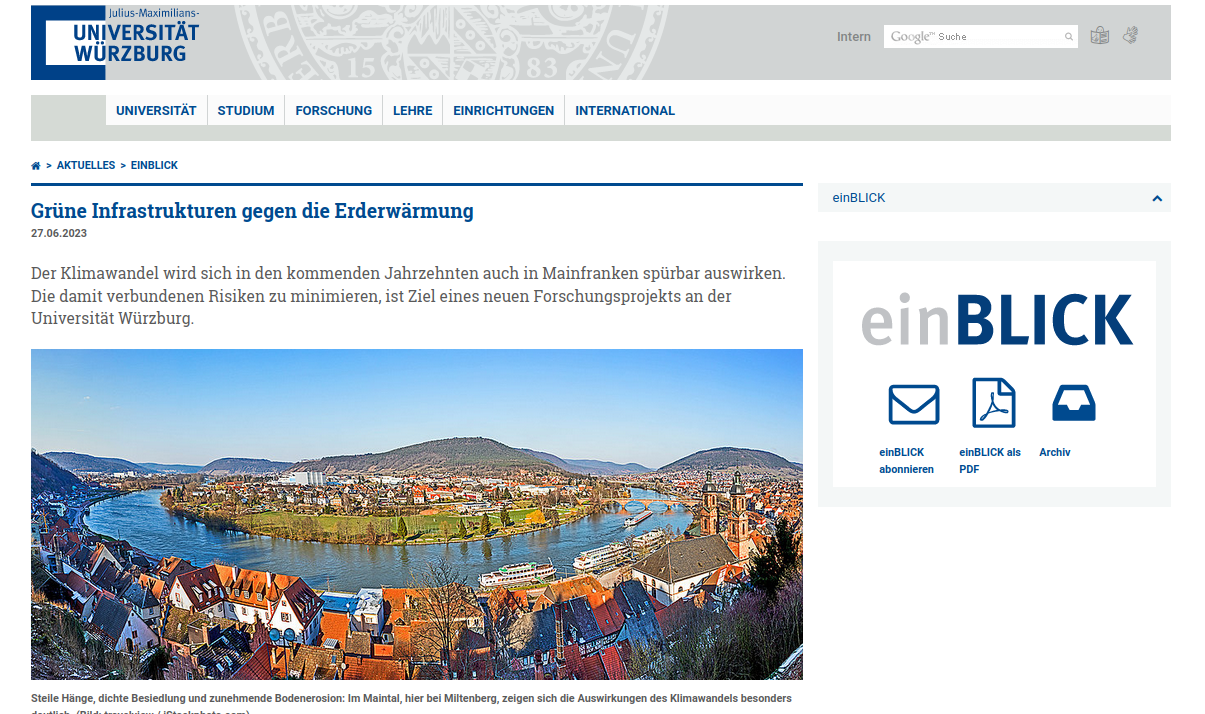

Our new project MainPro got featured by the University

Our new project MainPro got featured by the University

m

June 30, 2023

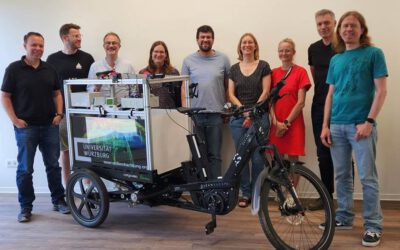
Our new project MainPro about green infrastructure against climate change got featured by the University. The news is unfortunately only available in german but more news about this project will be posted soon also in english.

“Sich auf die Veränderungen durch den Klimawandel vorzubereiten und drohenden Schäden schon jetzt durch geeignete Maßnahmen vorzubeugen: Das ist das Ziel eines neuen Forschungsprojekts an der Julius-Maximilians-Universität Würzburg (JMU). Der Klimawandel wird sich in den kommenden Jahrzehnten auch in Mainfranken spürbar auswirken. Die damit verbundenen Risiken zu minimieren, ist Ziel eines neuen Forschungsprojekts an der Universität Würzburg.

Nordbayern ist ein Hotspot des Klimawandels. Selbst unter der Annahme günstiger Szenarien ist davon auszugehen, dass in den kommenden Jahrzehnten mit Hitzerekorden und vermehrten Starkregen-Ereignissen zu rechnen ist.

Konkret geht der Klima-Report Bayern 2021 davon aus, dass die mittlere Temperatur im Freistaat bis zum Jahr 2100 um bis zu 4,8 Grad Celsius im Vergleich zu dem Zeitraum von 1971 bis 2000 ansteigen wird. Anstatt an durchschnittlich vier Tagen pro Jahr, wird das Thermometer dann an bis zu 40 Tagen Werte jenseits der 30 Grad anzeigen. Und schon bis zum Jahr 2050 soll die Zahl an Starkregen-Ereignissen und damit einhergehend die Bodenerosion um etwa 300 Prozent zunehmen.

Unterfranken ist davon in besonderem Maße betroffen. Schon heute zählt die Region zu den am stärksten von Hitze und Trockenheit belasteten Regionen Deutschlands mit der Folge, dass steigende Temperaturen, Dürrephasen und Extremwetter-Ereignisse bereits jetzt zu Belastungen für Bevölkerung, Wirtschaft und Natur führen.

Das bayerische Wissenschaftsministerium fördert das Vorhaben „Das Maintalprojekt: Ökosystembasierte Lösungen für Gefährdungs-Szenarios im fränkischen Maintal (MainPro)“ aus Mitteln des Europäischen Fonds für Regionale Entwicklung (EFRE) mit rund 1,8 Millionen Euro. Das Vorhaben ist Anfang Mai 2023 an den Start gegangen und läuft vier Jahre.”
follow us and share it on:

you may also like:

GLS-team visits Planetary Health exhibition

GLS-team visits Planetary Health exhibition

One of the aims of Geolingual Studies Geolingual Studies - Geolingual Studies is to ensure effective science communication beyond the scientific community and into the wider society. The Geolingual Studies team was given the opportunity to look at concepts and methods...

University press covered our anniversaries

University press covered our anniversaries

Einblick, the University of Würzburg's press medium, published an article on our double anniversary, 25 years of Earth observation research and 10 years of EAGLE M.Sc. program, today. Recently, they has visited us at our EORC to hear about our research and teaching...

Mapping Lava Tubes on Mauritius with iPhone Pro LiDAR

Mapping Lava Tubes on Mauritius with iPhone Pro LiDAR

Lava tube structures on Mauritius are quite hard to survey - tight, dark, and largely inaccessible to classical scanning equipment. As part of ongoing research by Dr. Kim Lea Holzmann (Chair of Animal Ecology and Tropical Biology, University of Würzburg), we're...

Johannes Mast wins Bernd Rendel Prize

Johannes Mast wins Bernd Rendel Prize

Johannes Mast is awarded the 2026 Bernd Rendel Prize for Geosciences by the Deutsche Forschungsgemeinschaft (DFG) for outstanding research as part of his dissertation. Johannes’s highly interdisciplinary work bridges the Geosciences, Linguistics, Data Science, and...

Two days of celebration, and a hundred hands behind it

Two days of celebration, and a hundred hands behind it

We've written plenty about the EORC 25th and EAGLE 10th anniversary already, the timeline, the talks, the EAGLE panel discussion, the exhibition. But there's a story we haven't told yet, and it's honestly the one that matters at least as much. Because none of it just...

Privacy Policy

Lehrstuhl für Fernerkundung & Lehrstuhl für Urbane Fernerkundung

Erdbeobachtung an der Universität Würzburg

Share This