Project EO4CAM Supports Municipal Adaptation to Heavy Rainfall Events

Project EO4CAM Supports Municipal Adaptation to Heavy Rainfall Events

m

February 26, 2026

How can municipalities effectively reduce the impacts of increasingly frequent heavy rainfall events? This question brought together local and regional stakeholders on 24 February 2026 at Wartmannsroth town hall in the district of Bad Kissingen, Germany. Participants included municipal and district representatives, water management and nature conservation authorities, forestry and agricultural stakeholders, planning experts, and representatives of the UNESCO Rhön Biosphere Reserve.

The Rhön region serves as a pilot area within the EO4CAM project, providing an important testing ground for translating scientifically derived Earth observation data into practical decision support for local climate adaptation.

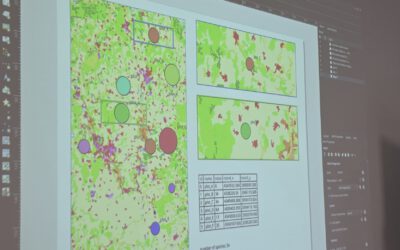
Researchers from the Earth Observation Research Cluster (EORC) at the University of Würzburg presented terrain-based analyses derived from digital terrain models. Indicators such as flow accumulation and soil moisture concentration help identify potential runoff pathways and water accumulation zones. Combined with simplified runoff modelling, these analyses reveal critical locations where heavy rainfall may trigger increased surface runoff, erosion, or local flooding.

During subsequent discussions, the data-driven insights were compared with existing planning activities, documented past events, and local experiential knowledge. A full-day field visit allowed participants to assess selected hotspots on site and jointly explore nature-based water retention measures in forests and agricultural landscapes.

The event highlighted how combining remote sensing, terrain analysis, and local expertise can support municipalities in developing targeted and actionable climate adaptation measures.

 

follow us and share it on:

you may also like:

Guest talk at ENS Lyon

Guest talk at ENS Lyon

Our PI Florian Betz was invited to give a seminar talk about his research on remote sensing of river dynamics at the ENS Lyon in France. The seminar "Cafe Fluvial" is part of the doctoral training and research network "H2O Lyon" in which a number of research...

Successful MSc Defense by Lena Jäger

Successful MSc Defense by Lena Jäger

On 24 February 2026, EAGLE MSc student Lena Jäger successfully defended her Master’s thesis titled “Assessing the potential of thermal UAS for spatio-temporal Arctic snow monitoring – A pilot study in Bjørndalen, Svalbard.” Her work focused on one of the Arctic’s most...

Henri Debray Successfully Defends PhD on Global Urban Morphology

Henri Debray Successfully Defends PhD on Global Urban Morphology

We are delighted to announce that our PhD student Henri Debray has successfully defended his doctoral thesis, “Characterizing Urban Morphology at a Global Scale: Geospatial Perspectives,”. Henri’s thesis builds on a series of his scientific publications investigating...

Dr. Simon Plank interviewed by NASA Earth Observatory

Dr. Simon Plank interviewed by NASA Earth Observatory

Home Reef, which is part of the Tonga Volcanic Arc, is the youngest volcanic island on Earth. Dr. Simon Plank, our habilitation candidate and guest lecturer from DLR, has been monitoring the evolution of Home Reef since the island emerged above sea level in September...

EOCap4Africa Training in Kinshasa

EOCap4Africa Training in Kinshasa

This week, 14 students are attending a test run of our Remote Sensing module on Remote Sensing for Biodiversity Conservation at the University of Kinshasa. This module is part of the EOCap4Africa project (funded by the Federal Agency for Nature Conservation, lead Dr....

KI4Stereo – Hybrid kick-off meeting at DLR

KI4Stereo – Hybrid kick-off meeting at DLR

KI4Stereo – Hybrid kick-off meeting at DLR: AI-based analysis of stereo image data for tree monitoringOn January 23rd, 2026, a hybrid kick-off meeting was held at DLR to officially launch the research project KI4Stereo (funded under the KMU-innovativ programme,...

Share This