
The Department of Remote Sensing at the International Africa Festival 2022 in Würzburg

The Department of Remote Sensing at the International Africa Festival 2022 in Würzburg

May 31, 2022

After two years of break, the International Africa Festival took place in Würzburg on the last weekend in May (26th to 29th of May). For three decades, the Africa Festival, the largest of its kind in Europe, has been a permanent fixture in the cultural events calendar of the city of Würzburg.

In addition to the cultural program, the University of Würzburg was represented with a scientific contribution on Africa-related research. As a unique feature this year, there were two exhibitions.

One collection was dedicated to the Benin bronzes. The stories of the Benin bronzes were retold scientifically, and background information, e.g., on the subject of restitution, was conveyed. The curator was Dr. Julien Bobineau, speaker of the Forum Afrikazentrum at the University of Würzburg, and Prof. Dr. Guido Fackler and Regina Reisinger (Museology, University of Würzburg)

The second exhibition, “Africa in Global Change,” presented a panorama of selected Africa-related projects at the University of Würzburg. The focus was on remote sensing-based research within the WASCAL-DE-Coop project (BMBF) and the international cooperation with the West African Science Service Centre on Climate Change and Adapted Land Use (WASCAL).

On the festival’s opening day, Ms. Claudia Roth, the Federal Government Commissioner for Culture and the Media, visited the exhibitions and discussed with the exhibition organizers. On all four days of the festival, the visitors welcomed the exhibited contributions with lively interest. In addition, staff members of the Department of Remote Sensing were available for exchange and discussion.

follow us and share it on:

you may also like:

Setting Up for the 2nd EO4CAM Nutzerworkshop

Setting Up for the 2nd EO4CAM Nutzerworkshop

Right now our staff are busy hauling cases, mounting displays and testing every cable for the 2nd EO4CAM Nutzerworkshop, “Erdbeobachtung für die Klimaanpassung, behördliche Akteure in Bayern”. The doors open tomorrow, and the exhibition...

A dashboard for multi-UAS thermal data

A dashboard for multi-UAS thermal data

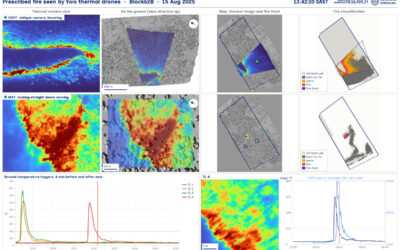
Mapping an active fire with various drones flying in parallel is hard enough. But getting the data processed, evaluated and turned into research datasets is a different story. The publication is on its way, and for now we’d like to share a dashboard by Antonio José...

Have you ever wondered how many trees there are on our campus?

Have you ever wondered how many trees there are on our campus?

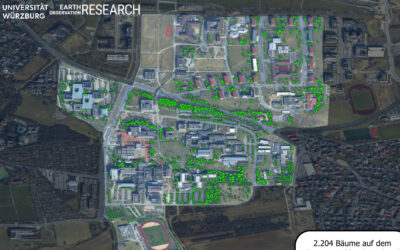
Sometimes a chat during a formal event like the one for the Urban:Pulse funding celebration, results in something totally different. Following a discussion with the vice-president of our University, we promised to look into the research by one of our PhD students...

Earth Observation at the DFG BETAFOR workshop

Earth Observation at the DFG BETAFOR workshop

Jakob Schwalb-Willmann represented our team at the DFG BETAFOR workshop in the Bavarian Forest National Park. The room was full of biologists, which is the whole point of an interdisciplinary project, and our UAS multisensor time series drew a lot of interest from the...

Thermal Drone Data Acquisitions: CalVal project with Informatics

Thermal Drone Data Acquisitions: CalVal project with Informatics

Thermal cameras on drones look very good - visually. They show us temperature of our study objects be it stressed trees, warm patches in a city or active fires. But we do not yet know for sure how far we can trust the temperature values they deliver especially when...

bzgl. Art. 50 Verordnung (EU) 2024/1689 (AI Act):

Überwiegend werden eigene originäre Texte und Bilder des EORC genutzt, jedoch sind einige Inhalte von blog post Texten teilweise mit Hilfe von KI überarbeitet worden und einige Bilder sind ganz mit KI erstellt, die jedoch deutlich keine photorealistische Darstellungen abbilden. Aussnahmen sind KI generierte fernerkundliche Datensätze, die explizit für Forschungszwecke mit KI erstellt wurden, hier wird aber durch den assoziierten Text der wissenschaftliche Grund der KI generierten Bilder erläutert.

Share This