
UAS analysis of fire and drought stress under controlled conditions

UAS analysis of fire and drought stress under controlled conditions

m

October 5, 2026

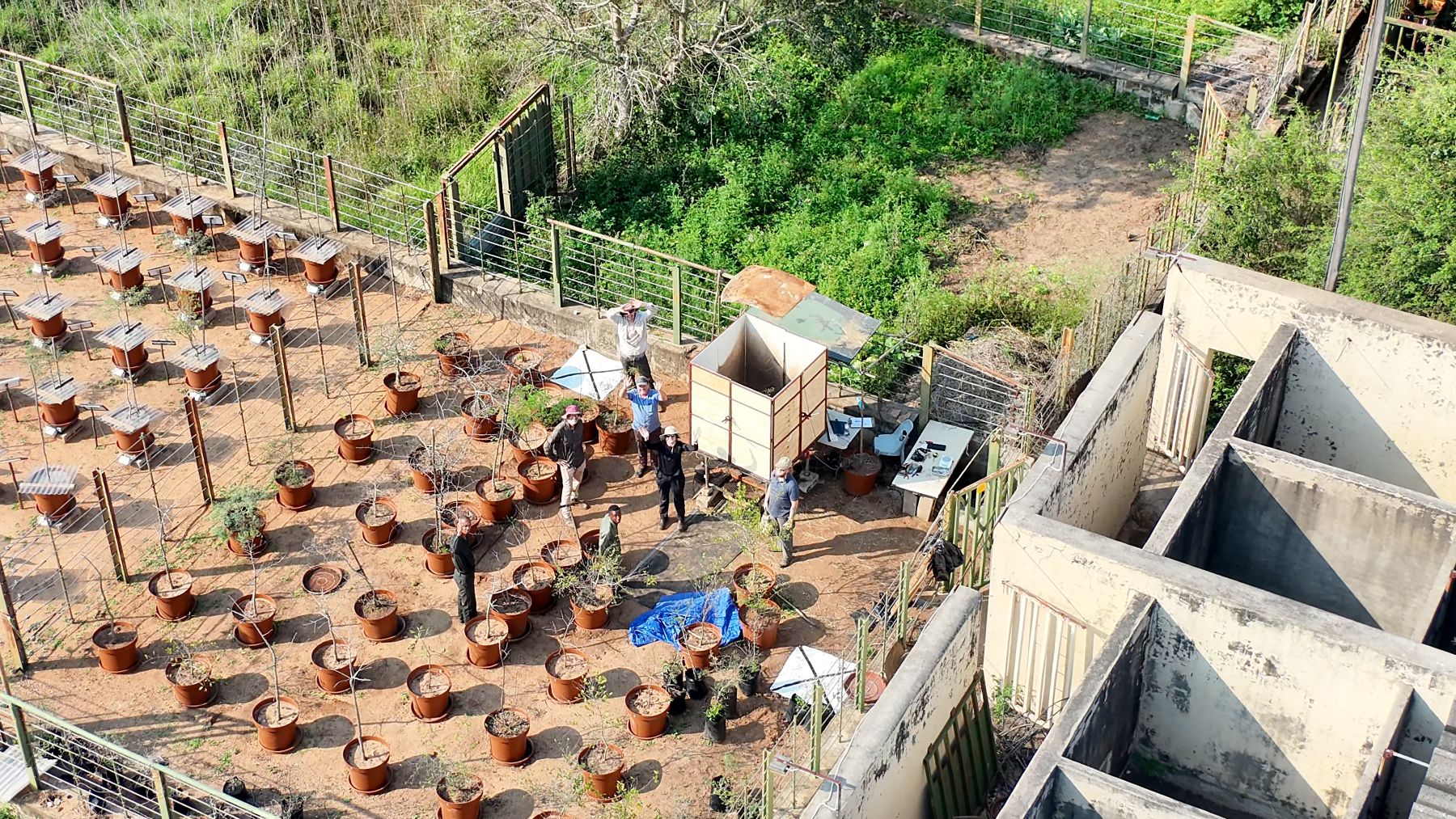
New update from the field work of our PhD researcher Luisa Pflumm in Kruger National Park! After weeks of fieldwork in the open savanna, Luisa’s work now moves into a more controlled setting, a burn chamber experiment carried out together with our collaborators from the University of Bayreuth, the University of Rhodes, and SANParks.

Within this experiment a selection of savanna trees were grown in pots as part of an experimental setup, with half of them exposed to reduced water availability over time (drought-treated) and the other half watered according to conditions typical for this region. These trees are now being placed into burn chambers with different amounts of fuel loads which are ignited under controlled conditions. The goal is to measure how the plants respond to the combined stress, looking at their hydraulics, as well as post-fire behaviour such as leaf loss, resprouting, and mortality.

Our team is accompanying the experiment with a thermal UAV. This is a useful opportunity to calibrate UAV-derived fire intensity measurements against thermocouple readings taken directly in the burn chambers, a comparison that’s hard to get in the field at this level of control.

The results will feed directly into the analysis of the larger savanna fire experiment, helping us to understand how UAV-based fire intensity measurements relate to ground conditions.

More about our results soon!

The research is done within a DFG funded project lead by Mirjana Bevanda and Tobias Ullmann.


follow us and share it on:

you may also like:

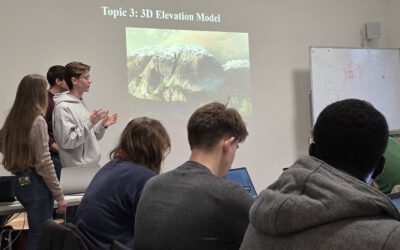
EAGLE students present blender for 3D globes & mountains or cities

EAGLE students present blender for 3D globes & mountains or cities

Our EAGLE M.Sc. students are in the middle of a series where they present scientific software for spatial work to each other. The idea is simple. Instead of just hearing about scientific spatial tools from a lecturer, the students pick one software, explore it and...

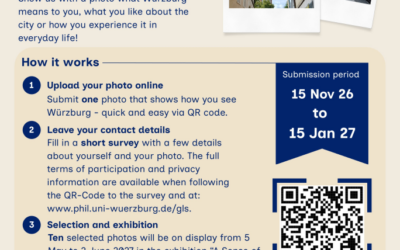
Photo contest – Würzburg through your lens

Photo contest – Würzburg through your lens

Take part in the Geolingual Studies photo contest and contribute to the exhibition "A Sense of the City". The GLS team wants to see what Würzburg looks like through your lens. Whether your photo depicts a well-known landmark or an overlooked corner, was taken by day...

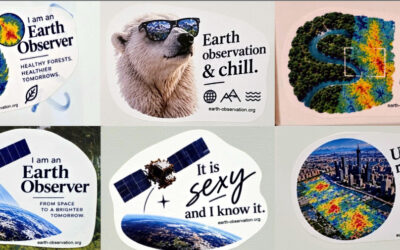
Stickers have landed

Stickers have landed

Our new EO stickers arrived last week, and they’re already out in the wild. You may spot them on laptops, water bottles and notebooks around campus. Hex logos, nerdy one-liners about satellites and code, and a few jokes only an Earth observation person will get. And...

Successful MSc Defense by Christina Krause

Successful MSc Defense by Christina Krause

Congratulations to our EAGLE student Christina Krause, who successfully defended her MSc thesis titled "Active Learning and Parameter-Efficient Feature Adaptation for Cross-City Seismic Building Type Transfer Using DINOv2 and Street-Level Imagery" on November 12,...

Successful MSc Defense by Marlene Bauer

Successful MSc Defense by Marlene Bauer

Congratulations to our EAGLE student Marlene Bauer, who successfully defended her MSc thesis titled "Robust and Uncertainty-Aware Informal Settlement Mapping – Cross-City Generalisation Across Diverse Urban Morphologies Using High-Resolution Satellite Imagery in...

bzgl. Art. 50 Verordnung (EU) 2024/1689 (AI Act):

Überwiegend werden eigene originäre Texte und Bilder des EORC genutzt, jedoch sind einige Inhalte von blog post Texten teilweise mit Hilfe von KI überarbeitet worden und einige Bilder sind ganz mit KI erstellt, die jedoch deutlich keine photorealistische Darstellungen abbilden. Aussnahmen sind KI generierte fernerkundliche Datensätze, die explizit für Forschungszwecke mit KI erstellt wurden, hier wird aber durch den assoziierten Text der wissenschaftliche Grund der KI generierten Bilder erläutert.

Share This