CAWa meeting with CAREC in Almaty

CAWa meeting with CAREC in Almaty

February 6, 2015

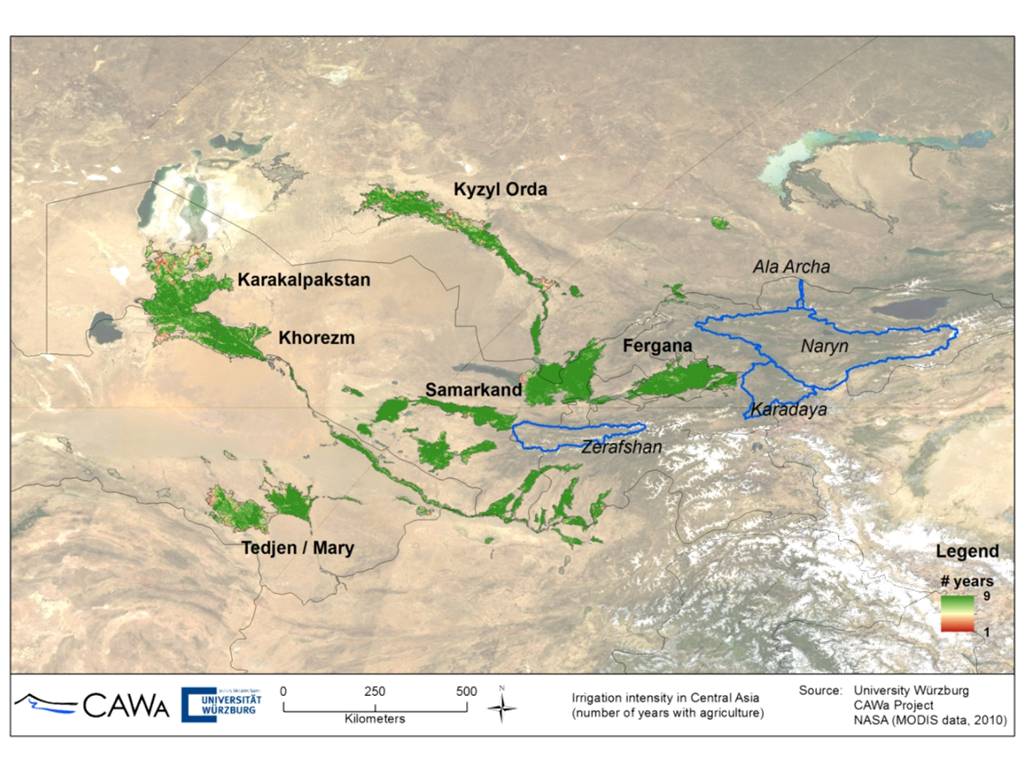
Irrigated cropland extent Central Asia

Focus region of CAWa WP3: Irrigation systems in the Aral Sea Basin

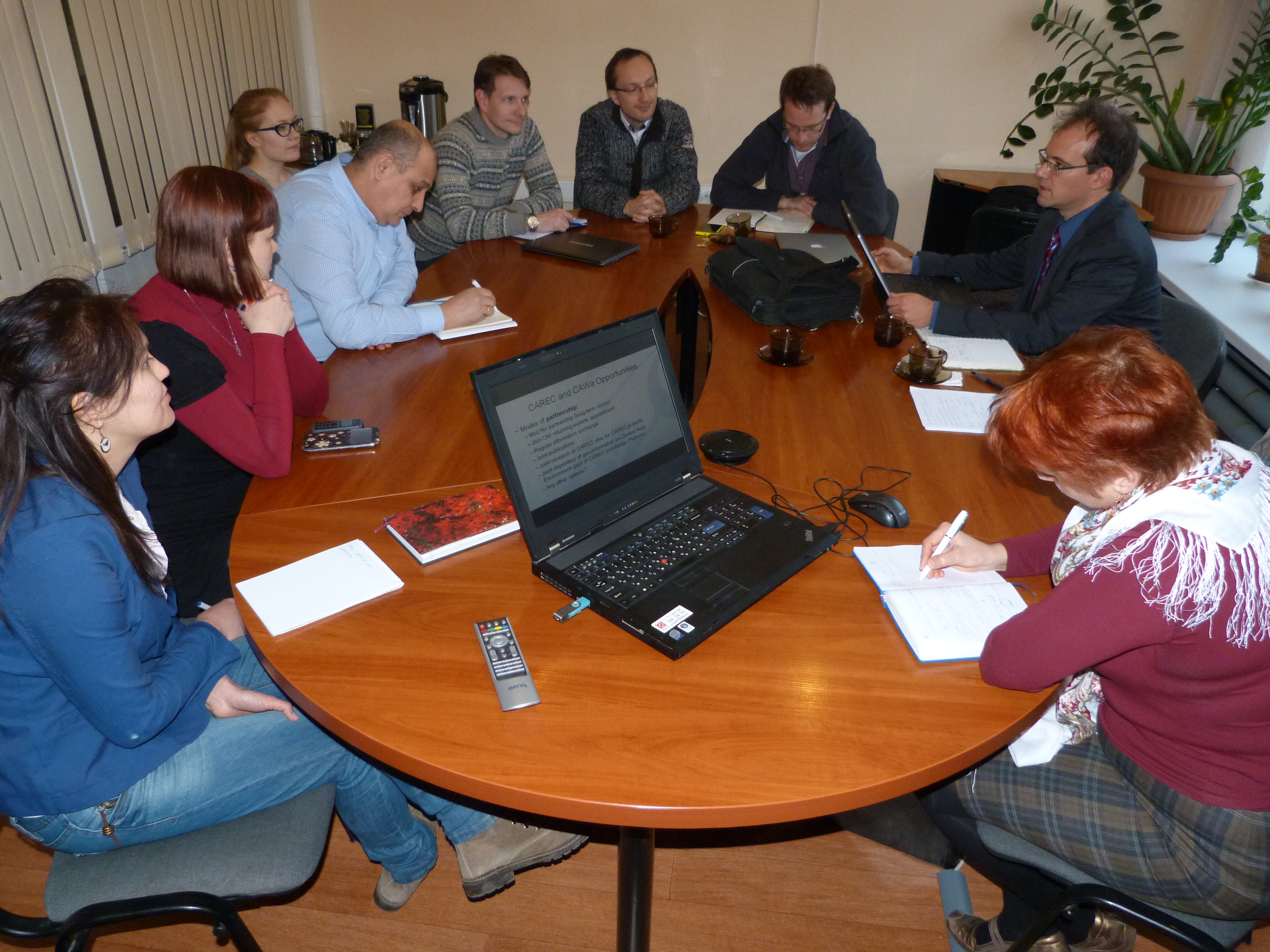
News from the CAWa project “Water in Central Asia”: On 6.2.2015 our team visited the Regional Environment Center of Central Asia (CAREC). The meeting focused on the identification of potential users and specification of use cases of the new web-based application “Water Use Efficiency Monitor for Central Asia” (WUEMoCA), which is subject of the third phase of the project.

WUEMoCA is the major topic of WP3 in CAWa phase III (2015-2017). It focuses on the provision of an online tool for regional assessments of water use efficiency in all extensive downstream irrigation systems of the transboundary Aral Sea Basin. The first aim is to provide information about crop yields of the major crops, i.e. “cotton”, “rice”, and “wheat”, based on free-of-charge accessible remote sensing (MODIS 250m) and meteorological (ECMWF) data aggregated at different scales ranging from Rayons to irrigation planning zones, and Oblasts. With this first part of the tool, negative developments should become visible (early warning and localization of indication for agricultural drought, harvest shortfalls).
P1140126

Final summary meeting of the CAWa meeting at CAREC in Almaty

Second, user interaction should become possible for adding data on additional crops and irrigation water amounts for the calculation of water use efficiency (how much water was used for crop production m3/t). The user will be enabled to contribute the additional information to the administrative boundaries and to request specific information based on user defined areas of interest. The second step should trigger user participation and raise interest in the development of own digital data management tools among the partners and users.

follow us and share it on:

you may also like:

Geometric calibration study of our thermal UAS sensor

Geometric calibration study of our thermal UAS sensor

At the EORC we deploy a range of space-borne and UAS-based sensors for environmental research. While many systems come with established calibration procedures, some of our UAS sensors require dedicated validation and characterization to ensure scientifically reliable...

EORC researchers teaching drone remote sensing at UNIS, Svalbard

EORC researchers teaching drone remote sensing at UNIS, Svalbard

During their current visit to Svalbard, EORC researchers have been teaching UNIS students from all over Europe on how drones can be used for remote sensing in the high Arctic. Invited by our UNIS collaborators Prof. Dr. Simone Lang (UNIS) and Prof. Dr. Eero Rinne...

Upcoming PhD Defense by Sebastian Buchelt on 11th February

Upcoming PhD Defense by Sebastian Buchelt on 11th February

We are happy to announce that our colleague Sebastian Buchelt will defend his PhD thesis "Potential of Synthetic Aperture Radar time series for mapping and monitoring of small-scale periglacial processes in alpine environments" on February 11th at 12 pm at...

Talk by Dr. Philipp on AI at Airbus

Talk by Dr. Philipp on AI at Airbus

Our former EAGLE M.Sc. graduate and EORC PhD graduate Dr. Marius Philipp will give talk about AI, ML and NLP within his current work at Airbus. The talk will take place next Wednesday, 11th of Feb., at 2pm in John-Skilton Str. 4a. It will take place either in seminar...

Urban Earth Observation Lecture: Understanding Cities from Above

Urban Earth Observation Lecture: Understanding Cities from Above

As part of the EAGLE M.Sc. programme, our international students attended this winter term the Urban Earth Observation lecture by EORC professor Hannes Taubenböck. The session offered a comprehensive overview of how remote sensing has evolved into a central tool for...

Share This