
CAWa meeting with SIC-ICWC in Tashkent

CAWa meeting with SIC-ICWC in Tashkent

February 6, 2015

P1140055

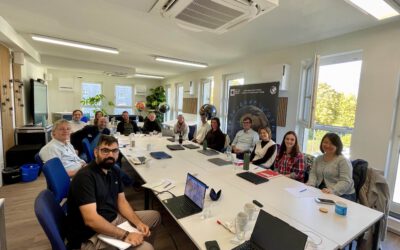
Discussion about use cases for the Water Use Efficiency Monitor for Central Asia (WUEMoCA), 4.2.2015

On 3.2.2015-4.2.2015 our CAWa team visited the Scientific Information Center of the Interstate Commission on Water Distribution in Central Asia. The meeting focused on specifications for the new web-based application “Water Use Efficiency Monitor for Central Asia” (WUEMoCA). We presented first concepts and learned about user demands of the new tool, which is planned to be developed in the third phase of the CAWa project “Water in Central Asia”.

WUEMoCA is the major topic of WP3 in CAWa phase III (2015-2017). It focuses on the provision of an online tool for regional assessments of water use efficiency in all extensive downstream irrigation systems of the transboundary Aral Sea Basin. The first aim is to provide information about crop yields of the major crops, i.e. “cotton”, “rice”, and “wheat”, based on free-of-charge accessible remote sensing (MODIS 250m) and meteorological (ECMWF) data aggregated at different scales ranging from Rayons to irrigation planning zones, and Oblasts. With this first part of the tool, negative developments should become visible (early warning and localization of indication for agricultural drought, harvest shortfalls).

P1140065

Our team members in front of the Scientific Information Center of the Interstate Commission on Water Coordination in Central Asia (SIC-ICWC)

Second, user interaction should become possible for adding data on additional crops and irrigation water amounts for the calculation of water use efficiency (how much water was used for crop production m3/t). The user will be enabled to contribute the additional information to the administrative boundaries and to request specific information based on user defined areas of interest. The second step should trigger user participation and raise interest in the development of own digital data management tools among the partners and users.

follow us and share it on:

you may also like:

Course on urban EO by Michael Wurm

Course on urban EO by Michael Wurm

Walk through any city and you pick up on things that are hard to put a number on. The noise of a main road, the heat that sits between buildings in summer, the question of whether that little park around the corner is really enough green space for the whole...

EireR R package: unified gateway to Irish geospatial data

EireR R package: unified gateway to Irish geospatial data

Anyone who's tried to do geospatial work across the whole island of Ireland knows the headache. Ireland is one island geographically, but it's split across two jurisdictions, the Republic and Northern Ireland, and each one runs its own data infrastructure. Different...

Impact of agrophotovoltaic facilities – an R package

Impact of agrophotovoltaic facilities – an R package

There's a new R package on the block, and it's solving a problem that sounds simple until you actually try to do it: how do you tell whether putting solar panels over a farm field is good or bad for the soil and the crops around them? Marlene, one of our EAGLE...

Presentation at the Kolloquium of the Technical University of Graz

Presentation at the Kolloquium of the Technical University of Graz

Dr. Ariane Droin presented the works of her PhD-Thesis at the Geo-Kolloquium of the Technical University of Graz with the title "Hochauflösende, skalenübergreifende Modellierung von Nachbarschaftserreichbarkeiten im urbanen Raum" on the 17th of June 2026. She showed...

Academic Evolution in Earth Observation

Academic Evolution in Earth Observation

A while ago, we shared a lighthearted post about our EORC Earth observation characters. What stayed with us afterward were the reactions from colleagues around the world. Quite a few professors commented, half joking and half serious, that sometimes they wish they...

Share This