
I am happy to share my newest publication on “Statistical Exploration of Sentinel-1 Data, Terrain Parameters, and in-situ Data for Estimating the Near-Surface Soil Moisture in a Mediterranean Agroecosystem” in the open access journal Frontiers in Water by Frontiers with my co-authors Nima Ahmadian and Markus Kurtenbach (University of Würzburg), Christopher Conrad (University of Halle-Wittenberg), Nunzio Romano and Paolo Nasta (University of Naples, Italy) and Heye Bogena and (Forschungszentrum Jülich).
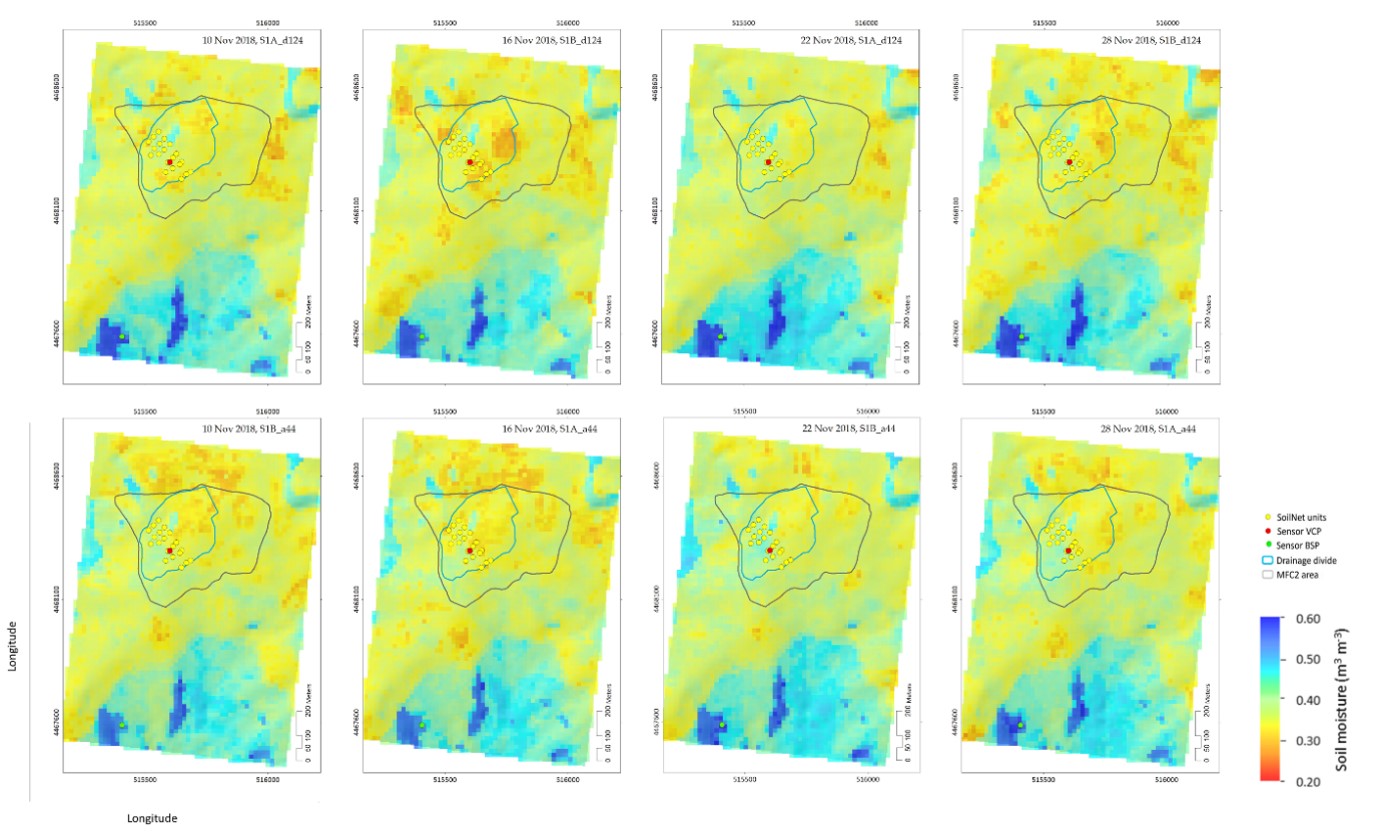
From the abstract: Reliable near-surface soil moisture (θ) information is crucial for supporting risk assessment of future water usage, particularly considering the vulnerability of agroforestry systems of Mediterranean environments to climate change. We propose a simple empirical model by integrating dual-polarimetric Sentinel-1 (S1) Synthetic Aperture Radar (SAR) C-band single-look complex data and topographic information together with in-situ measurements of θ into a random forest (RF) regression approach (10-fold cross-validation). Firstly, we compare two RF models’ estimation performances using either 43 SAR parameters (θNovSAR) or the combination of 43 SAR and 10 terrain parameters (θNovSAR+Terrain). Secondly, we analyze the essential parameters in estimating and mapping θ for S1 overpasses twice a day (at 5 a.m. and 5 p.m.) in a high spatiotemporal (17 × 17 m; 6 days) resolution. The developed site-specific calibration-dependent model was tested for a short period in November 2018 in a field-scale agroforestry environment belonging to the “Alento” hydrological observatory in southern Italy. Our results show that the combined SAR + terrain model slightly outperforms the SAR-based model (θNovSAR+Terrain with 0.025 and 0.020 m3 m−3, and 89% compared to θNovSAR with 0.028 and 0.022 m3 m−3, and 86% in terms of RMSE, MAE, and R2). The higher explanatory power for θNovSAR+Terrain is assessed with time-variant SAR phase information-dependent elements of the C2 covariance and Kennaugh matrix (i.e., K1, K6, and K1S) and with local (e.g., altitude above channel network) and compound topographic attributes (e.g., wetness index). Our proposed methodological approach constitutes a simple empirical model aiming at estimating θ for rapid surveys with high accuracy. It emphasizes potentials for further improvement (e.g., higher spatiotemporal coverage of ground-truthing) by identifying differences of SAR measurements between S1 overpasses in the morning and afternoon.
Full article: Schönbrodt-Stitt, S.; Ahmadian, N.; Kurtenbach, M.; Conrad, C.; Romano, N.; Bogena, H. R.; Vereecken, H.; Nasta, P. Statistical exploration of Sentinel-1 data, terrain parameters and in-situ data for estimating the near-surface soil moisture in a Mediterranean agroecosystem. Frontiers in Water2021, 3:655837. doi:10.3389/frwa.2021.655837