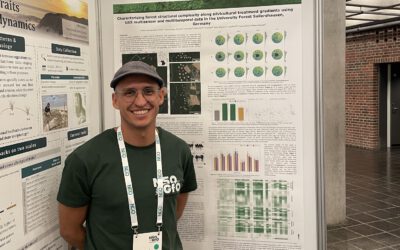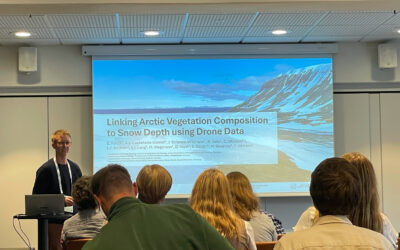
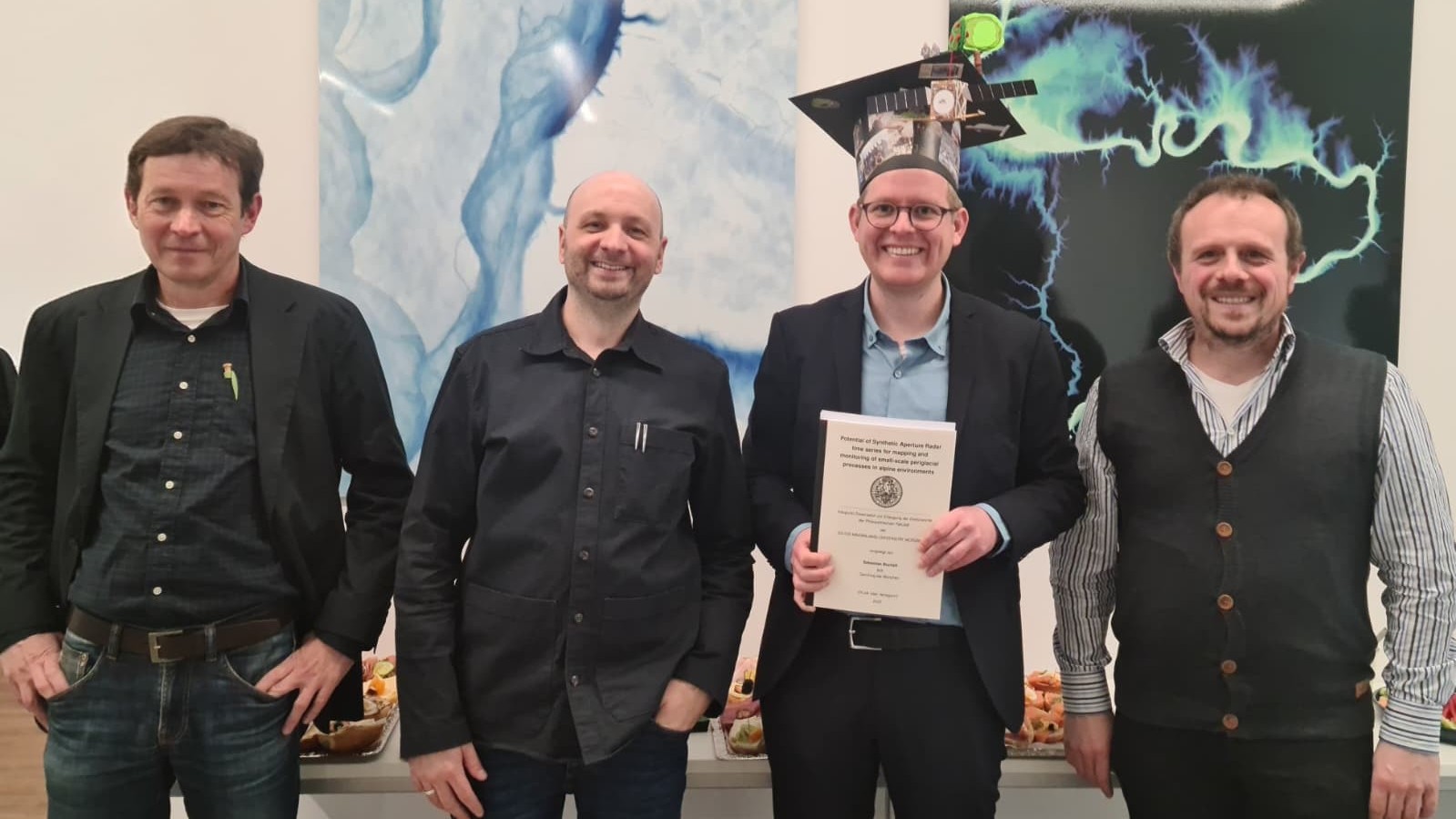

We are very pleased to congratulate our PhD student Sebastian Buchelt on his successful defense of his dissertation, “Potential of Synthetic Aperture Radar time series for mapping and monitoring of small-scale periglacial processes in alpine environments.” His work represents an important step forward in understanding how remote sensing can support long-term monitoring of fragile alpine permafrost systems.
Sebastian’s research demonstrates that Sentinel-1 SAR time series can reliably detect snowmelt phases and characterize periglacial surface dynamics across the European Alps. A central contribution of the thesis is the development and application of an open-source DInSAR workflow for multi-orbit Sentinel-1 data. By combining satellite-based deformation measurements with geophysical electrical resistivity tomography (ERT), he was able to reveal systematic relationships between subsurface conditions, geomorphological context, and observed surface movement patterns.
The results show that relatively stable, talus-connected rock glaciers are particularly well suited for monitoring rock glacier velocity (RGV), a key parameter of the essential climate variable Permafrost. In contrast, areas shaped by former glacial–periglacial interaction tend to be dominated by subsidence and seasonal degradation processes, making them less suitable for consistent velocity monitoring. DInSAR-derived displacement fields, movement direction, and seasonal signals allow a detailed delineation of active permafrost creep zones and even the identification of previously unrecognized subunits within complex landforms.
Overall, the integration of SAR time series and geophysical data provides a powerful framework for large-scale, long-term observation of alpine permafrost and its response to climate change. Sebastian’s work highlights the value of open, reproducible remote-sensing workflows and strengthens the scientific basis for monitoring mountain environments that are highly sensitive to warming.
We warmly congratulate Sebastian on this achievement and look forward to seeing how his research continues to influence periglacial and cryosphere studies in the years to come.