new article: Building capacity in remote sensing for conservation: present and future challenges

new article: Building capacity in remote sensing for conservation: present and future challenges

October 21, 2016

palumbo_rsec_2016Our new article on the importance of remote sensing training is published in RSEC, lead by Ilaria Palumbo from JRC titled “Building capacity in remote sensing for conservation: present and future challenges”.

from the abstract: Remote sensing (RS) has made significant contributions to conservation and ecology; however, direct use of RS-based information for conservation decision making is currently very limited. In this paper, we discuss the reasons and challenges associated with using RS technology by conservationists and suggest how training in RS for conservationists can be improved. We present the results from a survey organized by the Conservation Remote Sensing Network to understand the RS expertise and training needs of various categories of professionals involved in conservation research and implementation. The results of the survey highlight the main gaps and priorities in the current RS data and technology among conservation practitioners from academia, institutions, NGOs and industry. We suggest training to be focused around conservation questions that can be addressed using RS-derived information rather than training pure RS methods which are beyond the interest of conservation practitioners. We highlight the importance of developing essential biodiversity variables (EBVs) and how this can be achieved by increasing the RS capacity of the conservation community. Moreover, we suggest that open-source software is adopted more widely in the training modules to facilitate access to RS data and products in developing countries, and that online platforms providing mapping tools should also be more widely distributed. We believe that improved RS capacity among conservation scientists will be essential to improve conservation efforts on the ground and will make the conservation community a key player in the definition of future RS-based products that serve conservation and ecological needs.

Palumbo, I., Rose, R. A., Headley, R. M. K., Nackoney, J., Vodacek, A. and Wegmann, M. (2016), Building capacity in remote sensing for conservation: present and future challenges. Remote Sens Ecol Conserv. doi:10.1002/rse2.31

follow us and share it on:

you may also like:

Teaching activities in the Arctic: EORC at UNIS on Svalbard

Teaching activities in the Arctic: EORC at UNIS on Svalbard

It started a few years ago, when Mirjana Bevanda built up a collaboration with partners at UNIS, the University Centre in Svalbard. Jakob Schwalb-Willmann joined soon after, and today a growing group from EORC heads north to teach there, including Antonio...

A First Get-Together with the New EAGLE Generation 🦅

A First Get-Together with the New EAGLE Generation 🦅

A new EAGLE generation means new faces, new ideas, and the start of another journey in Earth Observation. And what better way to kick things off than with a relaxed evening at the pub? Our first social event brought together the new students, older EAGLE generations,...

An Evening with Professor Jarugu Narasimha Moorthy

An Evening with Professor Jarugu Narasimha Moorthy

It was a pleasure to have dinner with Professor Jarugu Narasimha Moorthy, who received an honorary doctorate from the Faculty of Chemistry and Pharmacy in recognition of his achievements. The ceremony took place on 29 September 2026 in the Chemistry Central Building....

Ecology or Sampling Bias? A Roadside Perspective on Invasion Risk

Ecology or Sampling Bias? A Roadside Perspective on Invasion Risk

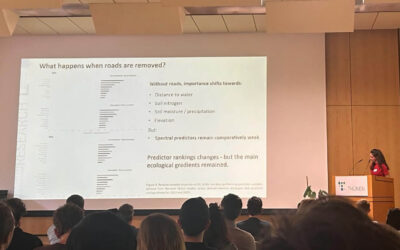
At the 2026 annual meeting of the AK Fernerkundung (German Working Group on Remote Sensing), which was hosted by the Thünen Institute in Braunschweig, our EORC team member Dr. Insa Otte presented research results on sampling bias in species distribution models in...

bzgl. Art. 50 Verordnung (EU) 2024/1689 (AI Act):

Überwiegend werden eigene originäre Texte und Bilder des EORC genutzt, jedoch sind einige Inhalte von blog post Texten teilweise mit Hilfe von KI überarbeitet worden und einige Bilder sind ganz mit KI erstellt, die jedoch deutlich keine photorealistische Darstellungen abbilden. Aussnahmen sind KI generierte fernerkundliche Datensätze, die explizit für Forschungszwecke mit KI erstellt wurden, hier wird aber durch den assoziierten Text der wissenschaftliche Grund der KI generierten Bilder erläutert.

Share This