
new publication on Green Cities

new publication on Green Cities

July 14, 2021

Hannes Taubenböck and colleagues published their new article “Which city is the greenest? A multi-dimensional deconstruction of city rankings”.

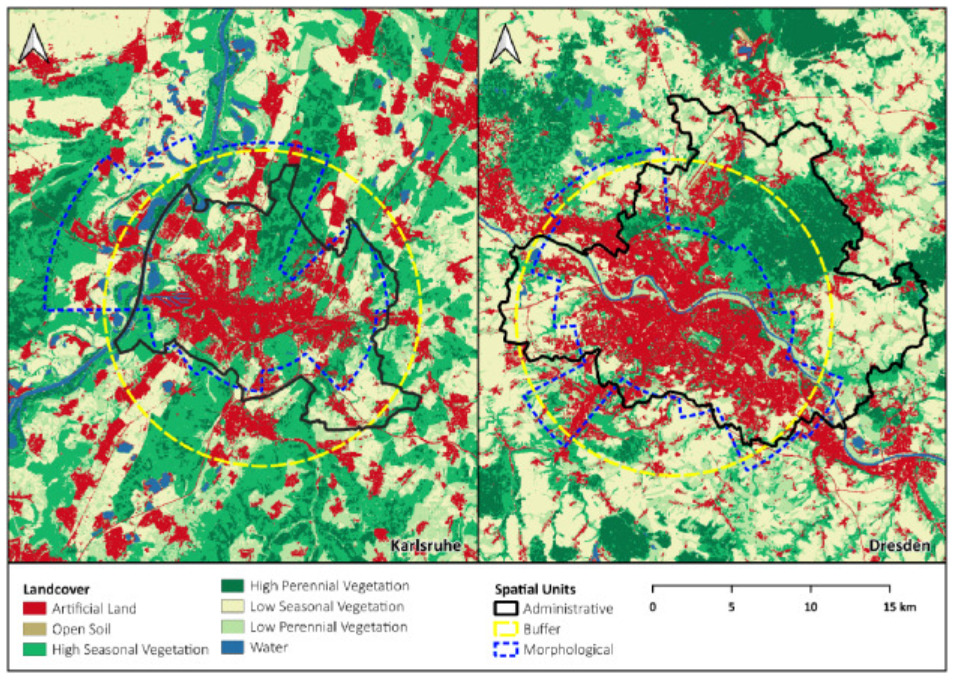
from the abstract: “The question “which city is the greenest” sounds trivial, but in reality, this question contains statistical ambiguities. In this study, we approach this issue by ranking cities by green space shares. However, we do not base our ranking only on one green parameter and the commonly used administrative boundaries. Instead, we broaden access to rankings through several approaches: First, we calculate two parameters, i.e. green space shares and green space per capita. Second, we apply these parameters for two cases: for all green areas as well as for green areas with a minimum size of one hectare. The latter are considered to have an impact on near-home recreation and the local climate. Third, we relate these parameters on the one hand to administrative spatial units constituting the entity ‘city’, but juxtapose these on the other hand with two alternative spatial reference units: a morphological spatial unit that closely encompasses the built-up pattern of the city, and a standardized buffer unit around the city centers. The variability of these manifold rankings obtained by this study makes clear: the rank of one city in a relational system to other cities depends strongly on these parameters and spatial units applied. In our experiments we rank and compare the 80 major cities in Germany. The diversity of results allows to discuss the susceptibility of spatial statistics to ambiguities that may arise from the use of different concepts. By integrating these multidimensional concepts into one final ranking, we propose a strategy for a more holistic and robust approach while revealing uncertainties.”

read more here: https://doi.org/10.1016/j.compenvurbsys.2021.101687

follow us and share it on:

you may also like:

Geometric calibration study of our thermal UAS sensor

Geometric calibration study of our thermal UAS sensor

At the EORC we deploy a range of space-borne and UAS-based sensors for environmental research. While many systems come with established calibration procedures, some of our UAS sensors require dedicated validation and characterization to ensure scientifically reliable...

EORC researchers teaching drone remote sensing at UNIS, Svalbard

EORC researchers teaching drone remote sensing at UNIS, Svalbard

During their current visit to Svalbard, EORC researchers have been teaching UNIS students from all over Europe on how drones can be used for remote sensing in the high Arctic. Invited by our UNIS collaborators Prof. Dr. Simone Lang (UNIS) and Prof. Dr. Eero Rinne...

Upcoming PhD Defense by Sebastian Buchelt on 11th February

Upcoming PhD Defense by Sebastian Buchelt on 11th February

We are happy to announce that our colleague Sebastian Buchelt will defend his PhD thesis "Potential of Synthetic Aperture Radar time series for mapping and monitoring of small-scale periglacial processes in alpine environments" on February 11th at 12 pm at...

Talk by Dr. Philipp on AI at Airbus

Talk by Dr. Philipp on AI at Airbus

Our former EAGLE M.Sc. graduate and EORC PhD graduate Dr. Marius Philipp will give talk about AI, ML and NLP within his current work at Airbus. The talk will take place next Wednesday, 11th of Feb., at 2pm in John-Skilton Str. 4a. It will take place either in seminar...

Urban Earth Observation Lecture: Understanding Cities from Above

Urban Earth Observation Lecture: Understanding Cities from Above

As part of the EAGLE M.Sc. programme, our international students attended this winter term the Urban Earth Observation lecture by EORC professor Hannes Taubenböck. The session offered a comprehensive overview of how remote sensing has evolved into a central tool for...

Share This