
For German version see below
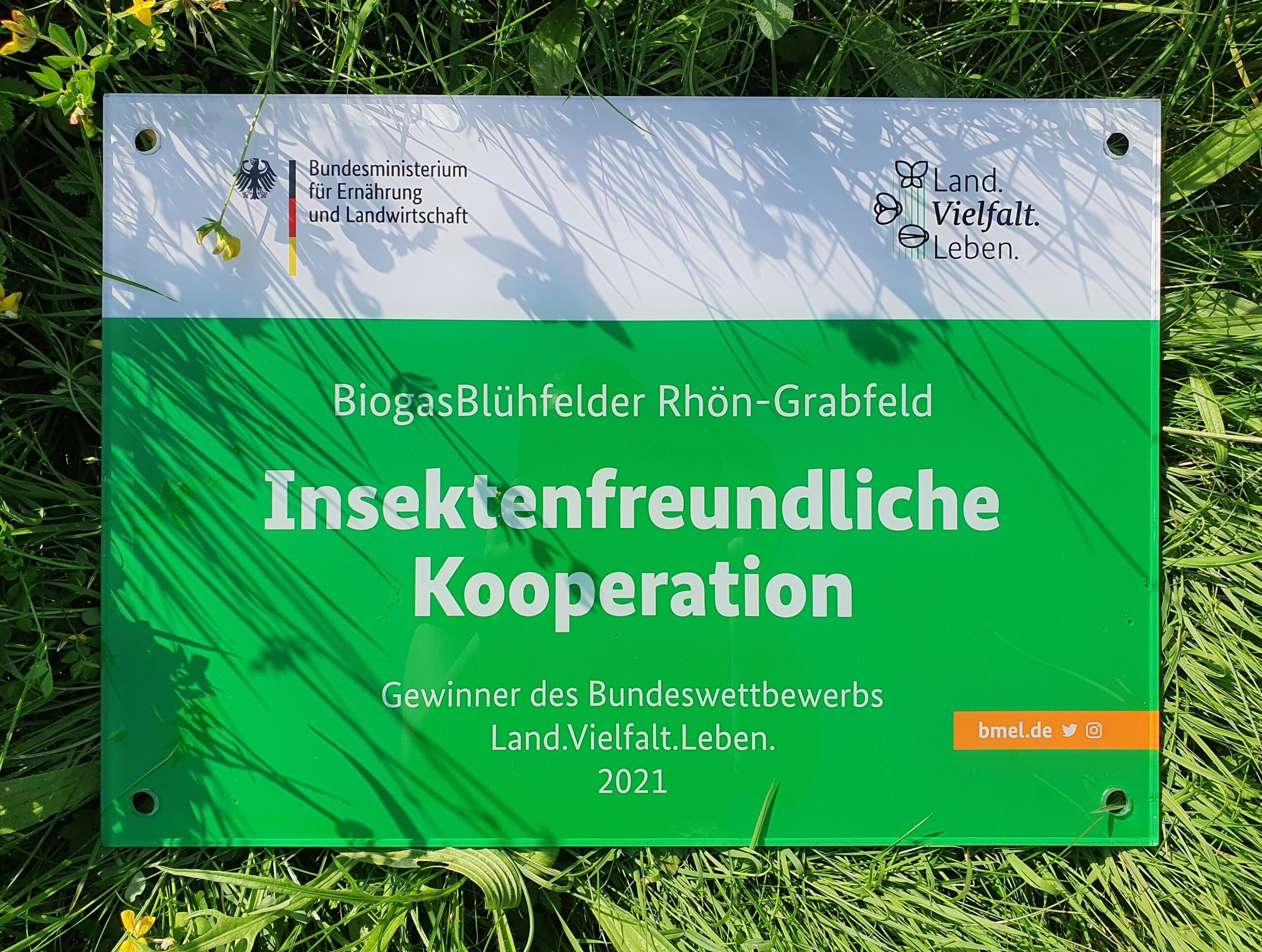
Together with other collaborative partners, the Department of Remote Sensing at the University of Würzburg was awarded for “Insect-friendly Cooperation” by the Federal Ministry of Food and Agriculture (BMEL) in the federal competition for insect-friendly agriculture Land.Vielfalt.Leben on June 22, 2021.
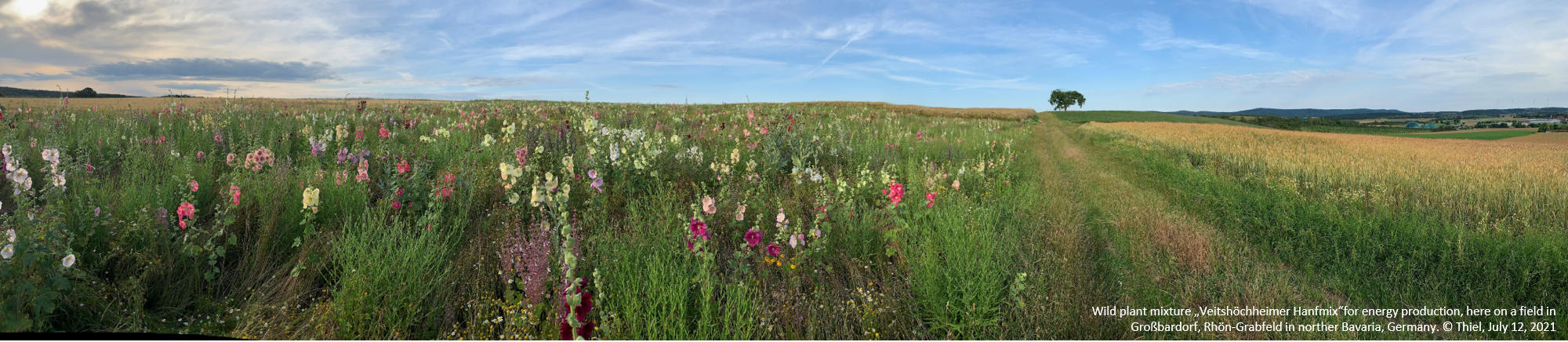
More than 40 farmers cultivate a perennial wild plant mixture, the “Veitshöchheim Hemp Mix” for energy production on more than one hundred hectares, thus making a valuable contribution to the preservation of biodiversity. The Department of Remote Sensing accompanies the project scientifically and investigates the potential of multi-annual Sentinel-2 time series data for yield estimation of the wild plant mixture.
The collaborative partners in the project “BiogasBlühfelder Rhön-Grabfeld” are diverse and come from agriculture (e.g., Bavarian Farmers’ Association and Bavarian State Institute for Viticulture and Horticulture LWG), nature conservation and species protection (e.g., BUND Naturschutz in Bayern e.V., Institut für Biodiversitätsinformation e.V., Deutscher Berufs- und Erwerbsimkerbund e.V.), operators of biogas plants (Bioenergie Bad Königshofen GmbH & Co. KG and Bioenergie Ostheim GmbH & Co. KG as well as Agrokraft Großbardorf GmbH & Co. KG and Agrokraft Streutal GmbH & Co. KG) and municipalities (Kommunale Allianz Fränkischer Grabfeldgau). The project is coordinated by the Agrokraft GmbH.
Gemeinsam mit weiteren Verbundpartnern wurde der Lehrstuhl für Fernerkundung, Universität Würzburg, am 22. Juni 2021 vom Bundesministerium für Ernährung und Landwirtschaf (BMEL) im Bundeswettberwerb für insektenfreundliche Landwirtschaft Land.Vielfalt.Leben für „Insektenfreundliche Kooperation“ ausgezeichnet.
Mehr als 40 Landwirte bauen auf über hundert Hektar eine mehrjährige Wildpflanzenmischung, den „Veitshöchheimer Hanfmix“ zur Energiegewinnung an und leisten damit einen wertvollen Beitrag zur Erhaltung der Artenvielfalt. Der Lehrstuhl für Fernerkundung begleitet das Projekt wissenschaftlich und untersucht das Potenzial von Sentinel-2 Zeitreihen zur Ertragsabschätzung der Wildpflanzenmischung.
Die Verbundpartner im Projekt „BiogasBlühfelder Rhön-Grabfeld“ sind vielfältig und kommen aus der Landwirtschaft (z.B. Bayerischer Bauernverband und Bayerische Landesanstalt für Weinbau und Gartenbau LWG), dem Natur- und Artenschutz (z.B. BUND Naturschutz in Bayern e.V., Institut für Biodiversitätsinformation e.V., Deutscher Berufs- und Erwerbsimkerbund e.V.), Betreibern von Biogasanlagen (Bioenergie Bad Königshofen GmbH & Co. KG und Bioenergie Ostheim GmbH & Co. KG sowie Agrokraft Großbardorf GmbH & Co. KG und Agrokraft Streutal GmbH & Co. KG) und Gemeinden (Kommunale Allianz Fränkischer Grabfeldgau). Koordiniert wird das Projekt von der Agrokraft GmbH.