
staff news: Dr. Insa Otte

staff news: Dr. Insa Otte

m

April 3, 2023

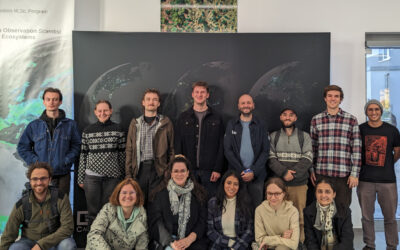
Insa is a postdoctoral researcher and lecturer at the Earth Observation Research (EOR) hub at the University of Würzburg (www.earth-observation.org). Insa has studied Physical Geography, Meteorology and Peace- and Conflict Studies at the University of Marburg with a focus on climatology and tropical montane ecosystems. In 2017, she completed her PhD in Environmental Informatics at University of Marburg, where she analysed atmospheric moisture input along an elevation and disturbance gradient under the impact of global vs. local changes at Mt. Kilimanjaro. She was lucky enough to stay in total 6 months at the foothills of Mt. Kilimanjaro, Tanzania for conducting field work during her PhD.Her passion for mountains, tropical ecosystems and large mammals on the African continent led to various African research projects and now to a habilitation project. Within this project she plans to develop a new remote sensing method for habitat conservation of endangered species in Central and Eastern Africa in close cooperation with the Dian Fossey Gorilla Fund and two National Parks in Ruanda, namely Akagera and Nyungwe National Park.Mainly, Insa is focusing on two research lines: (i) conservation of tropical habitats and (ii) improving and providing easier access to large amounts of earth observation data as scientific coordinator of the Data Cube (https://datacube.remote-sensing.org) Team at EOR.She is involved in projects in southern, western and eastern Africa – all of them also including capacity building of our project partners and beyond.

follow us and share it on:

you may also like:

Thermal Drone Data Acquisitions: CalVal project with Informatics

Thermal Drone Data Acquisitions: CalVal project with Informatics

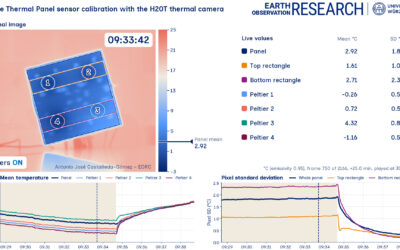
Thermal cameras on drones look very good - visually. They show us temperature of our study objects be it stressed trees, warm patches in a city or active fires. But we do not yet know for sure how far we can trust the temperature values they deliver especially when...
Würzburger Förderpreis awarded to our URBAN:Pulse project

Würzburger Förderpreis awarded to our URBAN:Pulse project

“A remote sensing scientist, a social geographer, an informatics researcher, a sports researcher, a psychologist, a linguist and an economist meet ... what sounds like the start of a joke, was the start of a great interdisciplinary research project.” That’s how Hannes...

Annual Meeting of the NetCDA consortium

Annual Meeting of the NetCDA consortium

On November 3-4, 2026, the NetCDA II (European Academic Network for Capacity Development in Climate Change Adaptions in Africa) project network of 12 German academic partners met at the EORC for their annual meeting. We welcomed our new German research institutions on...

Mainpost reported on Stefan Dech’s Bavarian State Medal

Mainpost reported on Stefan Dech’s Bavarian State Medal

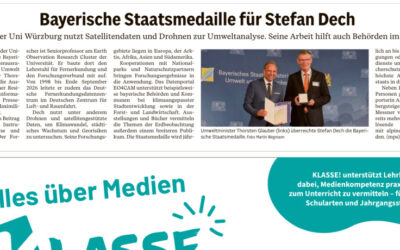
We’re happy to see that Mainpost, our local newspaper, also reported on the Bavarian State Medal for Outstanding Services to the Environment. Stefan Dech received it on October 21 at the Munich Residenz, and Environment Minister Thorsten Glauber gave the laudatory...

UrbanPulse in the Mainpost, and invitation to the festivities

UrbanPulse in the Mainpost, and invitation to the festivities

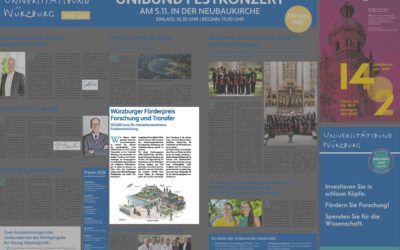
If you open the printed Mainpost today, keep an eye out for the Universitätsbund Würzburg’s invitation to the Festkonzert. Among the topics on the page, there’s one we’re rather proud of: our newly funded project URBAN:Pulse, which will be officially celebrated at the...

bzgl. Art. 50 Verordnung (EU) 2024/1689 (AI Act):

Überwiegend werden eigene originäre Texte und Bilder des EORC genutzt, jedoch sind einige Inhalte von blog post Texten teilweise mit Hilfe von KI überarbeitet worden und einige Bilder sind ganz mit KI erstellt, die jedoch deutlich keine photorealistische Darstellungen abbilden. Aussnahmen sind KI generierte fernerkundliche Datensätze, die explizit für Forschungszwecke mit KI erstellt wurden, hier wird aber durch den assoziierten Text der wissenschaftliche Grund der KI generierten Bilder erläutert.

Share This