
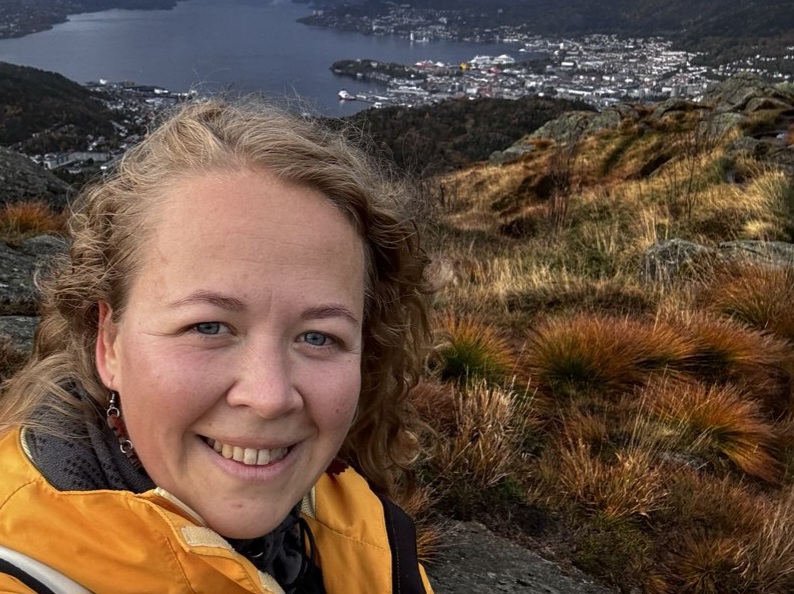

Our EAGLE student Daria recently wrapped up an internship at the University of Bergen in the Remote Sensing research group.
With the support of her supervisor, Dr. Benjamin Abreu Robson, she got to work on the Jostedalsbreen glacier using drone and satellite data. Her focus was on studying changes in glacier elevation, velocity, and roughness, as well as analyzing Snow Line Altitude (SLA) and Snow Cover Ratio (SCR) over the past 20 years. She also explored radar backscatter and glacier elevation changes using various datasets. “Being able to contribute to such meaningful research while working with cutting-edge technology has been truly rewarding,” Daria shared.
In August, she had the incredible opportunity to participate in a field trip to the glacier, where they used drones for hands-on data collection—an unforgettable adventure! “The field trip was definitely a highlight. It felt surreal to see the glaciers up close and collect data in such a dynamic, real-world setting,” Daria reflected.
Beyond the technical work, Daria met so many inspiring scientists and students from around the world. They had great discussions, weekly presentations, and even some fun group activities like hiking and cultural evenings. “The people I met during this internship made the experience even more special. Collaborating with such a diverse and passionate group of individuals was truly inspiring,” she said.
The city of Bergen was the perfect backdrop for this internship. With its stunning mountains and fjords, it’s a haven for nature lovers and hiking enthusiasts. Exploring trails like Mount Fløyen and enjoying breathtaking views made every day special. “Bergen’s natural beauty added a whole new dimension to this experience. Hiking through the mountains was the perfect way to unwind after a busy day of research,” Daria recalled.
Moreover, she was lucky to see the Aurora. “Witnessing the Northern Lights was a magical moment. It felt like nature was celebrating my time in Bergen with me.”
This internship was a mix of learning, connecting, and adventure. Daria is super grateful for the opportunity and all the wonderful memories she’s made. “I’ll always look back on this experience with gratitude. It’s been a perfect blend of professional growth and personal adventure.”
follow us and share it on:

you may also like:
DBU scholar Josipa Subotic
Almost a year ago, Josipa Subotic showed up at EORC as a DBU scholar, and now her stay with us is coming to an end. Josipa spent her time digging into snow cover properties around the Zugspitze, working with Sentinel-2 time series data. Multispectral imagery, lots of...
Collaboration in the Field: Exploring Crop Resilience with Earth Observation
Developing resilient agricultural systems requires close collaboration between research institutions, industry, and agricultural practice. At the Earth Observation Research Cluster (EORC), University of Würzburg, an ongoing joint study with the Bavarian State Research...
GLS-team visits Planetary Health exhibition
One of the aims of Geolingual Studies Geolingual Studies - Geolingual Studies is to ensure effective science communication beyond the scientific community and into the wider society. The Geolingual Studies team was given the opportunity to look at concepts and methods...
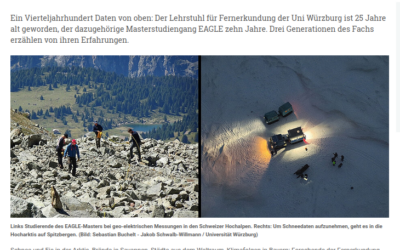
University press covered our anniversaries
Einblick, the University of Würzburg's press medium, published an article on our double anniversary, 25 years of Earth observation research and 10 years of EAGLE M.Sc. program, today. Recently, they has visited us at our EORC to hear about our research and teaching...
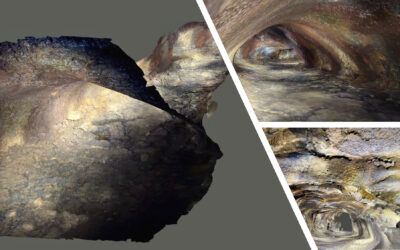
Mapping Lava Tubes on Mauritius with iPhone Pro LiDAR
Lava tube structures on Mauritius are quite hard to survey - tight, dark, and largely inaccessible to classical scanning equipment. As part of ongoing research by Dr. Kim Lea Holzmann (Chair of Animal Ecology and Tropical Biology, University of Würzburg), we're...
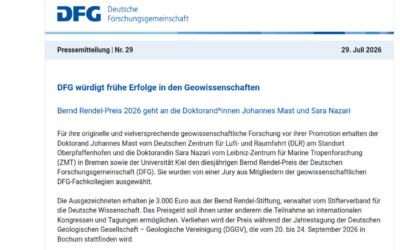
Johannes Mast wins Bernd Rendel Prize
Johannes Mast is awarded the 2026 Bernd Rendel Prize for Geosciences by the Deutsche Forschungsgemeinschaft (DFG) for outstanding research as part of his dissertation. Johannes’s highly interdisciplinary work bridges the Geosciences, Linguistics, Data Science, and...