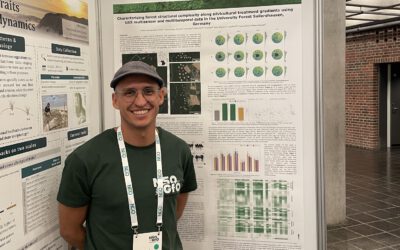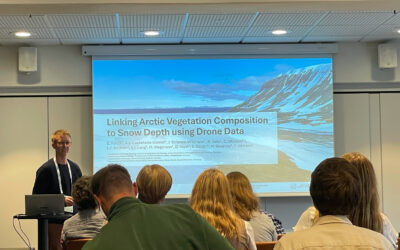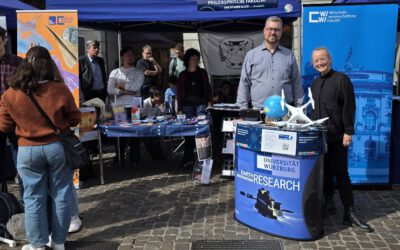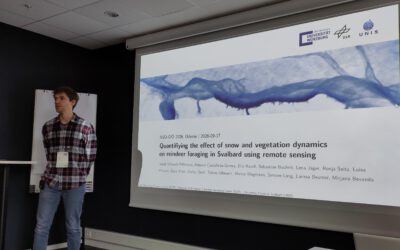
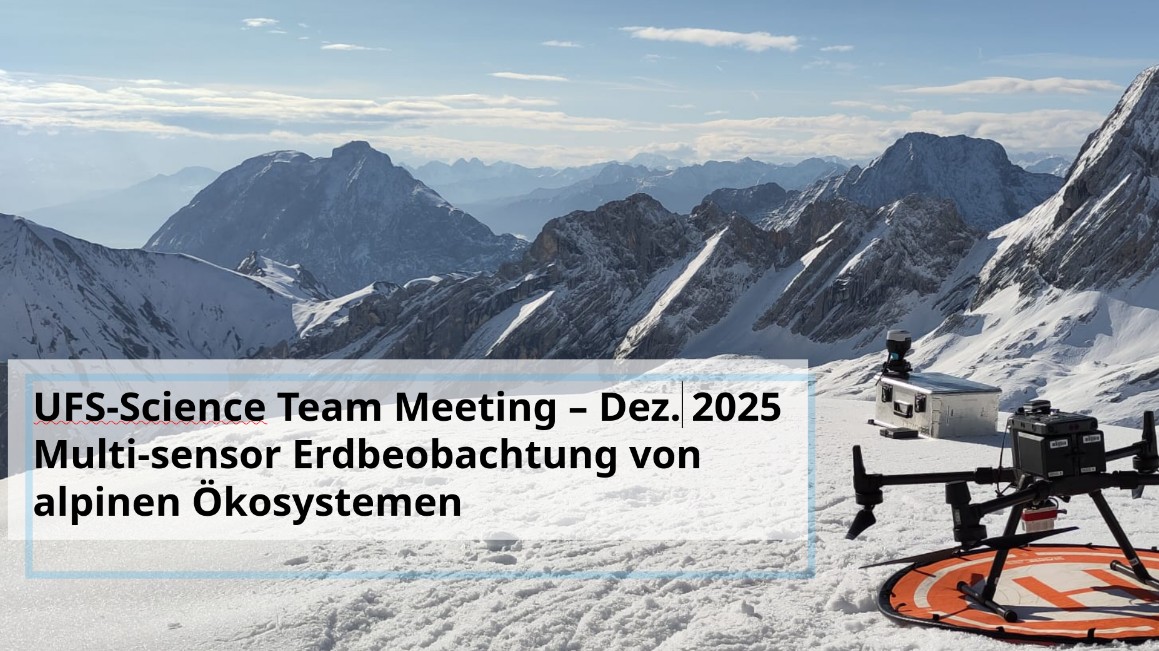

At the recent UFS (Umweltforschungsstation Schneefernerhaus) science team meeting, our group had the opportunity to present current and planned UAS-based research activities in the high-mountain environment surrounding the Zugspitze. The meeting offered an ideal setting to share our progress, discuss technical challenges, and explore collaborative perspectives with colleagues working across a wide range of alpine research topics.
Our presentation focused on the use of LiDAR, thermal, and multispectral UAS sensors to investigate snow properties, as well as applications in geomorphology, biology, and informatics. A central highlight was our first set of LiDAR-based snow height results from a 2000 × 250 m transect on the Zugspitzplatt, surveyed using UAS in combination with in-situ snow measurements.
The initial outcomes are promising:
-
We can map snow surface properties at a spatial resolution of 2 cm, and
-
Achieve vertical snow-height accuracy of approximately ±2 cm using UAS LiDAR..
We also discussed current challenges, particularly the limited validation of snow depth above 2.5 m, as our snow probes only reach this length. As a result, measurements for deeper snowpacks could not be validated during this campaign — a clear point for improvement in future fieldwork.
Beyond the technical insights, the meeting revealed many shared research interests with other UFS partners, including teams working on glacier dynamics, permafrost monitoring, and snow science. These overlaps open encouraging possibilities for future collaboration, both within the UFS science team and across the broader alpine research community.
We look forward to continuing these conversations and strengthening our contributions to high-mountain environmental research.