
Here is the abstract of the paper:
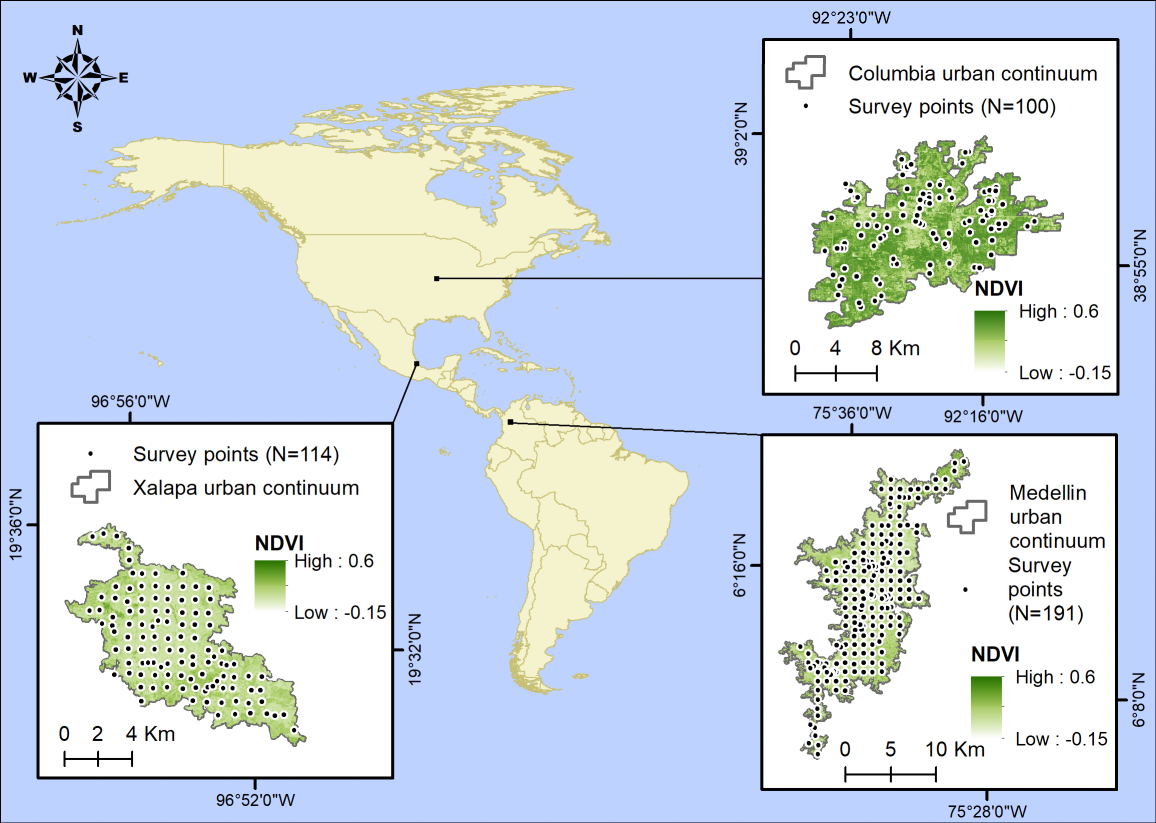
Remote sensing technologies enhance our ability to describe environmental heterogeneity, potentially improving biodiversity predictions. The normalized difference vegetation index (NDVI), a widely used index, along with other vegetation descriptors derived from land cover, often shows positive relationships with bird diversity; however, its reliability as a predictor across contrasting urban contexts remains uncertain. We examined the relationships between the NDVI, woody vegetation cover, and bird species richness across three cities—Columbia (USA), Xalapa (Mexico), and Medellín (Colombia)—using a city-wide, multi-scale approach, based on Landsat-8 and Sentinel-2 satellite imagery, with buffer distances of 50, 100, 200, and 400 m. The NDVI consistently showed significant positive relationships with bird species richness, except at the 50 m buffer in Columbia (Sentinel-2 satellite), where the relationship was close-to-significant (p = 0.073). Woody vegetation cover also showed significant positive relationships with bird species richness, except in Columbia, where woody vegetation cover was positively associated with bird species richness at the 200 and 400 m buffers but negatively associated at the 50 and 100 m buffers, with all relationships for this metric being non-significant. The proportion of variability in bird species richness associated with the NDVI or woody vegetation cover remained, on average, below 28 %, varying by city, vegetation metric, spatial resolution, and buffer distance. Despite the NDVI and woody vegetation cover being potential key drivers of bird diversity, our findings highlight the need for caution when interpreting ecological patterns solely based on remote sensing-derived vegetation radiometric indices. This caution is particularly relevant when using such indices for landscape and biodiversity monitoring to inform urban planning and conservation efforts.
Here is the link to the full paper: https://doi.org/10.1016/j.ufug.2025.129211