
New publication explores how forest structure shapes beetle communities

New publication explores how forest structure shapes beetle communities

February 13, 2026

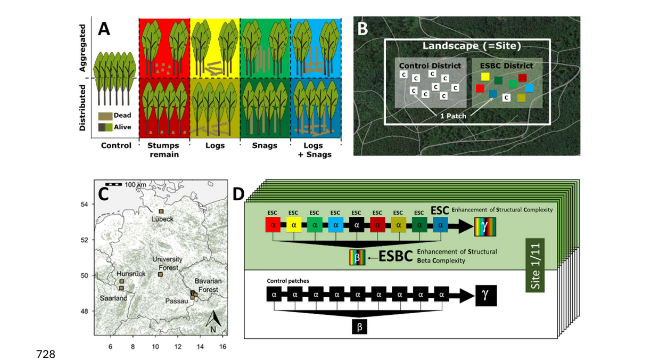
A new peer-reviewed publication investigates how between-patch heterogeneity and old-growth forest attributes influence the structure of beetle metacommunities in temperate forests. The study, led by Dr. Oliver Mitesser from the Biology Department, combines field-based ecological assessment with high-resolution unmanned aerial system (UAS) measurements of forest structure.

Our EORC UAS research group contributed spatially explicit forest structural data that enabled quantitative characterization of canopy complexity and habitat variability across patches. Co-authors from the team include Dr. Mirjana Bevanda, Dr. Jakob Schwalb-Willmann, and Antonio Castaneda-Gomez. By integrating remote sensing with metacommunity ecology, the study advances understanding of how structural legacies of forest management and natural disturbance shape biodiversity patterns.

The findings underscore the ecological relevance of fine-scale structural heterogeneity and demonstrate the value of UAS-derived 3D forest metrics for biodiversity research, monitoring, and conservation planning in temperate ecosystems. The work highlights the importance of interdisciplinary collaboration between ecology and geospatial science in addressing complex questions of habitat structure and species assemblages.

The publication is available here:

https://www.authorea.com/users/961848/articles/1330828-old-growth-attributes-by-chain-saw-how-between-patch-heterogeneity-changes-the-metacommunities-of-beetles-in-temperate-forests?commit=9486ea3c1408d5940db222f76aded36b13c55367


follow us and share it on:

you may also like:

New Technical publication on Regional Planning Smart Solution

New Technical publication on Regional Planning Smart Solution

Urban and regional planning increasingly relies on geospatial technologies to support evidence-based decision-making. Within the European research project FUTURAL – Empowering the Future of Rural Regions, researchers at the Earth Observation Center (EOC) of the...

Drone manufacturer Wingtra visits EORC

Drone manufacturer Wingtra visits EORC

Is it possible to combine the efficiency of a fixed-wing drone with the precision of a laser scanner? That question brought researchers from EORC together with Wingtra, a Swiss company designing and manufacturing fixed-wing UAS, to exchange on UAS research and discuss...

How We Learned to Fly: The Story Behind UAS Research at EORC

How We Learned to Fly: The Story Behind UAS Research at EORC

Every research group that's ever bought a drone has a story about the first one it lost. We're no different. So let's just get that out of the way up front: this is the inside story of how UAS (Unoccupied Aerial System) research grew up at the Earth Observation...

Ticks from Above: UAS Fieldwork for the MONID Habitrack Project

Ticks from Above: UAS Fieldwork for the MONID Habitrack Project

Forest edges are tricky places. They're where woodland meets open ground, where light and shade trade off every few meters, and where, it turns out, ticks tend to do really well. That last bit is exactly why Dr. Ariane Droin, Sofía García de León, Dr. Jakob...

New paper on GDP estimatation from space

New paper on GDP estimatation from space

Reliable and up-to-date sub-national data on the gross domestic product (GDP) data remain scarce in many regions across the globe. However, in a new study we show how high-resolution GDP estimates can be derived from multisource remote sensing and auxiliary inputs...

Share This