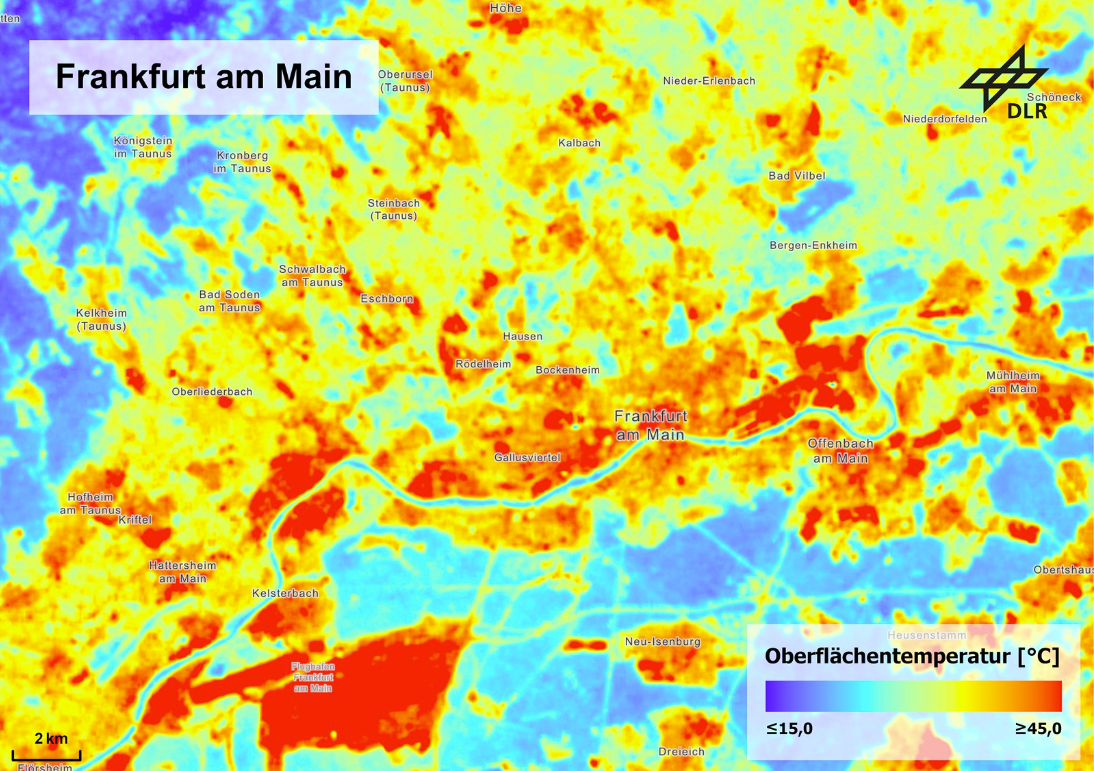

New publication on the influence of city size and urban form on the surface urban heat island effect
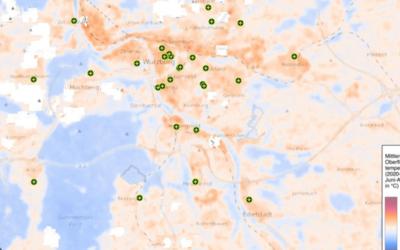
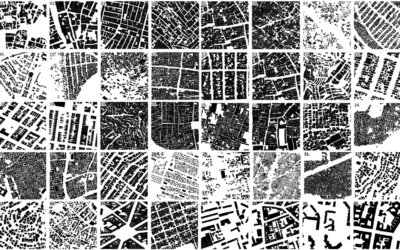
Researchers from CEC-Ingenieure, the Department Georisks & Civil Security (GZS) of the German Aerospace Center (DLR), the Strategic Landscape Planning and Management School of Life Sciences of the Technical University of Munich, and our Earth Observation Research Cluster (EORC) of the University of Würzburg teamed up for a study on the influence of city size and urban form on the surface urban heat island effect. The paper titled “The influence of city size versus urban form on land surface temperature variation and the surface urban heat island effect: A cross-city analysis of German cities” was just published in the journal PLoS One by Regan Doyle, Tobias Leichtle, Stephan Pauleit and Hannes Taubenböck.
Here is the abstract of the paper: This paper seeks to: 1) determine the extent of the intra-urban surface urban heat island (SUHI) effect within German cities using novel urbanization-level data with high spatial resolution, and 2) to assess the influence of city size and urban form using this data together with landscape metrics. The study uses aggregated Landsat LST data to measure the intra-urban SUHI effect across German cities of various population sizes. The first stage of the research utilizes urbanization-level data based on differing thresholds of population and building density, providing a novel method of measuring the correlation between the intra-urban SUHI phenomenon and density. The second stage assesses the impact of urban form by calculating specific landscape metrics using high-resolution land cover data, which is then clustered to identify homogeneous patterns among cities. We show that the SUHI effect can be found within all cities included in the study; however, a positive correlation between increase in city size and increase in heat stress could not be confirmed. The study shows that German urban areas are characterized by specific patterns of urban form that correspond with size, and specific urban forms particularly related to density and shape correspond with higher overall LST.
Here is the link to the full paper: https://journals.plos.org/plosone/article?id=10.1371/journal.pone.0340060
This research is part of our works on urban green and urban heat – for some further reading of recent papers please see here:
- DLR zeigt hohe Hitzebelastung in deutschen Großstädten https://www.dlr.de/de/aktuelles/nachrichten/2025/dlr-zeigt-hohe-hitzebelastung-in-deutschen-grossstaedten
- The world’s largest cities under climate change and their adaptive capacity to rising heat https://www.nature.com/articles/s41598-025-19954-z
- Identification of the potential for roof greening using remote sensing and deep learning https://www.sciencedirect.com/science/article/pii/S0264275125000824
- The impact of urban configuration types on urban heat islands, air pollution, CO2 emissions and mortality in Europe https://www.sciencedirect.com/science/article/pii/S2542519624001207
- Spatially-optimized urban greening for reduction of population exposure to land surface temperature extremes https://www.nature.com/articles/s41467-023-38596-1
- Exposure to urban heat – Citizen Science and remote sensing for the measurement and modeling of indoor and outdoor temperatures and its influencing factors https://www.sciencedirect.com/science/article/pii/S2212095523001165
- Are public green spaces distributed fairly? A nationwide analysis based on remote sensing, OpenStreetMap and census data https://www.tandfonline.com/doi/pdf/10.1080/10106049.2023.2286305
- Does urbanization mean a loss of greenspace? A multi-temporal analysis for Chinese cities https://www.sciencedirect.com/science/article/pii/S0048969723049987
- Green cities cost more green: Examining the impacts of different urban expansion patterns on NPP https://www.sciencedirect.com/science/article/pii/S0360132322011064
- Seasonal and Diurnal Variation of Land Surface Temperature distribution and its Relation to Land Use/Land cover Patterns https://www.mdpi.com/1660-4601/19/19/12738
- Which city is the greenest? A multi-dimensional deconstruction of city rankings https://www.sciencedirect.com/science/article/pii/S0198971521000946