
From September our EORC PI Florian Betz will join the Collegium de Lyon as invited Fellow in Watershed Sciences. During his fellowship, he will collaborate closely with researchers from the H2O’Lyon Graduate School of Integrated Watershed Sciences on the project “From pixels to fluvial processes – using satellite time series for analyzing biogeomorphic dynamics across river systems in Kyrgyzstan and Europe.”
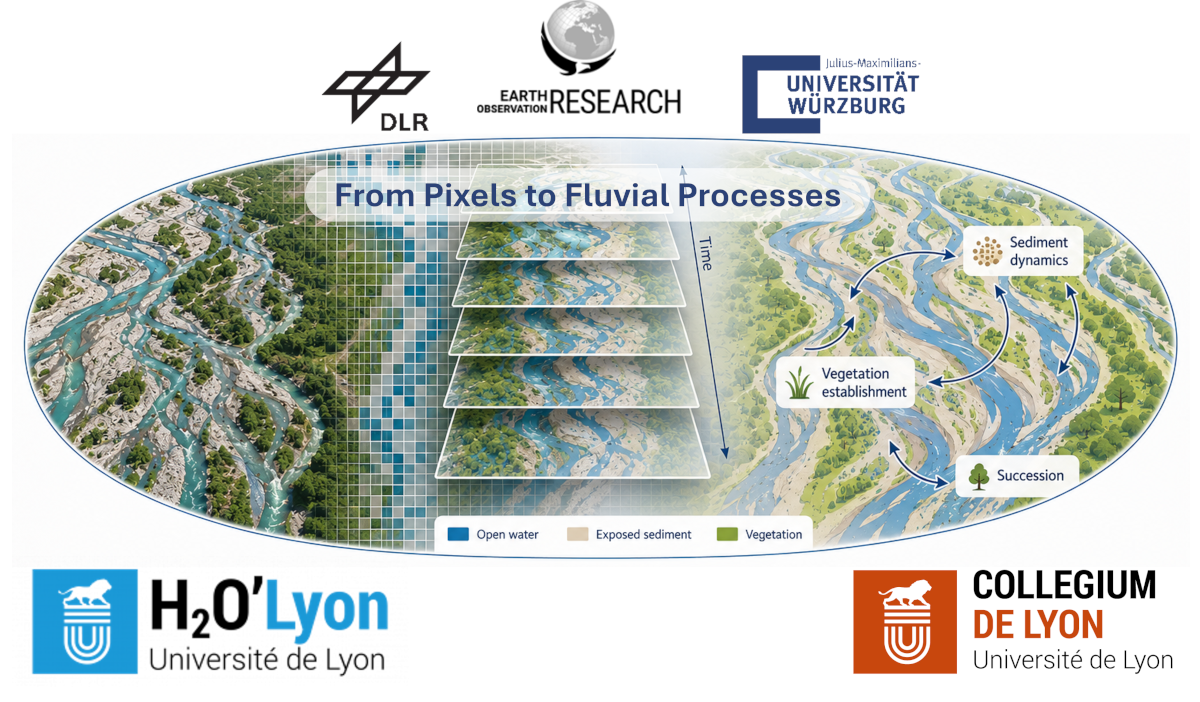
The project addresses a central challenge in river remote sensing: moving beyond static maps towards the observation of the processes that continuously reshape river corridors. Rivers are highly dynamic systems. Channels migrate, sediment bars emerge and disappear, vegetation establishes on newly created surfaces, and floods repeatedly reorganize the landscape. These interactions between hydrology, geomorphology and vegetation create complex riverscapes that support high levels of biodiversity and provide important ecosystem services. Satellite archives now allow many of these dynamics to be observed over years and decades. During the fellowship, Florian Betz will, jointly with colleagues from Lyon and Würzburg, develop workflows that use dense satellite time series to quantify such biogeomorphic processes across entire river systems.
A first focus will be the classification of biogeomorphic succession stages using super-resolution Sentinel-2 imagery. Rather than simply separating water, sediment and vegetation, the aim is to identify the transition from newly exposed sediment surfaces to increasingly established riparian vegetation. The project will then add a temporal perspective by analysing trajectories of coupled hydromorphological and vegetation change. Intra-annual processes such as inundation patterns and vegetation phenology will also be considered. Field observations and UAV data will provide reference information for machine-learning models predicting indicators such as inundation duration, sediment classes, vegetation cover and succession stage.
An important objective is to make these approaches scalable. Cloud-computing workflows will therefore be developed to enable application beyond individual study reaches and ultimately across large river networks. The methods will be evaluated in contrasting river systems in Kyrgyzstan and Europe. Comparing these very different riverscapes will help determine which remotely sensed indicators and modelling approaches can be transferred across regions and which remain strongly dependent on local environmental conditions.
An interdisciplinary environment for river science
The Collegium de Lyon provides an ideal setting for this work. As an institute of advanced studies, it brings together international researchers from different disciplines and institutions, creating space for scientific exchange and the development of new interdisciplinary ideas. The fellowship also offers the opportunity to strengthen collaboration with H2O’Lyon, an interdisciplinary research and training environment centred on integrated watershed sciences. Its broad expertise in hydrology, geomorphology, ecology and water-related research complements the Earth observation perspective developed in Würzburg. This combination is particularly important for river remote sensing. Satellite data can reveal where and when landscapes change, but understanding what these changes mean requires close interaction with process-based river science.
The fellowship will therefore provide an opportunity to connect complementary approaches developed in Lyon and Würzburg, cross-test methods within different river systems, and build new collaborations around the large-scale observation of river dynamics. In the longer term, the project aims to contribute to globally consistent monitoring of riverscapes as dynamic systems rather than static landscape features. By integrating satellite time series, UAV observations, field data, machine learning and river science, the work seeks to move one step closer from observing pixels to understanding fluvial processes.