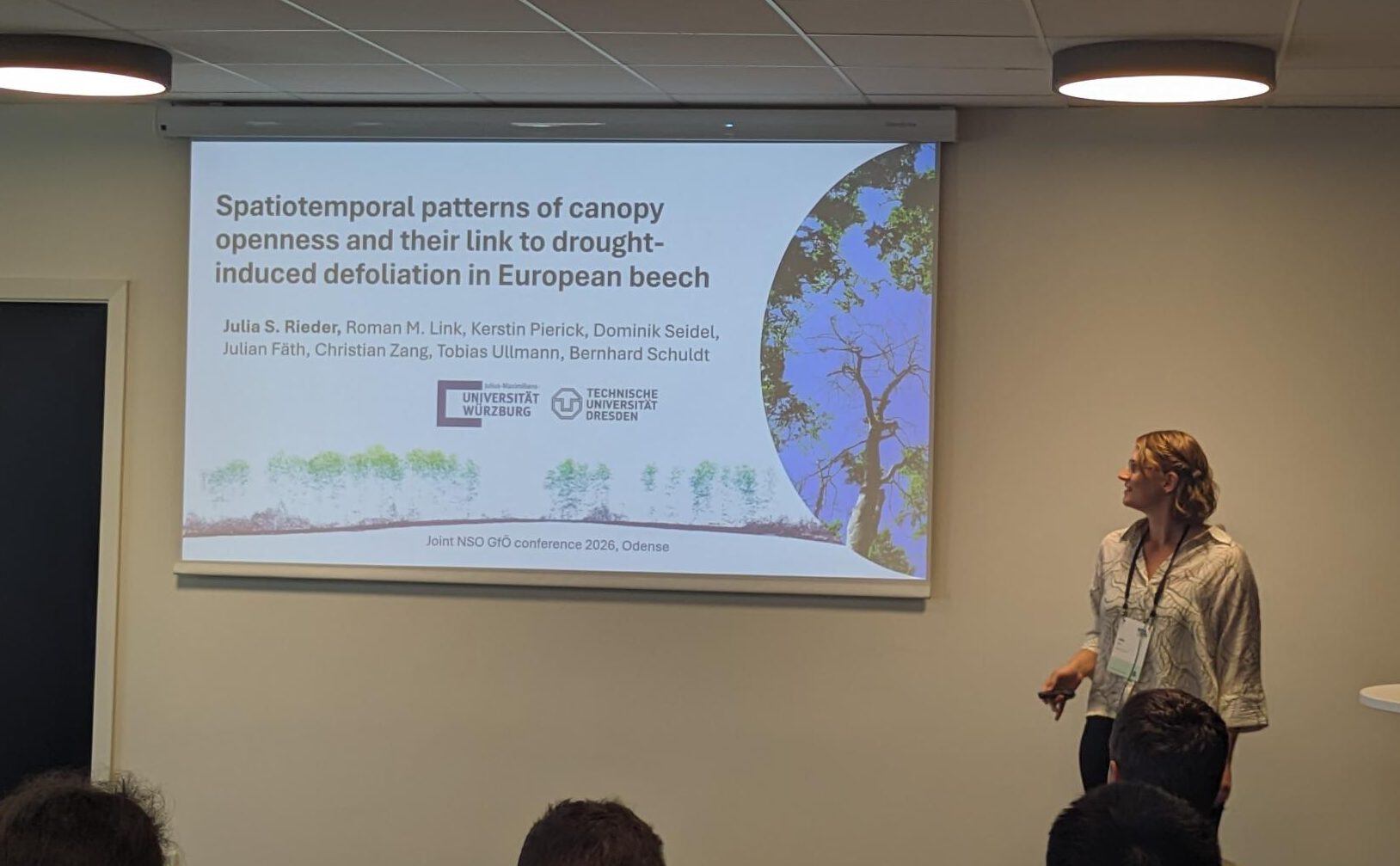

Julia Rieder presents on relationship between beech canopy gap dynamics and defoliation at NSO-GfÖ 2026

Julia Rieder presents on relationship between beech canopy gap dynamics and defoliation at NSO-GfÖ 2026

September 18, 2026

At the joint NSO-GfÖ 2026 conference in Odense, Denmark, EORC postdoc and EO4cam researcher Dr. Julia Rieder gave an interesting talk on the use of airborne laser scanning (ALS) data and orthophoto time series data from airplane campaigns to detect change in canopy openness of European Beech and the link of openness to the tree’s loss of leafs (defoliation) due to drought. The research she presented during the session “Drought” on Wednesday has been part of her PhD studies in the context of the Beechdecline and EO4CAM projects.

Julia showed that canopy gap dynamics can be well observed using orthophoto time series, but the effect of canopy gap size on defoliation of a beech tree differ across the directions of the canopy gaps in relation to the position of a tree: For example, canopy gaps to the north are negatively correlated (possibly due to higher water availability or different microclimate), gaps to the west show positive effect, leading to higher defoliation. These findings were recently published in the journal Forestry. Julia’s talk, titled “Spatiotemporal Patterns of Canopy Openness and Their Link to Drought-Induced Defoliation in European Beech” draw much interest by conference participants.

The conference on research in ecology across various fields has been attended by nearly 1000 researchers. Jointly organised by the Nordic Society Oikos, representing the ecological societies of Denmark, Sweden, Norway, Finland, and Iceland, and the Gesellschaft für Ökologie, representing Austria, Switzerland, and Germany, it offered a unique opportunity to bring together researchers from various ecological research fields and research regions – from forestry topics, agriculture, alpine and arctic ecosystems to experimental ecology, insect research and more. The University of Würzburg was represented both through the contributions of the EORC as well as members of the Unviersity’s bio centre.

follow us and share it on:

you may also like:

EAGLE students present blender for 3D globes & mountains or cities

EAGLE students present blender for 3D globes & mountains or cities

Our EAGLE M.Sc. students are in the middle of a series where they present scientific software for spatial work to each other. The idea is simple. Instead of just hearing about scientific spatial tools from a lecturer, the students pick one software, explore it and...

Photo contest – Würzburg through your lens

Photo contest – Würzburg through your lens

Take part in the Geolingual Studies photo contest and contribute to the exhibition "A Sense of the City". The GLS team wants to see what Würzburg looks like through your lens. Whether your photo depicts a well-known landmark or an overlooked corner, was taken by day...

Stickers have landed

Stickers have landed

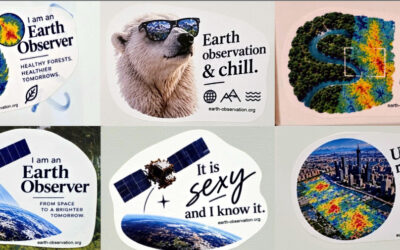
Our new EO stickers arrived last week, and they’re already out in the wild. You may spot them on laptops, water bottles and notebooks around campus. Hex logos, nerdy one-liners about satellites and code, and a few jokes only an Earth observation person will get. And...

Successful MSc Defense by Christina Krause

Successful MSc Defense by Christina Krause

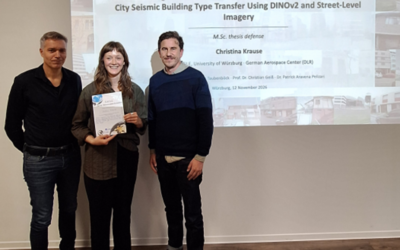
Congratulations to our EAGLE student Christina Krause, who successfully defended her MSc thesis titled "Active Learning and Parameter-Efficient Feature Adaptation for Cross-City Seismic Building Type Transfer Using DINOv2 and Street-Level Imagery" on November 12,...

bzgl. Art. 50 Verordnung (EU) 2024/1689 (AI Act):

Überwiegend werden eigene originäre Texte und Bilder des EORC genutzt, jedoch sind einige Inhalte von blog post Texten teilweise mit Hilfe von KI überarbeitet worden und einige Bilder sind ganz mit KI erstellt, die jedoch deutlich keine photorealistische Darstellungen abbilden. Aussnahmen sind KI generierte fernerkundliche Datensätze, die explizit für Forschungszwecke mit KI erstellt wurden, hier wird aber durch den assoziierten Text der wissenschaftliche Grund der KI generierten Bilder erläutert.

Share This