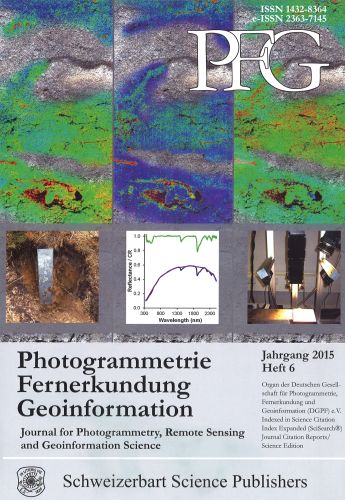

A special issue “Remote Sensing-assisted inventory of forest attributes” edited by Dr. Hooman Latifi (University of Würzburg) and Prof. Dr. Barbara Koch (University of Freiburg) was recently announced by the journal Photogrammetrie-Fernerkundung-Geoinformation (PFG). The PFG is the official international journal of the German Society for Photogrammetry, Remote Sensing and Geoinformation (Impact Factor: 0.55). This special issue aims at covering the state-of-the-art research in forest inventory by using multi-source remote sensing data and methods. The results of ongoing research work published by this issue can possibly support the practitioners and decision makers towards an advanced and extended use of remote sensing in design and implementation of forest inventories on various scales. To this aim, both fundamental and practice-oriented research works are welcome that accommodate one of the following scopes:
- Remote sensing for National Forest Inventories (NFI): possibilities and challenges
- Data assimilation, fusion and integration from multiple remote sensing platforms
- Statistical issues: Bias/Variance trade-off, model setup, distributional properties and dimension reduction techniques
- Multitemporal mapping and monitoring of forest disturbances caused by biotic and abiotic agents
- New spectral, textural and structural indices to support forest inventory
- Species-specific information for forest inventory: data- , tree type- and process-driven influential factors
- Integration of forest phenology in remote sensing-assisted forest inventory
- Remote sensing o forest successional stages
- Modeling forest structural attributes which metrics to derive? Which data to use? Which performance to achieve?
- Forest as a bioenergy pool: How well we are at deriving forest biomass by remote sensing?
- Global models for estimation of Gross Primary Production (GPP) and carbon binding
In addition to original research articles, well-funded review articles are also welcome.
The intended full manuscripts should be sent via email to hooman.latifi@uni-wuerzburg.de. Manuscripts will undergo a standard review process, and the accepted manuscripts will be published at once in the issue 3/2017 of the PFG.
The official announcement can be retrieved here.