
Mapping Paleontology using UAS on cliffs

Mapping Paleontology using UAS on cliffs

m

May 28, 2025

We’ve recently started an exciting research project focused on mapping steep rock slopes that contain valuable paleontological information. Unlike most drone surveys that focus on horizontal ground surfaces, our work is aimed vertically—capturing data along exposed cliff faces where ancient layers of rock are visible.
To do this, we’re using drones equipped with multispectral, hyperspectral, and LiDAR sensors. These tools allow us to collect detailed data about the surface composition and structure of the rock slopes. Our aim is to better understand the geological context of fossil-bearing layers and how they vary across these vertical exposures.
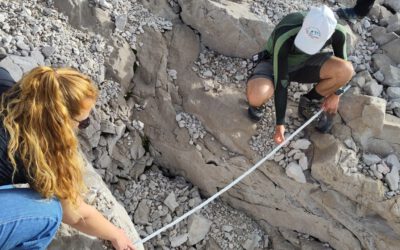
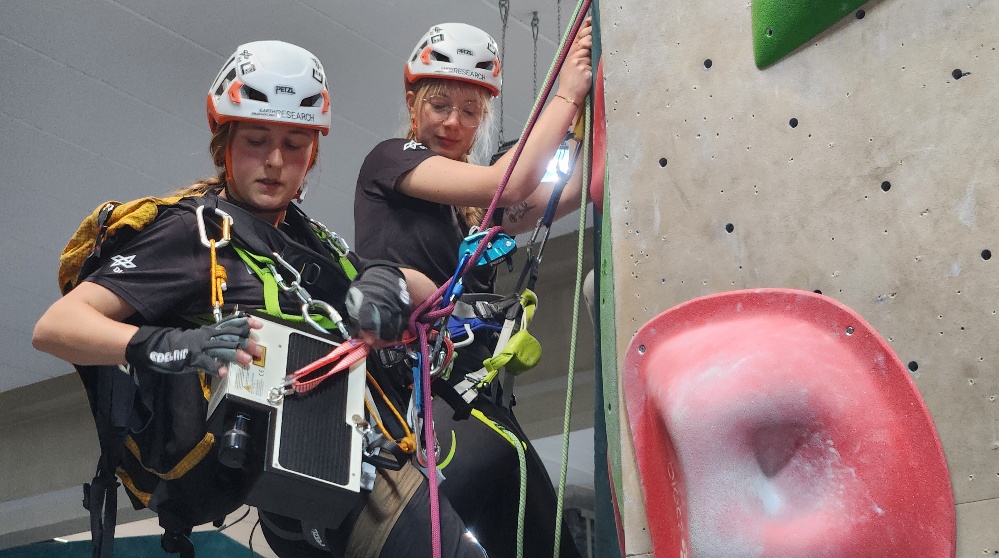
Fieldwork is also an essential part of the project. In order to verify and support the drone data, members of our team—including staff and students—will carry out field measurements directly on the rock face. This means safely lowering themselves onto the steep slopes to collect spectral data by hand. Thanks to our local bouldering gym “Rock In” are we able to test our setup for lowering some of our researchers down the cliff for collecting field data – checking redundant safety approaches and applicability with the sensor equipment is important for the success of our project.
By combining remote sensing and hands-on fieldwork, we hope to improve our understanding of the paleontological record preserved in these challenging, yet scientifically rich environments.

follow us and share it on:

you may also like:

EAGLEs at SANParks – Kruger National Park

EAGLEs at SANParks – Kruger National Park

Our EAGLEs Sebastian Rothaug and Clemens Schömig just finished their 2+ months for the internship/InnoLab in Kruger National Park. The work was done with SANparks, Dr. Coetsee and Dr. Wigley within a year-long collaboration of EORC researcher Dr. Bevanda. The...

Fieldwork in Focus: Our New “Hex Wall” Installation

Fieldwork in Focus: Our New “Hex Wall” Installation

At EORC, the transition from physical reality to digital analysis is a core part of our methodology. While our primary output consists of Earth Observation data the foundation of this work is laid in the field. To document this essential aspect of our research, we...

Super-Test-Site Würzburg consortium meeting

Super-Test-Site Würzburg consortium meeting

The team of our "Super-Test-Site Würzburg" consortium (University of Würzburg, the Karlsruhe Institute of Technology, the Friedrich-Alexander-University Erlangen-Nürnberg, Leibniz-Institute for Länderkunde in Leipzig  and the German Aerospace...

EORC collaborations: Nature and Conservation with Remote Sensing

EORC collaborations: Nature and Conservation with Remote Sensing

Our Earth Observation Research Centre (EORC) at the University of Würzburg is involved in many collaborations applying remote sensing to environmental monitoring, conservation, and ecosystem research. Our work spans mountain ranges, forests, savannahs, and protected...

Share This