
This week, the Arctic System Science Conference 2026 has been taking place in Potsdam. Hosted by the Alfred Wegener Institute (AWI), the conference offers a place for researchers to exchange on past, present and future scientific research of the Arctic system – including oceanic, sea-ice, atmospheric, ecosystem, bio-geochemistry and anthropology research.
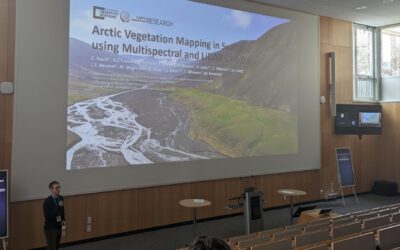
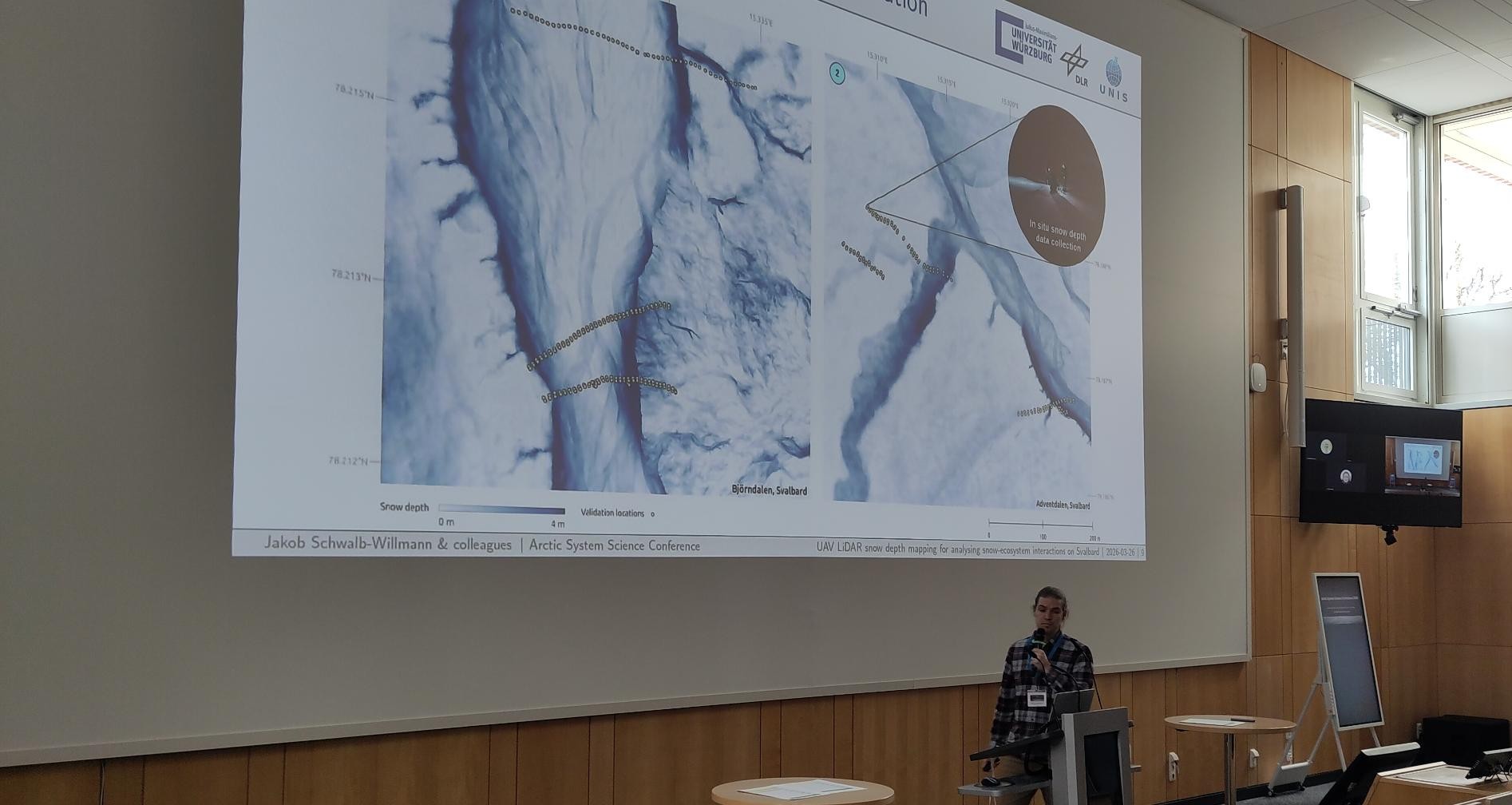
The Earth Observation Research Cluster (EORC) at University of Würzburg contributed with research in the field of terrestrial Arctic ecosystem research. Elio Rauth presented his PhD research on Arctic vegetation mapping in Svalbard using UAS remote sensing. Jakob Schwalb-Willmann presented work on UAV LiDAR snow depth mapping for analysing terrestrial snow-ecosystem interactions on Svalbard, important for quantifying local ecological effects of snow on both vegetation and animal population dynamics and to overall understand the impact of spatio-temporal snow depth evolution on Arctic ecosystem dynamics. The projects are collaborative efforts between researchers at the EORC at University of Würzburg and the University Centre in Svalbard (UNIS), including Mirjana Bevanda (EORC), Antonio Castañeda Gómez (EORC), Elio Rauth (EORC), Sebastian Buchelt (EORC), Larissa Beumer (UNIS), Simone Lang (UNIS) and others.
The conference has been a great opportunity among international researchers working in the Arctic, some of which utilize remote sensing at sea, in the air, and on the land. We are grateful for the opportunity and are looking forward to the next Arctic System Science conference.
From the abstract:
UAV-LiDAR-derived snow depth mapping for analysing snow-ecosystem interactions on Svalbard: Snow depth is a crucial climate variable in Arctic terrestrial ecosystems. Acting as an insulating layer, snow depth regulates subnivean temperature and active layer thickness, protects vegetation from exposure to harsh conditions, and impacts water and soil nutrient availability during melt. Thereby, it affects vegetation dynamics and influences resource availability for wildlife such as reindeer. Simultaneously, snow depth can constrain forage accessibility for herbivores and increase energetic costs of moving and feeding during winter. However, local ecological effects of snow remain poorly understood, largely due to lack of snow depth data at ecologically relevant spatio-temporal scales. In this study, we investigate the potential of spatially continuous UAV-derived snow depth data for analysing snow-ecosystem interactions on Svalbard. We use a fixed-wing, LiDAR-enabled Uncrewed Aerial Vehicle (UAV) to derive snow depth as the difference between surface elevations recorded under snow-covered and snow-free conditions. Employing Real Time/Post Processing Kinematics (RTK/PPK), we achieve a spatial resolution of 2.5 cm for 216.5 ha at cm-scale positional accuracy. Extensive in situ validation temporally synchronous to UAV acquisitions shows high UAV-derived snow depth estimation accuracy (R²=0.93. n=340). Using semi-variogram and autocorrelation function thresholding, we analyse spatial scales of snow depth variation, quantifying folding frequencies at or below 2.5 metres. Additionally, we find that UAV-derived snow depth shows no spatially stable correlation with standard proxies conventionally used in Arctic ecology research when spatially continuous snow data are unavailable. Our findings suggest that UAV-derived snow depth data at cm scale have high potential to improve the understanding of snow depth impacts on Arctic ecosystem dynamics.
Authors: SCHWALB-WILLMANN, Jakob; CASTAÑEDA-GÓMEZ, Antonio José; RAUTH, Elio; BUCHELT, Sebastian; JÄGER, Lena; SEITZ, Ronja; PFLUMM, Luisa; KLEIN, Doris; DECH, Stefan; ULLMANN, Tobias; WEGMANN, Martin; LANG, Simone Iris; BEUMER, Larissa Teresa; BEVANDA, Mirjana.