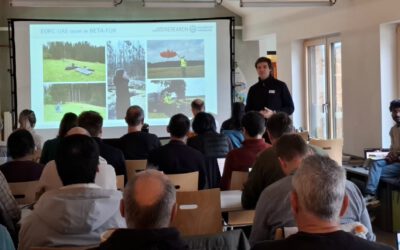


On January 14, 2025, Konstantin Müller will defend his master thesis ” Animal Path Segmentation and Analysis via Deep Neural Network Regression ” at 12:00 in seminar room 3, John-Skilton-Str. 4a.
From the abstract:
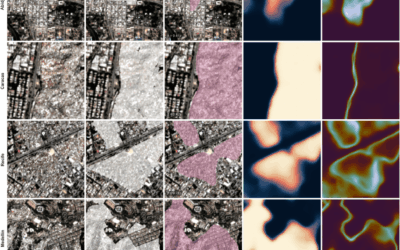
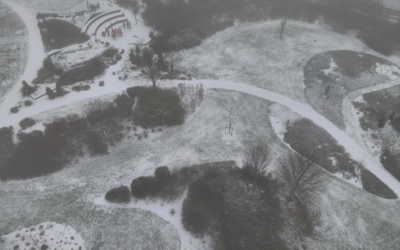
Animals play a vital role for well-functioning ecosystems. Information about their behavior is crucial to understand the health and state of the surrounding environment. Their small- and large-scale movements leave traces visible as individual paths or resting sites in the landscape. With our approach, we utilize Unmanned Aerial Vehicle (UAV) based RGB data to precisely locate and segment animal paths from an aerial view. We receive continuous data of paths and accomplish a broad picture of all animals involved in the movement processes. By observing the animals’ paths instead of the animals themselves, we maximize the applicability of our approach as for traditional methods the process of observing or tagging animals can be frequently constrained by natural protection rules or habitats with poor connectivity regarding chips. The results of the study are primarily applied to the area of the Kruger National Park (KNP), South Africa, for which the understanding of the animals’ behavior plays a key role concerning actions for conservation management. Building upon other well-known line delineation tasks such as road segmentation, this research explores the ability of convolutional neural networks, especially encoder-decoder-based architectures, to map animal paths from UAV data. The project is guided by three research questions regarding (1) the impact of ground truth data generation on segmentation accuracy, (2) the contributions of network enhancements to improve segmentation, and (3) the generalizability of the model to different natural environments.