
Media reports on our work

Media reports on our work

July 16, 2024

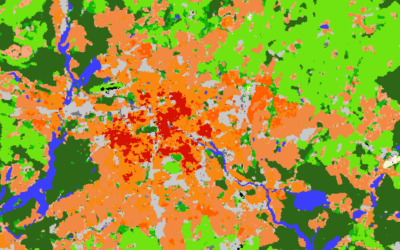
We recently reported on our study published in The LANCET Planetary Health Journal on the impact of urban configuration types on urban heat islands, air pollution, CO2 emissions, and mortality – please see here: https://remote-sensing.org/new-publication-in-the-lancet-planetary-health-journal/.


In this study we analyzed – as part of an international team of researchers – how different urban configuration patterns affect the environment and human health. Here is the link to the open access publication: https://www.thelancet.com/journals/lanplh/article/PIIS2542-5196(24)00120-7/fulltext


Now Der Spiegel, Welt and other media have reported on this study – see e.g. here:

https://www.spiegel.de/wissenschaft/staedte-gegen-hitze-schuetzen-weisse-daecher-kuehlen-besser-als-gruene-a-60679c25-fab4-4274-92ea-78de42ff9f36

https://www.welt.de/wissenschaft/article252370178/Sommer-Weisse-Daecher-und-reflektierende-Materialien-schuetzen-vor-Hitze.html


follow us and share it on:

you may also like:

New publication on the physiology of grapevines

New publication on the physiology of grapevines

We are happy that Marco Lutz, one of our external PhD candidates supervised by Tobias Ullmann, has published a new article in Scientific Reports, together with Daniel Heßdörfer, Tobias Ullmann and Melanie Brandmeier. Measuring how well a grapevine photosynthesizes...

Remote Sensing for Germany #2

Remote Sensing for Germany #2

Last year, we gave an overview of our remote sensing work on environmental issues having a special focus on Germany – https://remote-sensing.org/remote-sensing-for-germany-1/ . To follow on from this, we present today a selection of studies on spatial patterns...

bzgl. Art. 50 Verordnung (EU) 2024/1689 (AI Act):

Überwiegend werden eigene originäre Texte und Bilder des EORC genutzt, jedoch sind einige Inhalte von blog post Texten teilweise mit Hilfe von KI überarbeitet worden und einige Bilder sind ganz mit KI erstellt, die jedoch deutlich keine photorealistische Darstellungen abbilden. Aussnahmen sind KI generierte fernerkundliche Datensätze, die explizit für Forschungszwecke mit KI erstellt wurden, hier wird aber durch den assoziierten Text der wissenschaftliche Grund der KI generierten Bilder erläutert.

Share This