
New Funded Project on Automated Detection of Mining Areas

New Funded Project on Automated Detection of Mining Areas

December 17, 2025

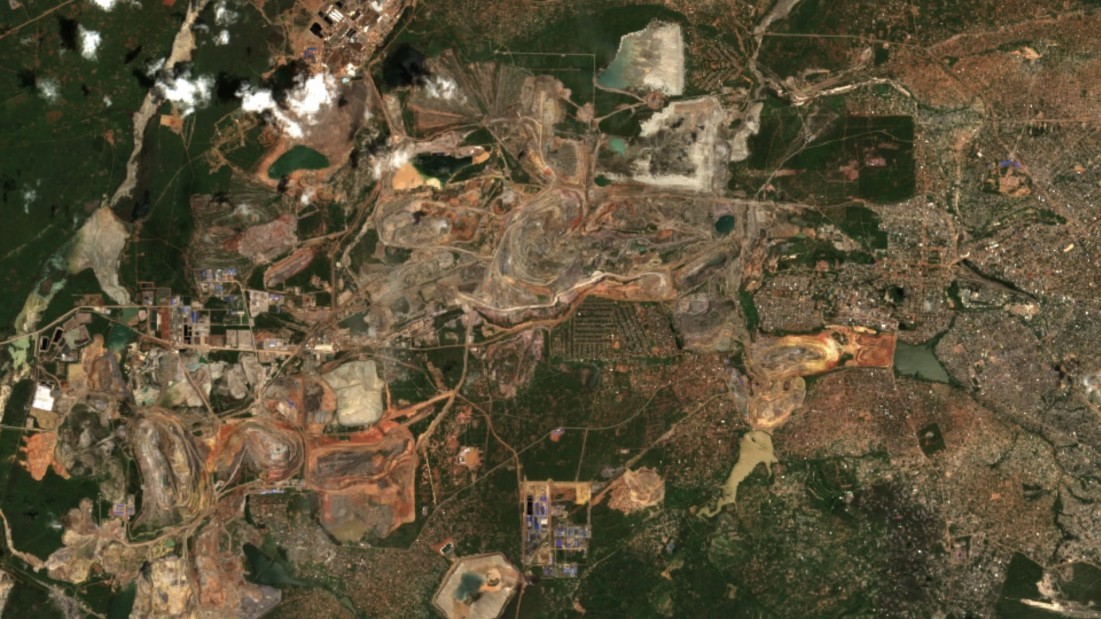
In a newly launched research project funded by the KSB Foundation, we focus on the automated identification of mining areas based on remote sensing data. The aim is to systematically detect large-scale mining activities and to track their spatial and temporal development.

Building on this, the project seeks to quantify the temporal dynamics of mining sites and the associated environmental changes using model-based approaches. This includes, for example, estimates of water consumption, amounts of extracted ore, and other indicators related to land surface change over time.

A particular focus is placed on cobalt, a metal that is essential for the energy transition and is predominantly mined in the southern part of the Democratic Republic of the Congo (DRC). Despite its growing global importance, the environmental and societal impacts of cobalt mining are still insufficiently quantified at larger spatial scales.

In addition to mining activities themselves, the project also addresses settlement dynamics in the vicinity of mining areas. The region around Kolwezi provides a striking example of the close relationship between the expansion of mining areas and surrounding settlement development. Characterizing and quantifying these interactions represents a key component of the project.

By combining remote sensing, spatial analysis, and modeling, the project aims to contribute to a better understanding of mining-related dynamics and to provide a data-driven basis for future environmental and sustainability assessments.

follow us and share it on:

you may also like:

Presentations from EORC and DLR at REALCORP

Presentations from EORC and DLR at REALCORP

At the CORP Planning Conference 2026 this week in Vienna, EORC and DLR contributed various presentations: John Friesen presented a contribution from the EO4CAM project in the form of a conference paper and discussion session titled "Assessing Pedestrian Accessibility...

Farewell to Our Second Cohort of ERASMUS+ Scholars

Farewell to Our Second Cohort of ERASMUS+ Scholars

This winter semester, we had the pleasure of hosting the second cohort of eight ERASMUS+ scholars from Ghana, Rwanda, and South Africa. As their semester at our university comes to an end, we are delighted to celebrate their achievements and bid them a warm farewell....

EORC at the Smart Forest Conference: Research meets Practive

EORC at the Smart Forest Conference: Research meets Practive

This week, our EO4CAM staff Sonja and Julian attended the Smart Forest Conference in Freising, a meeting that brings together researchers, forestry practitioners, and technology developers working at the interface of forest science and digital innovation. Over two...

EO4CAM Data Portal Launched to Support Climate Adaptation in Bavaria

EO4CAM Data Portal Launched to Support Climate Adaptation in Bavaria

New Earth observation platform provides satellite-based information for public authorities and planners A new Earth observation data portal is bringing satellite-derived environmental information closer to climate adaptation planning. On 9 March 2026, the EO4CAM data...

Privacy Policy

Lehrstuhl für Fernerkundung & Lehrstuhl für Urbane Fernerkundung

Erdbeobachtung an der Universität Würzburg

Share This