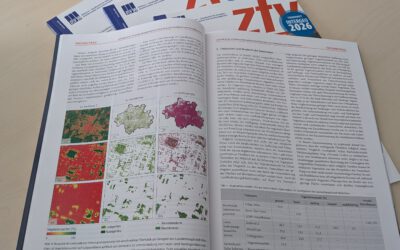
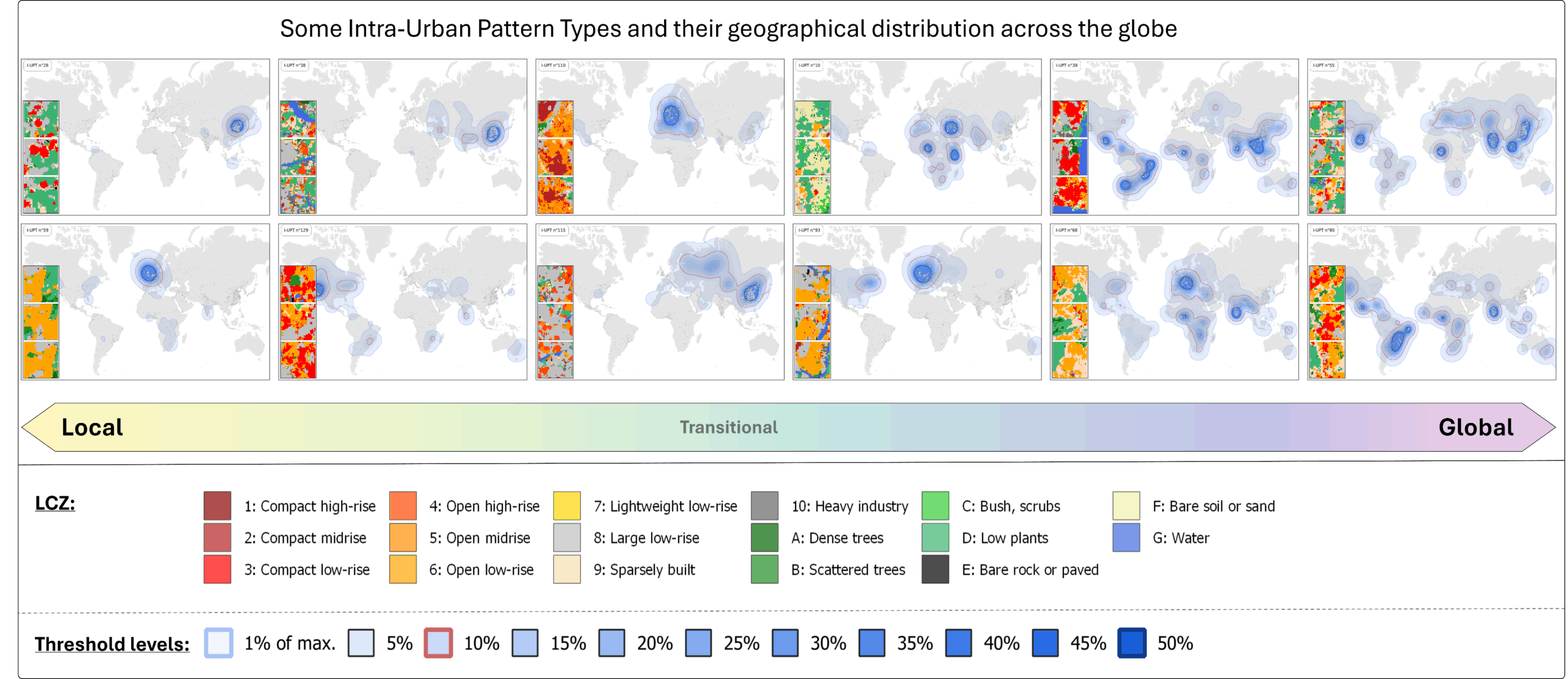

Researchers from our Earth Observation Research Cluster and the Geolingual Studies team of the University of Würzburg, the Earth Observation Center (EOC) of the German Aerospace Center (DLR) in Oberpfaffenhofen, from Data Science in Earth Observation of the Technical University of Munich and from the Munich Center for Machine Learning teamed up for a study on distributions of types of urban fabrics around the world. The paper titled “Distributions of types of urban fabrics around the world: Beyond narratives of global regularities and local specificities” was just published in the journal Applied Geography by Henri Debray, Richard Lemoine Rodríguez, Michael Wurm, Xiao Xiang Zhu and Hannes Taubenböck.
Here is the abstract of the paper: The physical forms of cities emerge from the interplay of diverse processes shaped by various factors, including political, cultural, economic, and geographic influences. As such, this physical aspect, the urban fabric is deeply heterogeneous at multiple levels, from the intra-urban to the global scales. Although peering into these two scales provided the field of urban morphology great insights, the combination of both scales has, to the best of the authors knowledge, never been investigated, mainly because of lack of data. Yet, this combination of such scales could enable the understanding of global and local processes of homogenization or specification of the urban fabric and the way they embed themselves in nowadays urbanization. The recent evolutions in data quality, coverage, comprehensiveness and consistency makes such cross-scaled investigations now possible. Previous work proposed a universal typology of intra-urban patterns relying on a global classification of intra-urban morphology. Based on these results, this study aims to localize the distinct intra-urban patterns across the globe to characterize their geographical distributions. By categorizing these geographical distributions into six main modes, ranging from the most local to the most global, we assess for each type of intra-urban patterns their global spread. This allows to quantify the status quo on the homogeneity or heterogeneity of the global urban fabric. We find that although close to half of the global urban fabric is composed of very widely spread patterns, a non-neglectable number of patterns exist only in very specific regions of the globe. We thus show empirically that in its current status quo, the global urban fabric leans toward a global homogeneity, yet at the same time, local heterogeneities are persistent on a worldwide scale. This informs us about the dissemination of urban planning practices and paradigms and enables us to critically ponder on their driving forces.
Here is the link to the full paper: https://www.sciencedirect.com/science/article/pii/S0143622825002656
The paper is closely linked to previous studies on types of urban fabrics:
- https://www.sciencedirect.com/science/article/pii/S1569843225002572
- https://www.sciencedirect.com/science/article/pii/S0169204623000300
This research is part of our work on global urbanization– we have reported on this research direction in detail: https://remote-sensing.org/studies-on-global-urbanization/