
A new paper titled “The effect of urbanization, scale, and geography on air pollution in India’s cities and districts” was just published in the journal npj Clean Air by Anand Sahasranaman, Nishanth Kumar, Thilo Erbertseder, Michael Wurm, Hannes Taubenböck and Luís M. A. Bettencourt. This collaboration of the researchers from the Madras Complexity Collective in Chennai in India, the Centre for Complex Universität in Chicago ity Science at the Imperial College London in the UK, the Earth Observation Center (EOC) of the German Aerospace Center (DLR), Germany, our Earth Observation Research Cluster (EORC) of the Julius-Maximilians University (JMU) in Würzburg in Germany, the University of Chicago, IL, USA and the Santa Fe Institute, Santa Fe, USA goes back to a long-standing scientific exchange. In 2020, Hannes Taubenböck was invited to give a guest lecture on “Urban Science with a view from Space” at the University of Chicago, USA. In 2024, Luís M. A. Bettencourt was invited to give a guest lecture titled “Using high-precision remote sensing for localizing sustainable development worldwide” at the EOC of the German Aerospace Centre (see https://remote-sensing.org/guest-lecture-by-prof-dr-luis-bettencourt-from-the-university-of-chicago-at-dlr-eoc/).
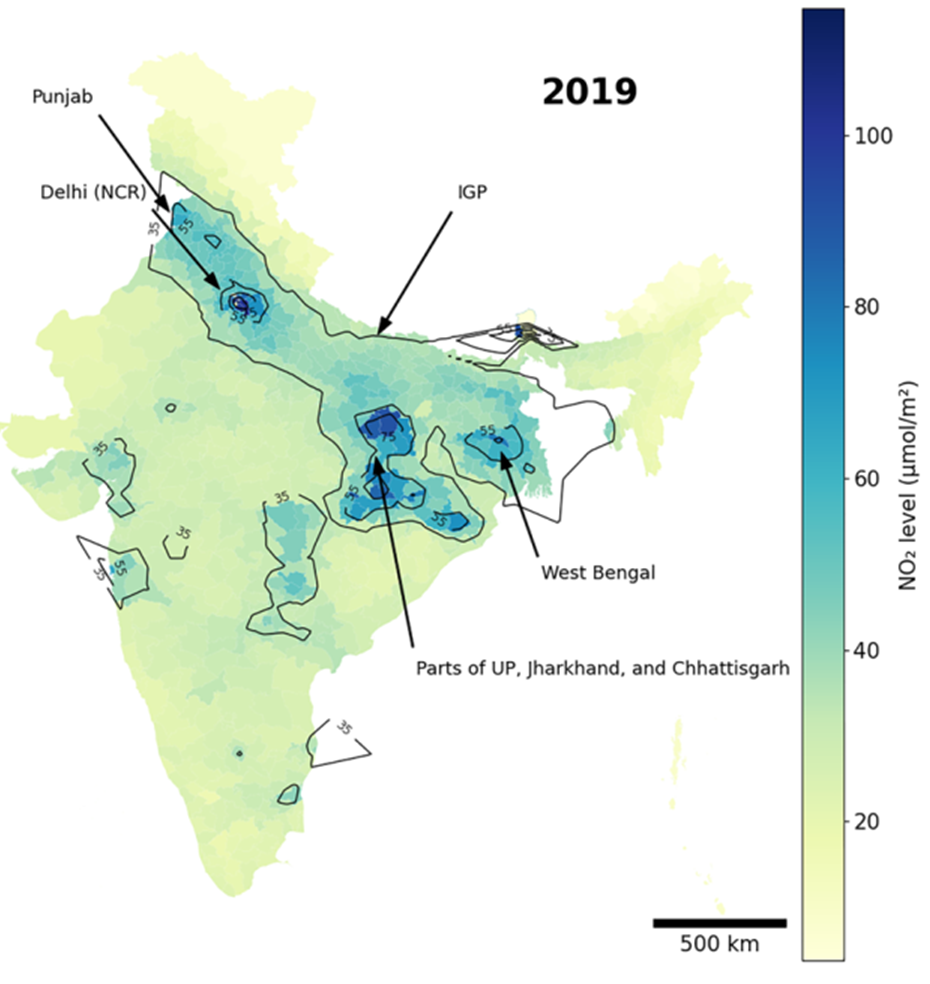
The now jointly published study investigates how urbanization, spatial scale, and geographical factors influence air pollution (PM₂.₅) across Indian cities and districts. Using high-resolution satellite data (e.g., from MODIS and VIIRS) and ground measurements, the authors analyze pollution patterns across different urban-rural gradients and geographic regions. Key findings show that while urbanization generally increases pollution, the relationship is non-linear and varies by region due to differences in topography, climate, and emission sources. Metropolitan areas exhibit higher pollution levels, but smaller towns and rural districts near industrial zones or in enclosed basins can also face severe air quality issues. The study emphasizes that pollution dynamics depend critically on local geography and scale of analysis, highlighting the need for context-specific policies rather than one-size-fits-all approaches. It calls for integrated, spatially resolved air quality management strategies tailored to India’s diverse urban and rural landscapes.