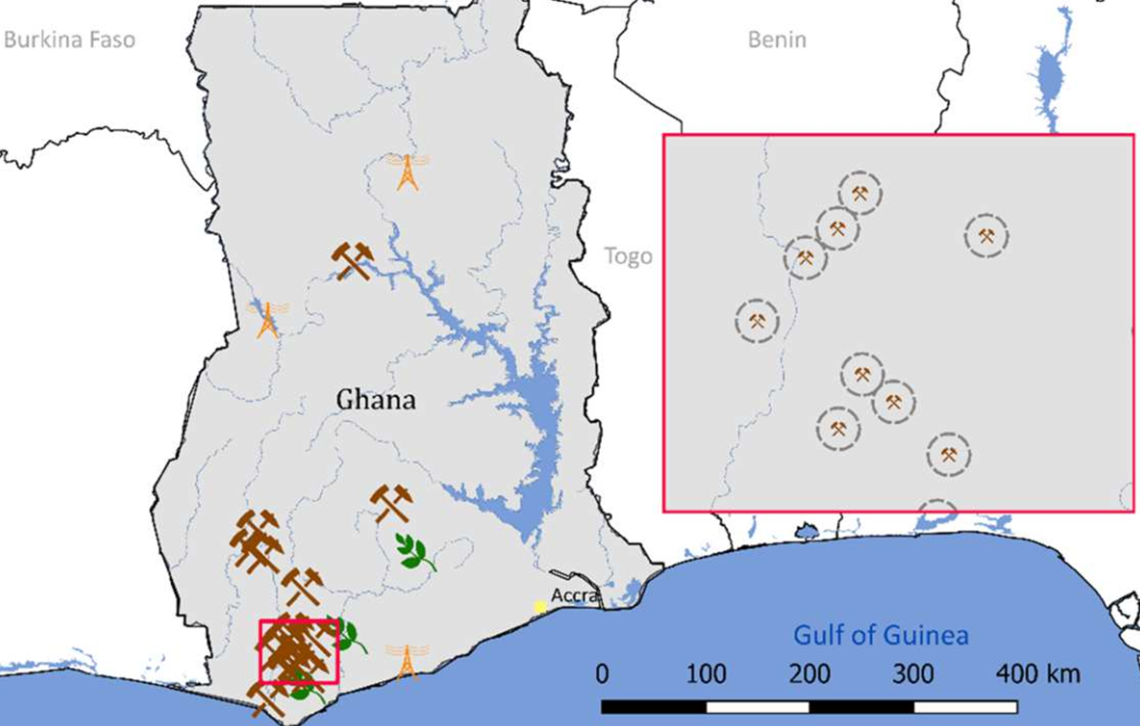

Researchers from our Earth Observation Research Cluster (EORC) here at the University of Würzburg in Germany, the Morgan State University in Baltimore in the USA, the Koforidua Technical University in Koforidua in Ghana, and the Earth Observation Center (EOC) of the German Aerospace Center (DLR) in Germany teamed up for a study on how perceived industrial pollution shapes community evaluation and migration intentions in rural Ghana. The paper titled “How does perceived industrial pollution shape community evaluation and migration intentions in rural Ghana? Integrating household surveys with satellite-based air-quality context” was just published in the Environmental Research Communications journal by Itohan-Osa Abu, Michael Thiel, Chibuike Ibebuchi, Clement Nyamekye, Tobias Ullmann, Jürgen Rauh and Hannes Taubenböck.
Here is the abstract of the paper: Perceived environmental pollution has become a growing concern in rural industrial communities across Ghana, raising questions about how industrial development is evaluated and experienced by local populations. This study investigates how perceptions of industrial pollution shape community
evaluation and out-migration intentions. Using a mixed-methods approach, we combined household survey data from 1,102 respondents across 22 industrial communities with satellite-based pollution measurements from Sentinel-5P. Industrial communities were defined using spatial buffers around major industrial emission sources. Surveys were conducted in English, Pidgin English, and Twi, using stratified random sampling to include both indigenes and migrants. Multivariable logistic regression was used to assess the relationship between perceived pollution types (air, water, noise) and two binary outcomes: intent to migrate and negative community evaluation. Air pollution was the strongest predictor of both outcomes, with respondents who reported it showing significantly higher odds of considering migration (Odds Ratio [OR]=1.57, p<0.05) and more than twice the odds of giving a negative community rating (OR=2.45, p<0.05). Migrant respondents had lower adjusted odds of reporting air pollution than non-migrants (OR=0.62, p<0.001), indicating that migrants were less likely than locals to report air pollution. Reporting of air pollution was also significantly associated with socioeconomic status (p<0.001) and self-employment (p<0.001), indicating that income dynamics and economic activity are associated with environmental awareness. To contextualize perception data, Sentinel-5P observations were analyzed for six atmospheric pollutants. These satellite-derived observations provide regional environmental context for community perceptions rather than causal attribution to individual industrial facilities. Satellite observations revealed significant temporal changes (p<0.05) in methane and dust concentrations between 2018 and 2025. Together, these findings identify statistically significant associations between perceived environmental conditions and social outcomes in industrial host communities.
Here is the link to the full paper: https://iopscience.iop.org/article/10.1088/2515-7620/ae56d8
This study was conducted within the framework of the MIGRAWARE project with funding from the German Federal Ministry of Education and Research (BMBF; FKZ: 01LG2082B).
This research belongs to a group of works in the context of migration in West Africa, see here for related works:
- How Do Rural Industrial Sites Impact Migrant Motives and the Socio-Economic Conditions of Local and Migrant Populations https://www.sciencedirect.com/science/article/pii/S2468227625000171
- The migrant perspective – Measuring migrants’ movements and interests using geolocated tweets https://onlinelibrary.wiley.com/doi/10.1002/psp.2732
- Africa’s digital urban frontier: Inequality in social media activity between consolidated and newly urbanized areas in Africa https://www.sciencedirect.com/science/article/pii/S0143622825001821
- The unseen – An Investigative Analysis of Thematic and Spatial Coverage of News on the Ongoing Refugee Crisis in West Africa https://www.mdpi.com/2220-9964/12/4/175
- Mining-Driven Settlement Dynamics: Evidence from the Cobalt Belt in the Democratic Republic of Congo https://ieeexplore.ieee.org/document/11076051