
New publication: Does NDVI explain patterns of urban bird diversity? Insights from temperate to tropical cities

New publication: Does NDVI explain patterns of urban bird diversity? Insights from temperate to tropical cities

December 19, 2025


The Normalized Difference Vegetation Index (NDVI) is one of the most widely used indicators in remote sensing and environmental research. However, like any index, it has inherent limitations that must be carefully considered when applied to specific ecological questions. In a newly published study, researchers from our Earth Observation Research Cluster (EORC), the University of Helsinki, the National University of Colombia in Medellín, and the University of Missouri formed an interdisciplinary collaboration that integrated expertise in urban ecology and remote sensing to critically assess whether NDVI can reliably serve as a proxy for bird species richness in urban environments, as suggested by previous studies.
Using a combination of satellite-derived vegetation metrics and field-based bird data from temperate and tropical cities, the authors found that NDVI is generally but not consistently positively associated with urban bird species richness. Importantly, NDVI explained less than 28% of the observed variability in species richness across cities and spatial scales. The study therefore concludes that, although NDVI captures ecologically meaningful aspects of urban vegetation and is relevant to biodiversity research, it should not be used as a standalone or reliable proxy for bird species richness in cities.

Here is the abstract of the paper:

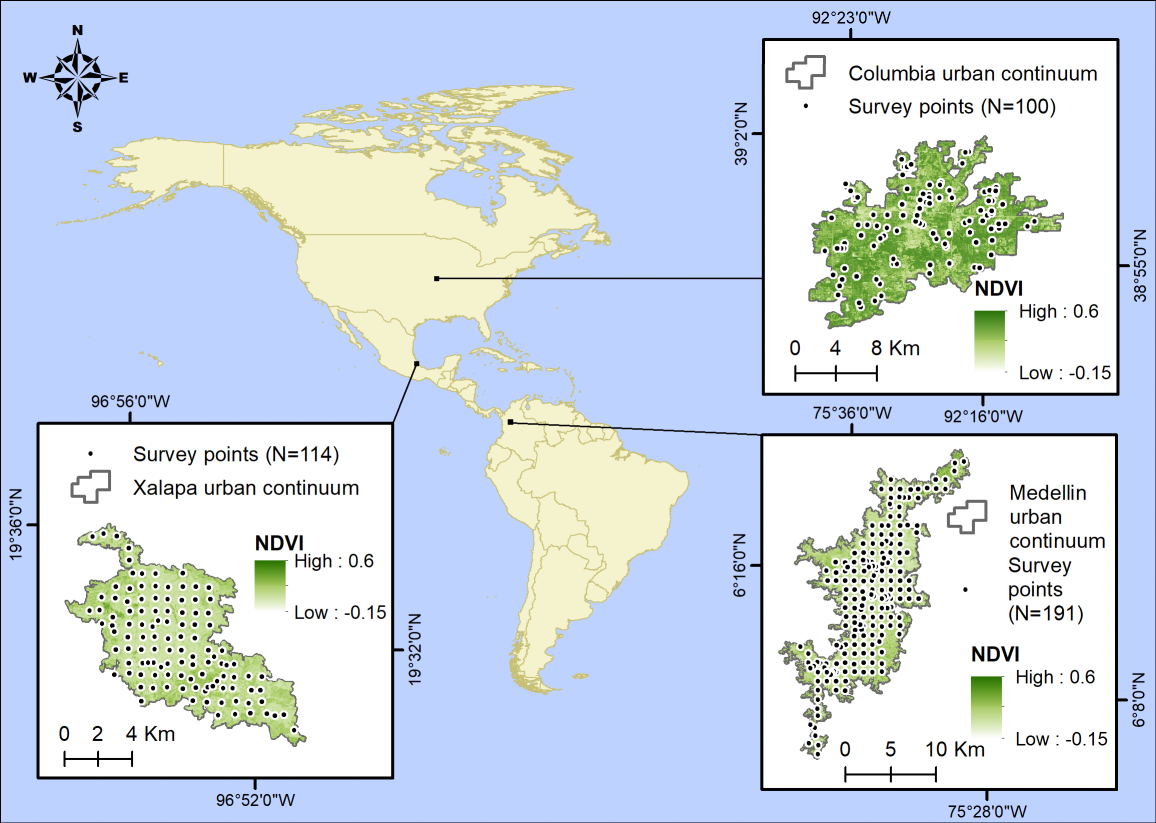
Remote sensing technologies enhance our ability to describe environmental heterogeneity, potentially improving biodiversity predictions. The normalized difference vegetation index (NDVI), a widely used index, along with other vegetation descriptors derived from land cover, often shows positive relationships with bird diversity; however, its reliability as a predictor across contrasting urban contexts remains uncertain. We examined the relationships between the NDVI, woody vegetation cover, and bird species richness across three cities—Columbia (USA), Xalapa (Mexico), and Medellín (Colombia)—using a city-wide, multi-scale approach, based on Landsat-8 and Sentinel-2 satellite imagery, with buffer distances of 50, 100, 200, and 400 m. The NDVI consistently showed significant positive relationships with bird species richness, except at the 50 m buffer in Columbia (Sentinel-2 satellite), where the relationship was close-to-significant (p = 0.073). Woody vegetation cover also showed significant positive relationships with bird species richness, except in Columbia, where woody vegetation cover was positively associated with bird species richness at the 200 and 400 m buffers but negatively associated at the 50 and 100 m buffers, with all relationships for this metric being non-significant. The proportion of variability in bird species richness associated with the NDVI or woody vegetation cover remained, on average, below 28 %, varying by city, vegetation metric, spatial resolution, and buffer distance. Despite the NDVI and woody vegetation cover being potential key drivers of bird diversity, our findings highlight the need for caution when interpreting ecological patterns solely based on remote sensing-derived vegetation radiometric indices. This caution is particularly relevant when using such indices for landscape and biodiversity monitoring to inform urban planning and conservation efforts.


Here is the link to the full paper: https://doi.org/10.1016/j.ufug.2025.129211

follow us and share it on:

you may also like:

New Publication on Agri-Photovoltaics Potential across entire India

New Publication on Agri-Photovoltaics Potential across entire India

For this study, Ingolstadt Technical University (THI) and Earth Observation Research Cluster at the University of Würzburg teamed up to map the potential for agri-photovoltaic across entire India. This technology has the potential to jointly adress Indias rising...

New publication on decoding stress in urban public spaces

New publication on decoding stress in urban public spaces

Researchers from the Karlsruhe Institute of Technology (KIT), the Earth Observation Center (EOC) of the German Aerospace Center (DLR) in Oberpfaffenhofen and our Earth Observation Research Cluster of the University of Würzburg teamed up for a study on decoding stress...

New publication on bottom-up building exposure modeling

New publication on bottom-up building exposure modeling

Researchers from the German Remote Sensing Data Center (DFD) of the German Aerospace Center (DLR), the Department of Geography of the Rheinische Friedrich-Wilhelms-University in Bonn and our Earth Observation Research Cluster (EORC) of the...

New publication on national road traffic noise estimation

New publication on national road traffic noise estimation

Researchers from the Geography Department of the Humboldt-University Berlin in Germany, the Helmholtz AI as well as the Institute of Epidemiology of the Helmholtz Zentrum München in Neuherberg, the Institute for Medical Information Processing of the LMU...

Share This