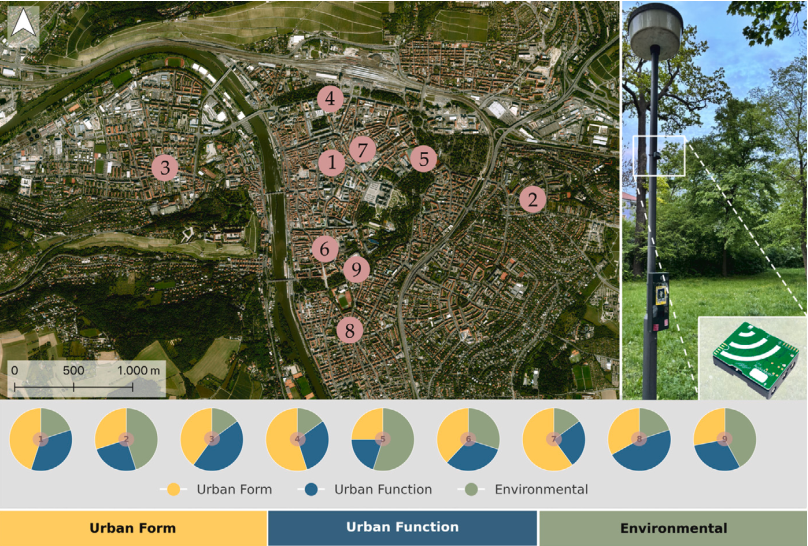

Researchers from our Institute of Geography and Geology and the Earth Observation Research Cluster (EORC) of the University of Würzburg, the Institute for Urban Public Health from the University Hospital Essen and the Earth Observation Center (EOC) of the German Aerospace Center (DLR) in Oberpfaffenhofen teamed up for a study on co-occurrence network analysis of urban acoustic environments. The paper titled “Co-occurrence network analysis of urban acoustic environments: Structural archetypes and perceived quality” was just published in the journal Computers, Environment and Urban Systems by Nils Karges, Timo Haselhoff, Hannes Taubenböck, Tobias Ullmann and Jürgen Rauh.
Here is the abstract of the paper: The character of an urban acoustic environment does not arise from individual sounds in isolation, but from their complex interactions. Current source-focused approaches reduce acoustic environments to inventories of sounds, overlooking the relational patterns that shape them. Here, we introduce a graph-theoretical framework that shifts the focus from ‘what is present’ to ‘how it connects’, quantifying the co-occurrence structure of urban soundscapes. Based on six months of continuous monitoring across nine contrasting sites, we constructed temporal co-occurrence networks comprising 26 sound classes. In line with our first research question, the resulting networks revealed three recurrent archetypes, dominant, transitional, and mixed, distinguished by measures of clustering, modularity, and centrality. The dominant type is characterized by the prevalence of a single sound source, the mixed type by the superposition of many heterogeneous sources, and the transitional type represents an intermediate state between the two. Conceptually, these measures capture three complementary structural dimensions: integration (clustering), segregation (modularity), and dominance (centrality). To test whether these structural regimes align with human perception, we conducted 1006 in-situ surveys. Mixed soundscapes, characterized by high integration and diversity of sound sources, were consistently perceived as more pleasant than dominant soundscapes. Our findings demonstrate that perceived quality depends not simply on how many sources are present, but on how they interact and integrate within the acoustic network. This structural approach provides robust, transferable metrics for designing healthier and more resilient urban environments.
Here is the link to the full paper: https://www.sciencedirect.com/science/article/pii/S0198971526000396
This study adds to our works on noise analysis. For related works, please see here:
- Urban contexts: A Geospatial Approach to Identifying In-Situ Measurement Sites for Urban Acoustic Environments https://www.sciencedirect.com/science/article/pii/S0301479725018778
- Soundscapes on edge – The real-time machine learning approach for measuring Soundscapes on resource-constrained devices https://elib.dlr.de/190129/
- National road traffic noise estimation with ensemble learning and multimodal geodata https://www.sciencedirect.com/science/article/pii/S1361920925004730
- Pixels, chisels and contours – technical variations in European road traffic noise exposure maps https://www.sciencedirect.com/science/article/pii/S0301479725014513
- Predicting traffic noise using land-use regression—a scalable approach https://www.nature.com/articles/s41370-021-00355-z
- Using CNNs on Sentinel-2 data for road traffic noise modelling https://ieeexplore.ieee.org/document/10144160