
New publication on NO2 air pollution trends and settlement growth in megacities
Researchers from the Earth Observation Center (EOC) of the German Aerospace Center (DLR) in Oberpfaffenhofen and our Earth Observation Research Cluster of the University of Würzburg teamed up for a study on air pollution trends and settlement growth in megacities. The paper titled “NO2 air pollution trends and settlement growth in megacities” was just published in the IEEE Journal of Selected Topics in Applied Earth Observations and Remote Sensing by Thilo Erbertseder, Hannes Taubenböck, Thomas Esch, Lorenza Gilardi, Heiko Paeth and Stefan Dech.
Here is the early access link to the paper: https://ieeexplore.ieee.org/document/10572220
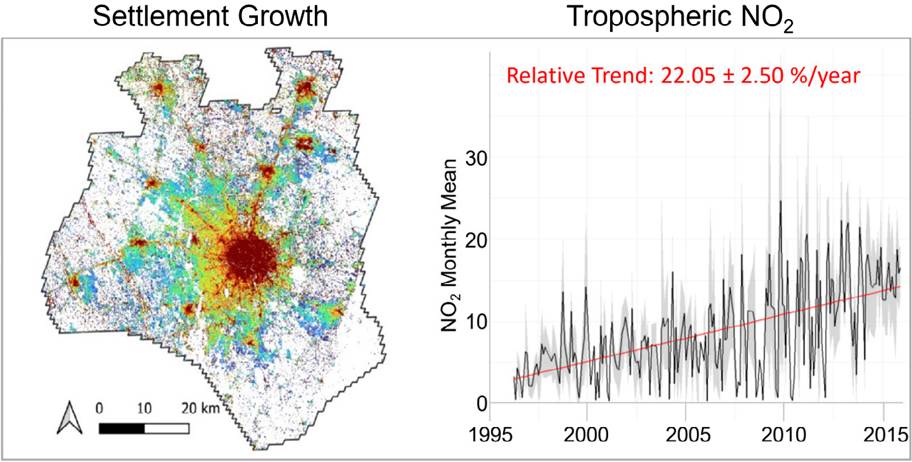
Abstract of the paper: Megacities exert substantial demands on the world’s energy resources, thereby producing large shares of atmospheric emissions and air pollution. Despite several studies on nitrogen dioxide (NO2) changes in megacities, a systematic analysis in relation to settlement growth is still pending. This study examines the trends of tropospheric NO 2 pollution in 38 megacities regarding settlement growth by analyzing Earth Observation (EO) data. Multi-annual records of tropospheric NO 2 from GOME (Global Ozone Monitoring Experiment), SCIAMACHY (SCanning Imaging Absorption spectroMeter for Atmospheric ChartographY), GOME-2A and GOME-2B are evaluated regarding the World Settlement Footprint evolution from 1996 to 2015. Compared to previous studies, this work strictly uses remote sensing data and the spatial concept of Functional Urban Areas (FUAs). Therefore, uncertainties due to inconsistent spatial references, incomparable administrative units as well as heterogeneously reported local data are widely excluded to enable an appropriate comparison of megacities across the globe. On average we observe an increase in tropospheric NO2 burden of 5.06 ± 0.83%/year and a relative settlement growth of 2.87%/year for the time period considered. We find a wide range of trends: relative NO 2 pollution ranges from an increase of 44.0 ± 5.9%/year to a decrease of -3.2 ± 0.2%/year, settlement growth rates vary from 0.3%/year to 9.5%/year. Despite this variety, the results exhibit a pronounced relation to the income group following the world’s economies classification of the World Bank. Complemented by a cluster analysis and ranking of the megacities the study provides indicators to develop a better understanding of the drivers and impacts of urbanization and air pollution.
This new paper is related to many research studies on air pollution and settlement growth in our lab:
https://www.sciencedirect.com/science/article/pii/S0034425721005599
https://link.springer.com/chapter/10.1007/978-3-662-44841-0_20
https://link.springer.com/article/10.1007/s00103-020-03177-w
https://ieeexplore.ieee.org/document/10572220
https://www.sciencedirect.com/science/article/pii/S0264275124003317