
New publication shows how underrepresented the refugee crisis in West Africa is in online media
Researchers from the Earth Observation Center (EOC) of the German Aerospace Center (DLR) in Oberpfaffenhofen and the University of Würzburg teamed up to document the thematic and spatial coverage of news media of the ongoing refugee crisis in West Africa. The paper titled “The Unseen—An Investigative Analysis of Thematic and Spatial Coverage of News on the Ongoing Refugee Crisis in West Africa” was just published in the ISPRS Journal of Geo-Information by Hansi Senaratne, Martin Mühlbauer, Ralph Kiefl, Andrea Cárdenas, Lallu Prathapan, Torsten Riedlinger, Carolin Biewer and Hannes Taubenböck. This study has been conducted as part of the project MIGRAWARE funded by the German Federal Ministry of Education and Research (BMBF)- programme WASCAL 590, WRAP 2.0., the Megacities project of the VW Momentum Initiative, and the project OpenSearch@DLR.
The study will presented at the workshop “Geolingual Studies (GLS) – A New Research Direction“. It will take place at the University of Würzburg from 26th to 28th of September 2023. For more details, please see here: https://remote-sensing.org/geolingual-studies-an-interdiscipliary-project-analyzing-interrelationships-between-physical-and-socio-cultural-space/
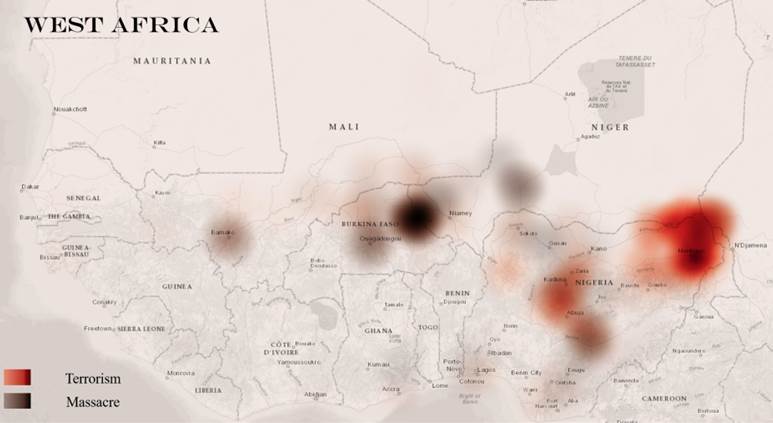
Abstract: The fastest growing regional crisis is happening in West Africa today, with over 8 million people considered persons of concern. A culmination of identity politics, climate-driven disasters, and extreme poverty has led to this humanitarian crisis in the region and is exacerbated by a lack of political will and misplaced media attention. The current state of the art does not present sufficient investigations of the thematic and spatial coverage of news media of this crisis in this region. This paper studies the spatial coverage of this crisis as reported in the media, and the themes associated with those locations, based on a curated dataset. For the time frame 12 March to 15 September 2021, 2017 news articles related to the refugee crisis in West Africa were examined and manually coded based on (1) the geographical locations mentioned in each article; (2) the themes found in the articles in reference to a location (e.g., Relocation of people in Abuja). The dataset introduces a thematic dimension, as never achieved before, to the conflict-ridden areas in West Africa. A comparative analysis with UNHCR (United Nations High Commissioner for Refugees) data showed that 96.8% of refugee-related locations in West Africa were not covered by news during the considered time frame. Contrastingly, 80.4% of locations mentioned in the news do not appear in the UNHCR repository. Most news articles published during this time frame reported on Development aid or Political statements. Linear multiple regression analysis showed GDP per capita and political stability to be among the most influential determinants of news coverage.
Read the full article here: https://www.mdpi.com/2220-9964/12/4/175