
New publication on the relationship between urban green and land ownership
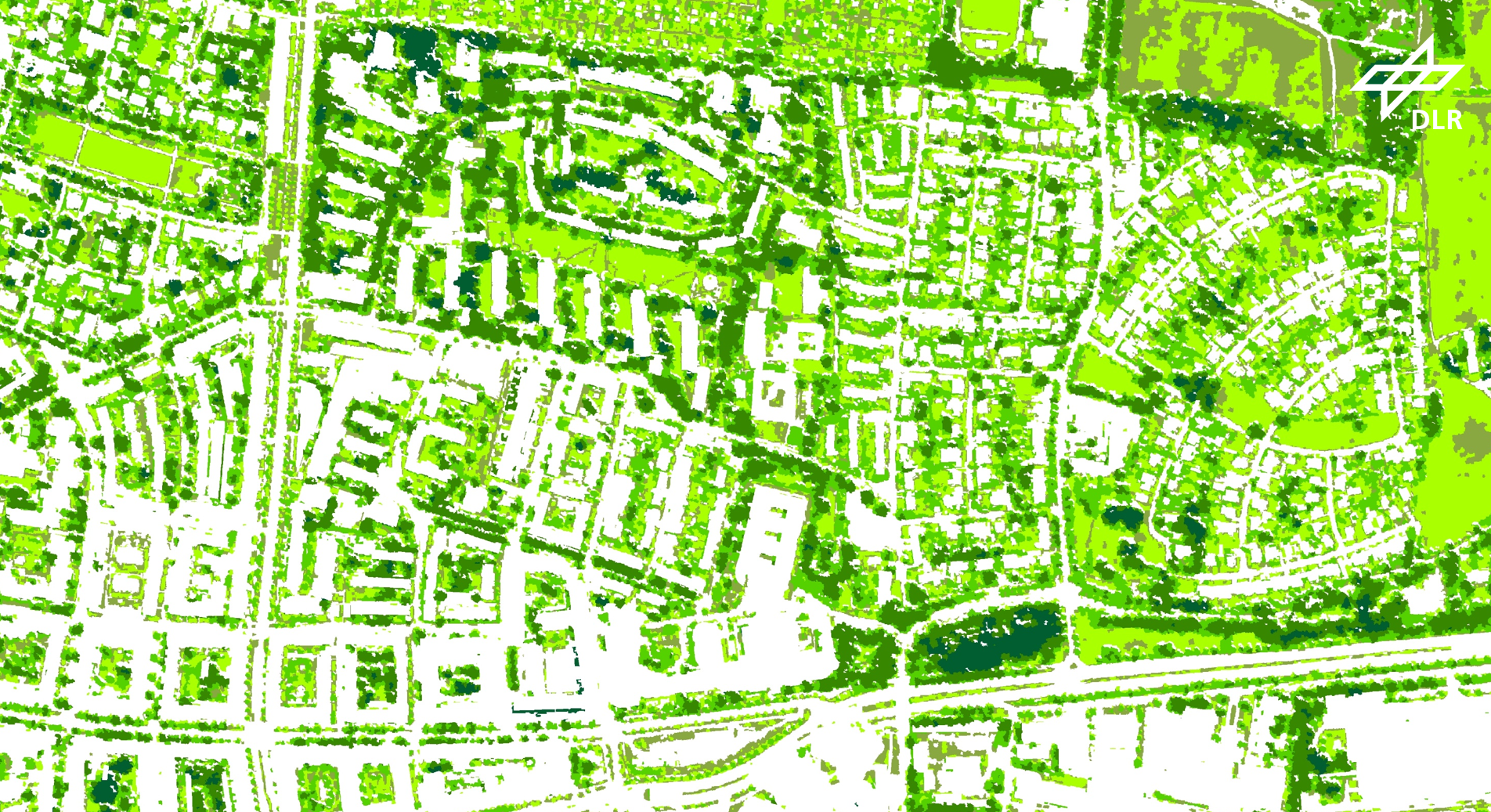
Researchers from the Technical University of Munich (TUM), the Earth Observation Center (EOC) of the German Aerospace Center (DLR) in Oberpfaffenhofen and our Earth Observation Research Cluster (EORC) of the University of Würzburg teamed up for a study on the relationship between urban green and land ownership. The paper titled “Patterns of urban green cover and green volume depend on land ownership in Munich, Germany” was just published in the journal Urban Forestry & Urban Greening by Xia Yao, Fabio S.T. Sweet, Tobias Leichtle, Hannes Taubenböck, Stephan Pauleit and Wolfgang W. Weisser.
Here is the abstract of the paper: Green space contributes to human well-being; however, it is often unequally distributed within a city. Here, we focused on the role of land ownership and examined the distribution of vegetation, i.e., urban green, in private and public areas in different urban land use categories in Munich, Germany. We compared green cover to green volume, i.e., 3D greenspace, using a novel high-resolution dataset. We found that green cover was more equally distributed than green volume in grid cells of 100 m x 100 m, as evidenced by consistently lower Gini coefficients for green cover compared to green volume across ownerships. Importantly, green volume was mostly provided by public land, especially parks, urban forests, and semi-natural areas. Low green volume was found in residential and industrial areas, even though green cover was also high in some of these cells. In total, the fraction of area that was green was higher for private areas than public areas in 52.7 % of all grid cells. For green volume, the fraction that was green was higher in public areas in more than 80 % of grid cells, except for those grid cells with very small overall green volume. In grid cells with little green volume, i.e., in cells with a general deficit of greening, public areas did not compensate for low values of vegetation in private areas. Because green volume is more closely related to the provisioning of many ecosystem services than green cover, there is a need to plant higher vegetation, such as trees or bushes. Our analysis shows that it is in particular the private land owners that need to be activated to increase green volume. This will not only increase the overall green volume in the city, but it will also reduce the green volume inequality in the city, in particular in areas where people live and work.
Here is the link to the full paper: https://www.sciencedirect.com/science/article/pii/S1618866726000889?via%3Dihub
This research is part of our works on urban green – for some further reading of recent papers please see here:
- The influence of city size versus urban form on land surface temperature variation and the surface urban heat island effect: A cross-city analysis of German cities https://journals.plos.org/plosone/article?id=10.1371/journal.pone.0340060
- The impact of urban configuration types on urban heat islands, air pollution, CO2 emissions and mortality in Europe https://www.sciencedirect.com/science/article/pii/S2542519624001207
- Spatially-optimized urban greening for reduction of population exposure to land surface temperature extremes https://www.nature.com/articles/s41467-023-38596-1
- Identification of the potential for roof greening using remote sensing and deep learning https://www.sciencedirect.com/science/article/pii/S0264275125000824
- Are public green spaces distributed fairly? A nationwide analysis based on remote sensing, OpenStreetMap and census data https://www.tandfonline.com/doi/pdf/10.1080/10106049.2023.2286305
- Does urbanization mean a loss of greenspace? A multi-temporal analysis for Chinese cities https://www.sciencedirect.com/science/article/pii/S0048969723049987
- Green cities cost more green: Examining the impacts of different urban expansion patterns on NPP https://www.sciencedirect.com/science/article/pii/S0360132322011064
- Which city is the greenest? A multi-dimensional deconstruction of city rankings https://www.sciencedirect.com/science/article/pii/S0198971521000946