
One of our staff members of the Earth Observation Research Cluster (EORC), Julia Rieder, just published a new R package titled “TreeCompR: Tree competition indices for inventory data and 3D point clouds”.
From the abstract:
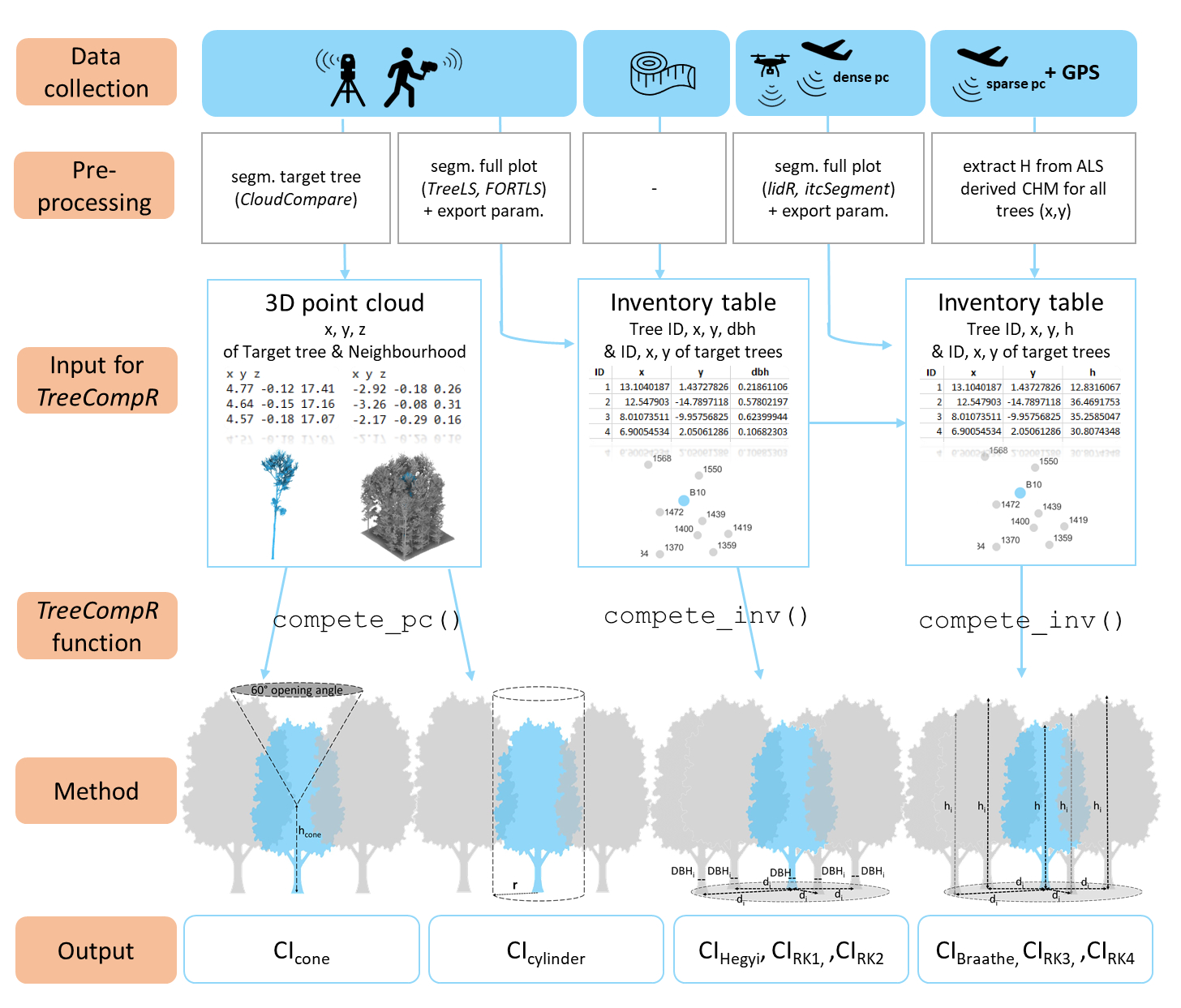
1. In times of more frequent global-change-type droughts and associated tree mortality events, competition release is one silvicultural measure discussed to have an impact on the resilience of managed forest stands. Understanding how trees compete with each other is therefore crucial, but different measurement options and competition indices leave users with the agony of choice, as no single competition index has proven universally superior. 2. To help users with the choice and computation of appropriate indices, we present the open-source/TreeCompR/ package, which can handle 3D point clouds in various formats as well as classical forest inventory data and serves as a centralized platform for exploring and comparing different competition indices (CIs). Within a common interface, users can efficiently select the most suitable CI for their specific research questions. The package facilitates the integration of both traditional distance-dependent and novel point cloud-based indices. 3. To evaluate the package, we used/TreeCompR/ to quantify the competition situation of 308 European beech trees from 13 sites in Central Europe. Based on this dataset, we discuss the interpretation, comparability and sensitivity of the different indices to their parameterization and identify possible sources of uncertainty and ways to minimize them. 4. The compatibility of/TreeCompR/ with different data formats and different data collection methods makes it accessible and useful for a wide range of users, specifically ecologists and foresters. Due to the flexibility in the choice of input formats as well as the emphasis on tidy, well-structured output, our package can easily be integrated into existing data-analysis workflows both for 3D point cloud and classical forest inventory data.
Access to full preprint: www.biorxiv.org/content/10.1101/2024.03.23.586379v1 <www.biorxiv.org/content/10.1101/2024.03.23.586379v1>
Access to the R package:https://github.com/juliarieder/TreeCompR <github.com/juliarieder/TreeCompR>
From the abstract:
1. In times of more frequent global-change-type droughts and associated tree mortality events, competition release is one silvicultural measure discussed to have an impact on the resilience of managed forest stands. Understanding how trees compete with each other is therefore crucial, but different measurement options and competition indices leave users with the agony of choice, as no single competition index has proven universally superior. 2. To help users with the choice and computation of appropriate indices, we present the open-source/TreeCompR/ package, which can handle 3D point clouds in various formats as well as classical forest inventory data and serves as a centralized platform for exploring and comparing different competition indices (CIs). Within a common interface, users can efficiently select the most suitable CI for their specific research questions. The package facilitates the integration of both traditional distance-dependent and novel point cloud-based indices. 3. To evaluate the package, we used/TreeCompR/ to quantify the competition situation of 308 European beech trees from 13 sites in Central Europe. Based on this dataset, we discuss the interpretation, comparability and sensitivity of the different indices to their parameterization and identify possible sources of uncertainty and ways to minimize them. 4. The compatibility of/TreeCompR/ with different data formats and different data collection methods makes it accessible and useful for a wide range of users, specifically ecologists and foresters. Due to the flexibility in the choice of input formats as well as the emphasis on tidy, well-structured output, our package can easily be integrated into existing data-analysis workflows both for 3D point cloud and classical forest inventory data.
Access to full preprint: www.biorxiv.org/content/10.1101/2024.03.23.586379v1 <www.biorxiv.org/content/10.1101/2024.03.23.586379v1>
Access to the R package:https://github.com/juliarieder/TreeCompR <github.com/juliarieder/TreeCompR>