
Researchers from the Earth Observation Center (EOC) of the German Aerospace Center (DLR) in Oberpfaffenhofen and our Earth Observation Research Cluster (EORC) of the University of Würzburg teamed up for a study on using open webcam data for traffic monitoring. The paper titled “Open webcam data for traffic monitoring: YOLOv8 detection of road users before and during COVID-19” was just published in the journal “Transportation Research Interdisciplinary Perspectives” by Dorothee Stiller, Michael Wurm, Jeroen Staab, Thomas Stark, Georg Starz, Jürgen Rauh, Stefan Dech & Hannes Taubenböck.
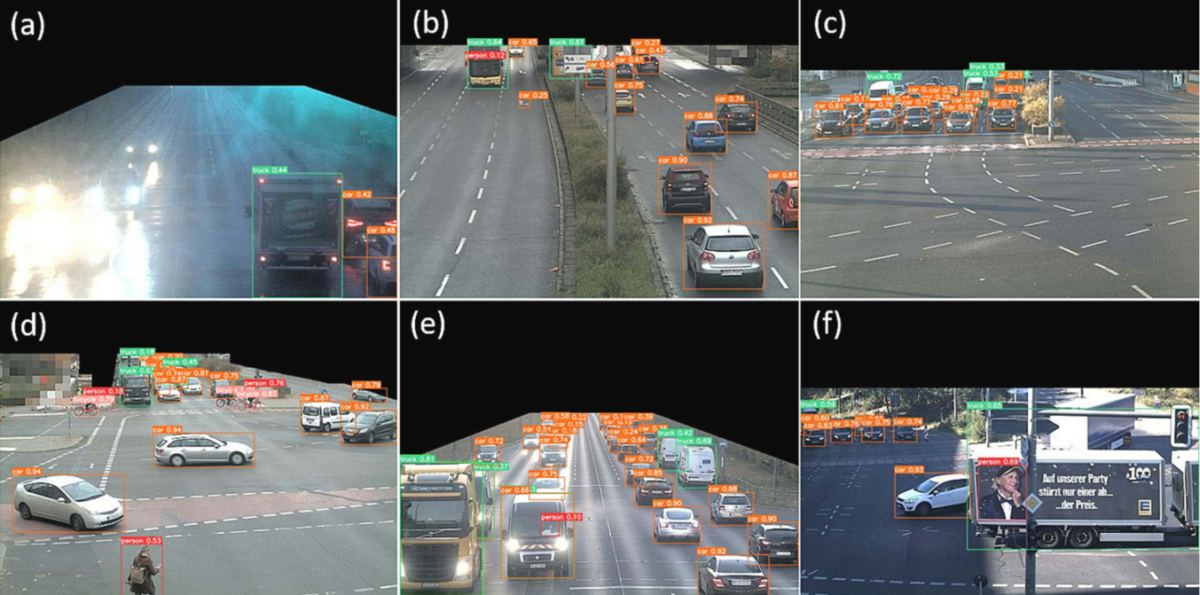
Here is the abstract of the paper: Traffic volumes are rising globally, creating a growing need for accurate and scalable data collection to address mobility challenges and enhance transport systems. Yet, traditional methods remain costly and time-consuming despite advances in automated monitoring. This study explores the feasibility of using open webcam data in combination with the state-of-the-art object detection model YOLOv8 out-of-the-box for road user monitoring. Publicly accessible webcam imagery presents challenges such as high variability in image quality, road user occlusion, and environmental factors like poor visibility due to weather conditions. To assess their potential for traffic monitoring, we utilize open webcam data from Germany to evaluate the performance of YOLOv8′s model variants, testing 110 parameter combinations with a manually labeled reference dataset. Among the tested out-of-the-box model variants, YOLOv8x achieved the highest performance, with an F1-score of 0.75. This optimized model was applied to about 500,000 open webcam scenes to monitor the change of road users before and during the COVID-19 pandemic. The analysis revealed a 9.5% overall reduction in road users volume, with motorized road users declining significantly while bicycles increased by 25.2%. This reflects mobility patterns observed during the COVID-19 pandemic, where restrictions led to a significant shift towards cycling as an alternative mode of transport. The results are plausible as they mirror broader trends in active mobility observed in various urban contexts. Our findings demonstrate the potential of leveraging open webcam data and pre-trained object detection models for scalable, cost-effective transport monitoring.
Here is the link to the full paper: https://www.sciencedirect.com/science/article/pii/S2590198225004531
This research is part of our various works on using remote sensing and geodata for traffic analysis – see here some related studies:
- AI-based counting of traffic participants using public webcams https://www.mdpi.com/2673-7590/5/3/87
- Does formal public transport serve the city well? The importance of semiformal transport for the accessibility in Medellín, Colombia https://journals.plos.org/plosone/article?id=10.1371/journal.pone.0321691
- Risk and space: modelling the accessibility of stroke centers using day- & nighttime population distribution and different transportation scenarios https://pubmed.ncbi.nlm.nih.gov/34187473/
- Spatial parameters for transportation: A multi-modal approach for modelling the urban spatial structure using deep learning and remote sensing https://www.jtlu.org/index.php/jtlu/article/view/1855
- National Road Traffic Noise Mapping with Ensemble Learning and Multimodal Geodata https://www.sciencedirect.com/science/article/pii/S1361920925004730?via%3Dihub
- Pixels, chisels and contours – technical variations in European road traffic noise exposure maps https://www.sciencedirect.com/science/article/pii/S0301479725014513
- Predicting traffic noise using land use regression – A scalable approach https://www.nature.com/articles/s41370-021-00355-z
- The influence of commuting on population exposure to air pollution: Toward global application with a proxy on the degree of urbanization https://ieeexplore.ieee.org/document/10579815
- How does pedestrian permeability vary across cities due to local barriers and urban morphology? A fine-grained assessment for all large cities in Germany https://www.sciencedirect.com/science/article/pii/S0198971524000449
- Spatial Accessibility in Transition: Evaluating Urban Growth and Service Distribution in Westhoek, Belgium https://ieeexplore.ieee.org/document/11076063
- Assessing the x-minuteness for urban structural types. https://ieeexplore.ieee.org/document/11076038