
The Cobalt Magnet: Rapid Urbanization and Migration
An incredible amount of the technology we rely on every day – from smartphones to lithium-ion batteries in electric vehicles – depends heavily on one single metal: cobalt. With more than 60% of the world’s cobalt produced in the Democratic Republic of the Congo (DRC), the high demand has resulted in large environmental and demographic shifts in the region. Read more here: https://www.uni-wuerzburg.de/en/news-and-events/einblick/single/news/satellite-images-capture-cobalt-mines-congo/
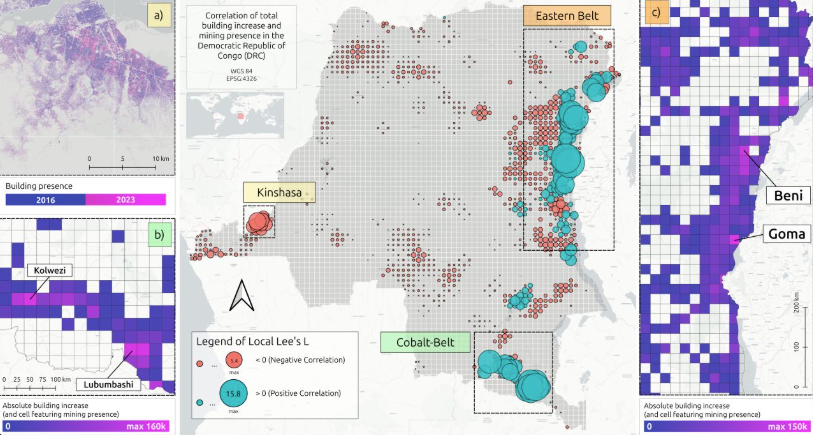
The promise of work and income has turned the DRC’s southwestern “cobalt belt” into a massive magnet for migration. Between 2016 and 2023, the scale of urban growth became visible from space – please see here on an earlier conference paper on these urban dynamics: https://ieeexplore.ieee.org/document/11076051
While the DRC overall saw a 20% to 30% increase in building structures over this seven-year period, certain cities, such as near mining sites saw building increases of over 150%. Across the entire cobalt belt, the number in buildings grew by over 50%. The largest city in the belt, Kolwezi, now borders mining and refinery areas spanning over 120 square kilometers – roughly twice the size of Manhattan.
In a more structured way, the linkage between mining activities and settlement expansion could be empirically proven in a new, recently published research paper by Konstantin Müller, John Friesen, Christian Geiß, Tobias Ullmann, Jean-Paul Kibambe-Lubamba, and Hannes Taubenböck. The authors from the Earth Observation Center (EOC) of the German Aerospace Center (DLR), the University of Kinshasa, DRC and our EORC at the University of Würzburg teamed up for this study that was just published in by IEEE: https://ieeexplore.ieee.org/document/11660450
Why This Matters: Transparency and Health
The goal of this research – funded by the KSB Foundation – isn’t just to generate data, but to drive accountability. The working conditions in many informal mines are notoriously hazardous, often involving child labor and severe health risks.
By combining automated satellite observation with local health and demographic studies, the researchers are providing NGOs, state authorities, and global corporations with transparent, objective data. While satellite images alone cannot solve the humanitarian challenges on the ground, making the exact locations, scale and speed of this mining boom visible is a crucial first step toward demanding safer, more sustainable resource extraction and transparent global supply chains.