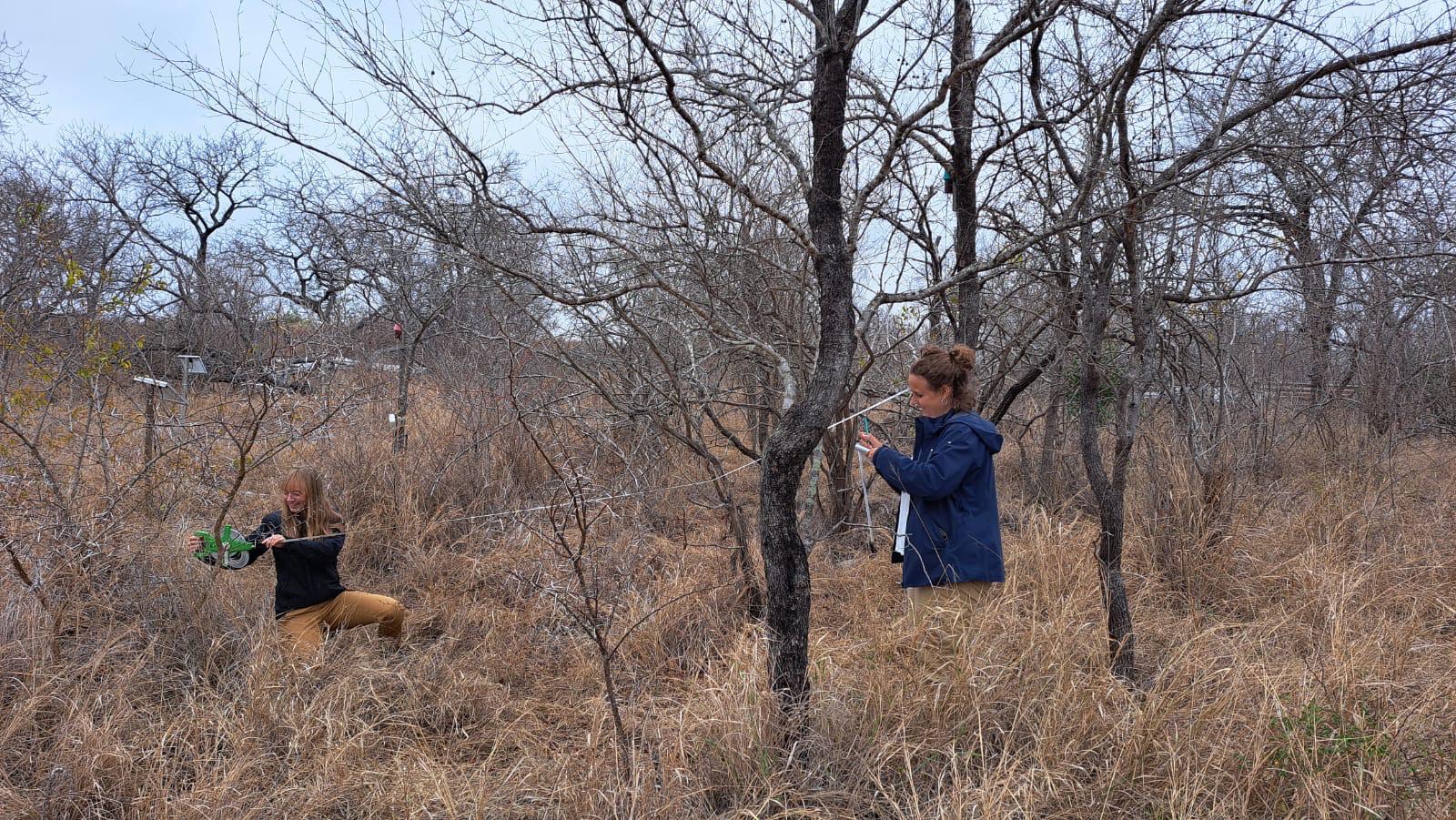

Our EAGLE M.Sc. students Marlene Bauer and Anna Bischof are currently doing their internship at SANparks, in the Kruger National Park, South Africa. After some intense months of preparation guided by their EORC supervisor Dr. Mirjana Bevanda and supported by the PhD student Antonio Castaneda-Gomez, they were well prepared for their Earth Observation studies in the african savannah. The next months they will spend their internship assisting the resident ecologists Corli Coetzee and Ben Wigley with their earth observation expertise. Already, they collected countless hours in the field sampling trees and fighting through thorny presumably snake-invested savanna shrubs, while enjoying the view of elephants, giraffes, and a seemingly infinite number of antelopes. The data they collect will serve as important ground truth data for their ongoing research, where they will use UAS imagery to investigate the effects of droughts on different savanna tree and shrub species.
But an internship is not just experiencing Earth Observation research. Marlene and Anna are always eager to enjoy the incredible landscape and spot the unfamiliar wildlife. On a recent bird-watching walk, they learned a lot about trees since they could not spot any of the birds. Having made many vet friends they also had the opportunity to take part in a lion necropsy, that caused them fear of revenge when multiple caged lions managed to break out right next door to them. Our students are very thankful for the opportunity and eager to explore the fascinating ecosystem around them.
But an internship is not just experiencing Earth Observation research. Marlene and Anna are always eager to enjoy the incredible landscape and spot the unfamiliar wildlife. On a recent bird-watching walk, they learned a lot about trees since they could not spot any of the birds. Having made many vet friends they also had the opportunity to take part in a lion necropsy, that caused them fear of revenge when multiple caged lions managed to break out right next door to them. Our students are very thankful for the opportunity and eager to explore the fascinating ecosystem around them.