
Thilo Erbertseder will defend his PhD thesis “Satellite-based analysis of NO2 air pollution: from global to urban aspect” on Wednesday 23rd of July at 3pm in John-Skilton Str. 4a, seminar room 1. All interested staff, students, family and friends are cordially invited to join his presentation.
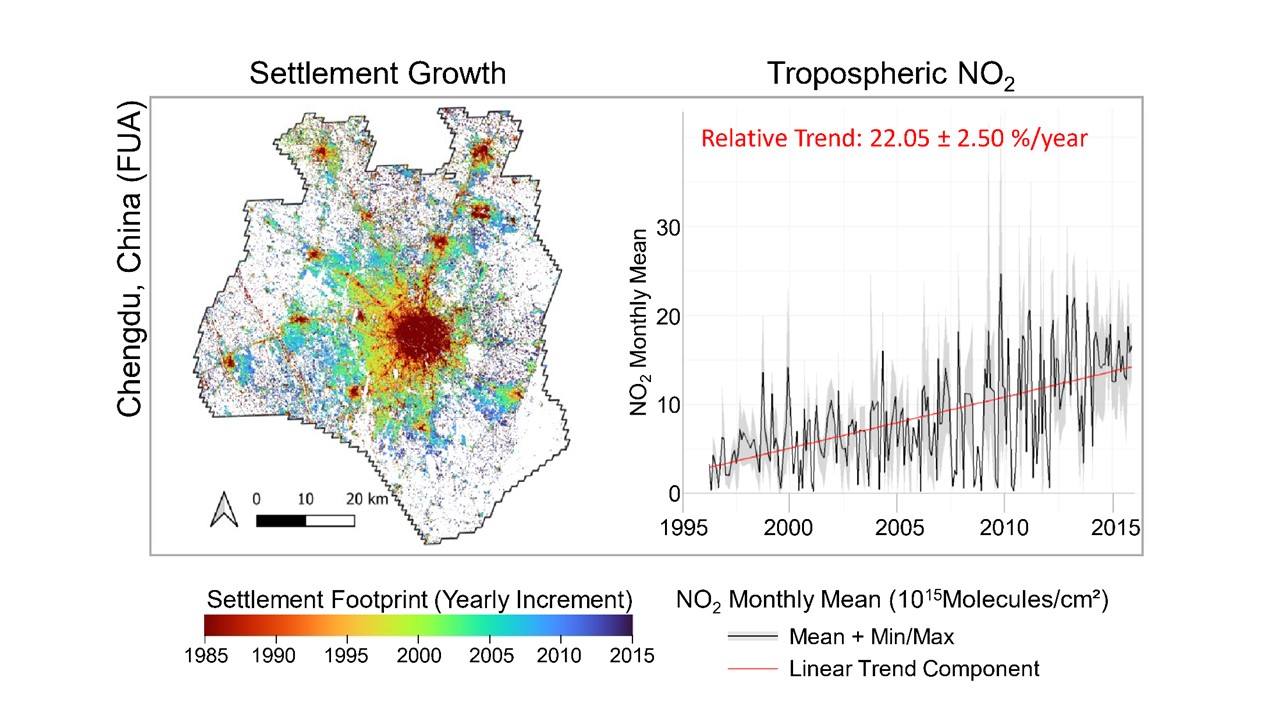
from his abstract: By leveraging a wide portfolio of Earth Observation (EO) data this dissertation explores the interplay between air pollution, urbanization, and environmental policy. Air pollution, particularly nitrogen dioxide (NO₂), poses a major health risk worldwide and is closely linked to human activity. While traditional ground-based monitoring provides sparse localized data, EO offers a powerful, consistent, and global perspective. The dissertation presents three interlinked studies across multiple spatial scales—global, national, regional and urban—focusing on NO₂ as a proxy for air quality and anthropogenic activity. The first study analyzes 38 global megacities from 1996 to 2015, revealing income-related differences in urban development and pollution dynamics. The second study identifies NO₂ hotspots across Germany at high spatial resolution, revealing strong associations with urban density, impervious surfaces, and road infrastructure. The third study assesses the effectiveness of a regional fiscal intervention on emissions, finding modest reductions and highlighting the need for complementary policy instruments like innovation incentives. Results support the Environmental Kuznets Curve (EKC) hypothesis, which suggests pollution rises with income in early development stages but declines in wealthier economies due to improved technology and regulation. In summary, the contributions of this dissertation demonstrate that EO of air pollution and urbanization, especially when integrated with complementary geospatial datasets such as socioeconomic indicators, economic metrics, and land cover information, provides a robust framework for comprehensively monitoring environmental dynamics. Furthermore, the insights offer decision-makers evidence-based guidance essential for the design of targeted, effective, and sustainable environmental policies and interventions.